Peregrine Farm News Vol. 7 #4, 3/31/10

What’s been going on?

The last day of March and a brilliant moon last night, just on the other side of full, it hangs on the tree line in the west as the sun is beginning to clear the horizon on the east. Signs of a good day to come. We need a solid day as “the stand”, as we call it, is rising like the phoenix after collapsing in January snow storm. Yesterday we got all of the posts back in line and the supporting beams in place so that today we can raise the rafters back up. With any luck we will be putting the tin roof back on tomorrow.

The moon setting over the rising Stand

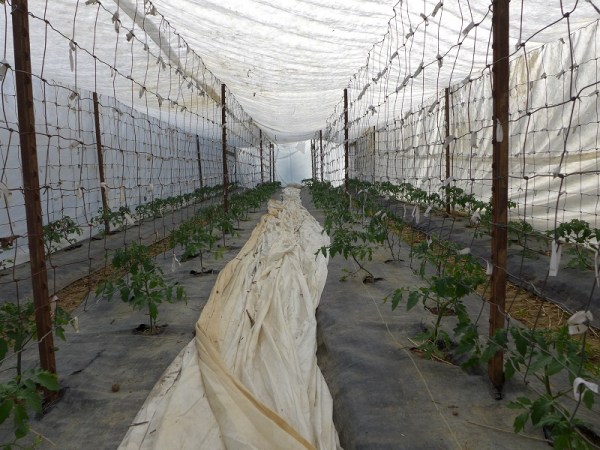
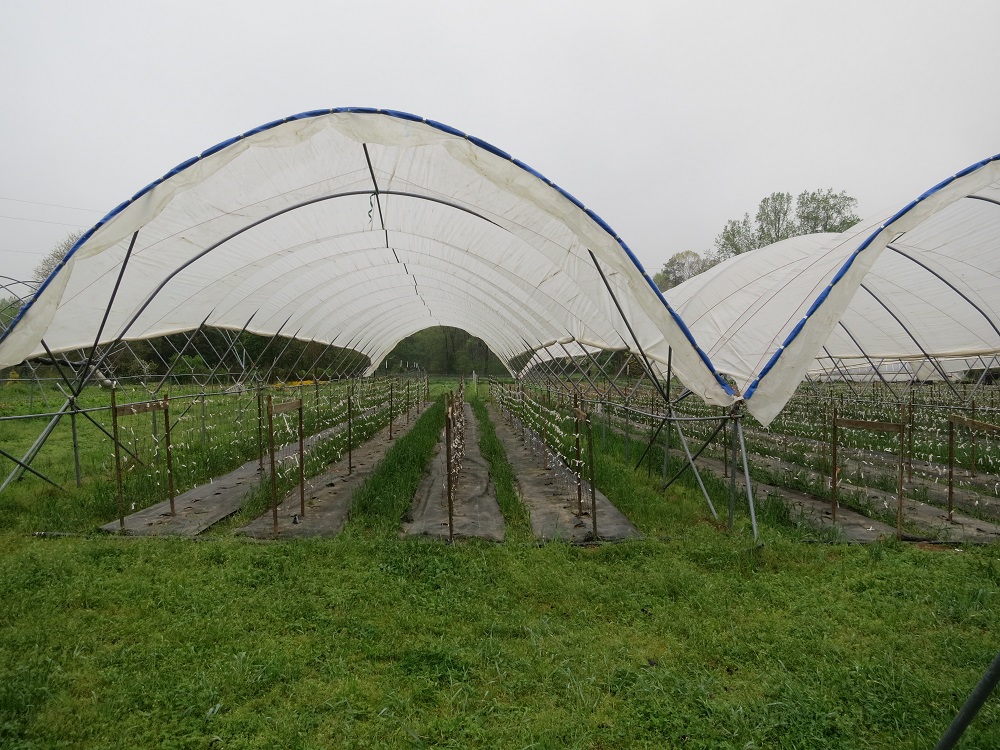
Lots of good progress this week, we did manage to slide the “little” tunnels to their 2010 positions. Prior to moving we also prepare all the beds that will be soon indoors with irrigation lines, landscape fabric and for the tomatoes the trellises that will support them. We slid on Thursday and then closed them up to help warm up the soil before planting the warm season crops that go in them. Yesterday the early cucumbers and tomatoes went in the ground, a few days late but happy none the less, hmm real tomatoes in two months!

Great rain for us on Sunday, no severe weather, just a nice long rain with just over an inch. I was beginning to twitch with the thought of having to set up irrigation this early in the season but this rain will keep that job off the list at least for another week. With the winds of yesterday it should be dry enough in the next day or two to return to cultivating the early season crops, have to get ahead of the weeds when they are small. The big batch of spring crops have been going in the ground over the last several weeks and are really beginning to grow now that we have had a good rain. Another round gets planted this week and next and then it is time to turn our sights to warm season flowers and getting ready for the main planting of tomatoes. With the temperatures reaching toward 90 later this week it will seem like it’s time for summer crops, not yet please!

Glenn and Cov planting tomatoes

What’s going to be at the market? Continue reading

Welcome to the News of the Farm

Just to help you get the most out of these posts, here are a few tips.

All posts have been categorized by year, or crop or some other way.  If you want to look at all the posts that talk about tomatoes, for example, you can either click on that category in the right hand column or on the word tomatoes at the bottom of the post.

The posts all have some additional tags on them too, like “storms” for example.  You can also find those tags at the bottom of all posts and can click on them, you will be taken to a page of posts that include that topic.

All the pictures are clickable and will open a larger version of that picture, if there is one.

And of  course any of the words highlighted in orange are links to other information that will open in another page.

Have fun!

6/23/04 Vol. 1 #15

Longest day of the year on Sunday and now Betsy begins to rejoice as the days get shorter, in her mind frost is surely just around the corner!  These are the kinds of mental games we play during the steamy days of summer.

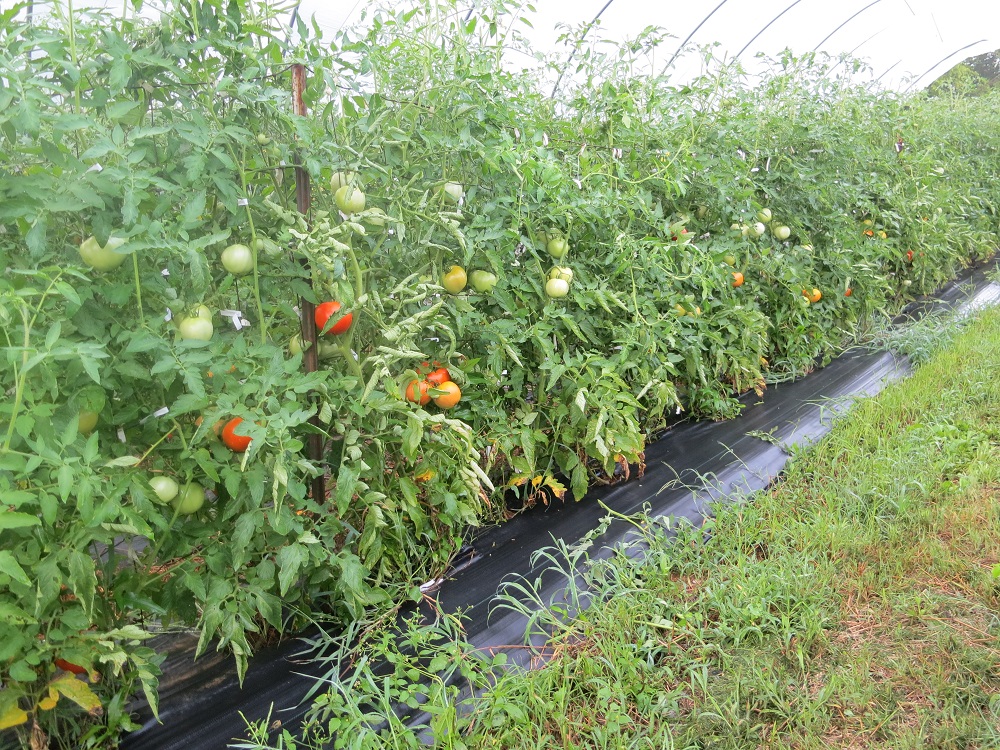
Tomato harvest is in full swing now and we are beginning to get into that summer harvest rhythm.  The spring vegetable crops grow so fast and are so tender that we have to harvest them every day or so to keep up.  These summer crops, like tomatoes and soon peppers, we harvest just twice a week in a concentrated effort then leave them alone to ripen up some more fruit.  New staff on the farm always take some training to get our tomato system down, from the beginning of turning under of the cover crop of wheat and clover, the laying of the reusable landscape fabric (don’t like to use and throw away black plastic), the building of the fence/trellis’s, careful planting of the many different varieties in just the right row (just so so as my grandmother used to say),  pruning and tying the plants up to the trellis, and then repeated tyings.

These steps are just anticipation of the real dance of carefully picking, wiping and sorting of the fruit themselves.  Every Monday and Thursday now we load the truck up with empty boxes and head to the field.  Certain people pick certain varieties and become specialists in their idiosyncrasies, the Cherokee Purples are hard to get the stems off and we sometimes have to use pliers, the big Striped Germans bruise so easily that you have to use two hands to gently pull them from the vine, the Green Zebra’s and the Aunt Ruby’s German Greens have to get just the right amber cast to them before they are ripe.  Back to the tailgate of the truck with full buckets and the sorting begins.

Each tomato is inspected and wiped with a soft cloth and put into one of three boxes for each variety, one for fully ripe ones, another for the ones that need a few more days to fully color up and a third for the freaks.  New helpers always need coaching on what is ripe and what constitutes a freak, great angst over to “freak it” or not “it just has one kind of funny spot?”  Then there is the “have to eat today” pile, fruit that got bruised or split in the picking process or is perfectly good but has one worm hole in it so it won’t keep.

When we are done picking we gently drive the boxes down to the packing shed and take them into the air-conditioned room and carefully stack them according to variety and ripeness, the ripe piles destined for the next market and the restaurants and the less ripe to while away a few days for the next market or the grocery stores.  Early in the season it is just a few boxes of a couple of varieties, this past Monday it was 40 or more boxes, next week it will be over a thousand pounds at each picking.

It has taken the whole morning to harvest and now we all stand around, soaked with sweat and stained green from rubbing up against the tomato foliage, as I select out one fruit of each variety to sample and cut off slices for each to try, “Wow, look how green that Aunt Ruby’s is inside and the flavor is really good”;  some folks like the Striped Germans some don’t “too sweet”;  noses wrinkle, in a good way, at the tartness of the Green Zebra;  they all love the Big Beef and rarely do we sample the Cherokee Purple after the first pickings because they all know it’s their favorite.  Everyone gets a bag and takes as many fruits as they want from the “have to eat today” pile and then round out their selections from the “freak” boxes and head home talking of the tomato sandwiches, salsas, and sauces they are going to make.

These Monday-Thursday harvests leave time the rest of the week to get other chores done, weeding some here, planting a little, trellising the peppers, cleaning the freshly harvested red onions in the shade when it’s beastly hot like it was last Friday, even finishing up projects put off like finally putting a door on the feed room of the Poultry Villa so the critters don’t eat holes in the feed bags that are being delivered this week.

Picture of the Week
These Kellogg’s Breakfasts will be ready to pick on Thursday

7/21/04 Vol. 1 #19

Pretty quiet out here on the farm this week, even with the slight break in the really hot weather we have been just chugging along with the usual chores.  The mid summer meeting season seems to have arrived and so we have been trying to attend some that we think might be good for us to participate in.  Most of the farmer meetings are in the winter when we all have lots of time to think about new ideas but it is all on paper or in slides.  There is a period during the growing season when short events happen, usually afternoon or evening, that allow us to actually see things growing, in person!

This week we attended a seed saving workshop.  With over 200 varieties of crops that we grow, it is just not possible to think about saving our own seed.  To do a good job of saving seed one really needs good isolation from other like plants so that you can be assured of no cross pollination, that would be really hard for us to achieve.  We have been interested in this for several years now, particularly in the heirloom tomatoes.  From time to time we have ordered tomato seed and when they began to produce it was clear that it was not what we had ordered, imagine how excited I might get if the Cherokee Purples turned out to be something else!  So we are looking at beginning to make selections for fruit quality and plant strength in some of these heirloom tomatoes so that we can have some more control over one of our most important crops.  In the back of my head I also have an interest in trying to develop our own Poblano pepper that would produce consistently under our conditions here in North Carolina.  We have trialed at least a dozen Poblano varieties and have found only one that does reasonably well and are afraid that we may not be able to get that one for too much longer.  The seed business these days has been in great flux as it becomes more and more consolidated.  We have lost several varieties over the past few years as the new companies decide to discontinue varieties for one reason or another (the main reason being dollar$).  I’m not sure it’s not just the heat that makes my head swim with such ideas!

The Broadbrested turkeys, known here on the farm as the “little guys”, are three weeks old now and will graduate to going outside from the Poultry Villa during the day to get them used to eating grass and sunshine and their new mother ship.  After two weeks of day time privileges they get to go out to the fields for good.  First along side, but separated by a fence, the “big boys” and finally total integration.

Picture of the Week
The Broadbreasted White Turkeys thinking about making a run for the outdoors!

8/18/04 Vol. 1 #22

Betsy says if that was a vacation then don’t ask her to go again!  Mostly due to the potential of the incoming storms we worked our tails off!  Normally on August break we do a little farm work and then take it easy but between crops that had to be harvested and battening down the hatches we only really felt like we had one slack day.  Oh well only six weeks to go until the Big break.  Until Hurricane Fran in 1996 we didn’t even think about big storms.  It’s the wind that really has us jumping, with all of these greenhouses that are like big sails we have to be conservative when it comes to the forecasts for wind.  Now every two years or so we have a fire drill taking plastic off greenhouses and tying down all of the equipment that normally is just strewn around the farm like five gallon buckets and other light items.  This time the wind didn’t come but as you all know, as of early Saturday morning they were calling for up to 60 miles per hour winds.  Our “Big Tops” are supposed to take up to 70 mph but who wants to try it? So we uncovered them knowing that  the rain would then do such damage to the crops under them (the tomatoes for sure) that we would have a loss there.  This is not a drive the car into the garage kind of job, it takes hours and it can’t be windy so we have to make these calls a day or more in advance.  So we spent the better parts of Thursday and Friday securing things and then parts of Saturday and Sunday untying things.  Now believe me we are glad the storms did not come but it sure didn’t make for a relaxing break!

Other exciting news is that we are headed to Turin, Italy in late October for a first ever international small farmer congress being put on by the Slow Food organization.  We are honored to have been nominated by the local Slow Food group and then to have been accepted to attend along with 500 other producers from the US and a total of 5000 worldwide!  Slow Food is a group that originated in Italy, about 20 years ago, which is dedicated to the preservation and enjoyment of local, handcrafted foods like you find at market.  Every two years they have a huge exposition in Turin displaying and tasting artisanal foods from around the world called the Salone de Gusto.  For the first time ever they are overlapping that event with this congress of small producers called Terra Madre where we will participate in workshops and discussions on sustainable ways of producing great foods.  Incredibly they are paying for all of our expenses except for our plane tickets!   We have asked that they pay for half of our airfare so the local group is having a fund raiser next Wednesday the 25th at Pop’s restaurant in Durham.

Pop’s will donate a portion of the evening’s profits to Slow Food, and the donations will be used to offset the travel costs of two local farmers so that they can attend the Terra Madre conference in Turin, Italy in October. (For more info on Terra Madre, please go to http://slowfoodusa.org/events/terramadre )


We are excited about the possibilities of this trip and hope that we come back with lots of new ideas, maybe the next pepper roaster or something equally fabulous.  We will have more details in future newsletters.

Picture of the Week
Tomatoes, now uncovered, succumbing to foliar disease from too much damp weather.

3/17/05 Vol. 2 #2

OK so it’s now three days from the official beginning of spring and it’s snowing!   We have consulted with lots of our fellow farmers and no one can quite remember a spring this late in getting started.  We are moving forward with the planting plan, as usual, and I think we have caught back up to where we need to be but things just look sad out there in the cold!  There are now over 6000 heads of lettuce in the field and I managed to get the first spinach, turnips, carrots, radish, beets, broccoli raab and the first two plantings of sugar snap peas in the ground but we are still waiting to see them come up.  Most of the flowers look good except they are not as far along as they should be.  Now most of this will quickly correct itself with some consistent warm days, we do wonder though.

In the greenhouse I have gotten a little out of control.  Last week was the big tomato and pepper seeding and as hard as I try to not look at the seed catalogs the siren call of new varieties is seductive.  20 varieties of tomatoes this year including two new purples, several new reds including three we brought back from Italy.  On the pepper side the story is even worse.  36 varieties, partly due to our Italian travels again as well as our continued search for disease resistant varieties.  We have been devastated the last two wet seasons with bacterial leaf spot, which defoliates the plants.  This is a huge problem for large commercial growers and so the breeders are now releasing resistant varieties, at least in the sweet bells.  Our yellow bell has the resistance and it really works, we found one red bell last season that we liked and we are now going to trial four newer ones also.  There are also three new varieties in each of the Poblano and Anaheim/New Mexican green chile types.  The logistical nightmare of keeping track of all these varieties is huge;  from soaking seeds, to seeding in small-cell-size flats (almost 5000 seeds), to moving up the best seedlings into larger containers and then finally moving them to the field and remembering where they are!  All this talk of tomatoes and peppers makes it seem warmer outside already.

Picture of the Week

Snow falling outside while the collards, anemones and lettuce are staying warm inside.

4/20/05 Vol. 2 #7

I can feel the tsunami rolling towards the farm, just over the hill now!  There is always a week about this time of year when the honeymoon is over and we are in the middle of it.  It is a combination of getting ready to plant the big batch of tomatoes and the weather finally warming up enough so that things really start to grow and need attention like irrigation water.  Let’s just add the Farm Tour on top of  the pile while we are at it!  Saturday and Sunday is the Farm Tour.  Our annual opening of the doors to the general public to come see the farm.  Many of you have been on the Farm Tour before and it is a great opportunity to see many of the folks who sell and the Carrboro Market.  Few folks know that the tour was actually Betsy’s brainchild.  Eleven years ago she thought it would be great for customers to be able to go see the market vendors’ farms.  In the end Weaver Street Market sponsored the Tour as a benefit for Carolina Farm Stewardship Association.  Betsy designed the first tour and worked closely with Weaver Street and CFSA on timelines, etc.  Now in it’s tenth year thousands of people go on the tour and it raises thousands of dollars for the work CFSA does.  It is easy to go on the tour.  Just pick up a map at market or Weaver St. or many other local businesses and go to first farm that you want.  The best deal is to buy a button which will be your pass for as many people as you can stuff into one vehicle, for as many farms as you want.  30 farms this year so you will have to choose, it is hard to do more than 3 maybe 4 farms in a day.  In the mean time we will be mowing and picking up around the place, nothing like have hundreds of house guests all at once to make you buff up the joint!  Unfortunately the weather looks a bit mixed for the weekend, Saturday has a front moving in with a chance of rain and then the temperatures dropping with the wind picking up for a brisk Sunday.  Come on out anyway!

We have been moving steadily towards getting the main planting of tomatoes in the ground, got the Big Tops covered, beds prepared, irrigation lines down, row cover laid and today will begin to put up the 1000 feet of trellis to support them all.  It is a lot of work but these luscious fruits are about 15 percent of our business each year so we make sure that it is done right.  While everyone seems to remember us for our peppers (I think it is the hypnotic effect of the roaster in the fall) the tomatoes are a much bigger part of our life.  We have decided to put off the actual planting until early next week due to the weather forecast.  It is critical that they go in the ground and start growing vigorously without any stresses early on, it means much better plants and fruit later.  We had a good frost here on Sunday morning and had a couple of plants in the little tunnels burned a bit so we just want to be careful.  I started the irrigation dance yesterday by getting the pump back down to the pond and pumping water.  Flushed out all of the main lines running up the hill and all across the farm and then the rest of the week we will begin rolling out the irrigation lines, thousands of feet.

Picture of the Week
Just about the whole top of the farm, new flowers in the front, the little sliding tunnels on the left, lettuce in the middle and the Big Tops in the back, come and see it all on the tour.

4/27/05 Vol. 2 #8

We are still recovering from the Farm Tour.  We love having folks out to show them what we are up to but Saturday sure does become a long day with Market, then the Tour and then after Tour chores like picking asparagus and dutch iris.  Thank you to everyone who came out especially with such mixed and breezy weather, we feel it is important for the”city folks and the country folks” to get together (isn’t there a song in the musical Oklahoma like this?).  Part of the sustainability equation of environmental-economic-social is that our neighbors and customers are accepting of and in many ways a part of what we do on the farm.  We wouldn’t be successful without your support!

One of the questions we heard a lot over the weekend was why don’t you heat the greenhouses/tunnels?  It is partly for the same reason that we don’t use black plastic for mulch, make as few trips over the field with the tractor as possible, drive efficient vehicles, use a passive solar greenhouse for transplants, use drip irrigation and reuse those drip lines as long as possible….  I guess it all started with the oil embargoes of the 70′s when we realized that this oil thing was a limited resource.  From the beginning of the farm we have tried to use ways of producing crops (and living) that use the least amount of petroleum products as possible.  We knew that eventually the availability and price of oil would become a limiting factor in farming systems and we wanted to not be as dependant on it when that time came.  Sure there is still a lot of plastic on the farm, more that we like but much less than most commercial farms, unfortunately we have to use some of it to be competitive at this time.  There are still more things that we can do.  Hopefully greenhouse films will soon be made from something like corn starch, we can change the tractor over to bio-diesel, maybe we can run the irrigation pump off of solar panels.

It appears as if we missed the bullet again with the cold weather.  It was 30 degrees here on Monday morning without frost but everything we had covered made it through just fine and the asparagus didn’t get frozen!  Today the big round of tomatoes finally goes in the ground, it has taken some time to get ready for planting but we finished it all up yesterday.  We need to get them in because next week is pepper week and it is an even bigger job than tomatoes!  The first round of tomatoes in the sliding tunnels look great and they got pruned and tied up for the first time with lots of quarter sized fruit on them!  Only 5 weeks until we eat the first one!  We of course planted yet more flowers, the last of the spring vegetables and for the first time in a long time, sweet corn.  We haven’t had the room for corn until this year and so I thought let’s see if we can grow a really good sweet corn.  After much research I settled on both a white and a bicolor both with “excellent flavor, sweetness, and eating qualities”.  Now we will see if they actually perform well, you will know if they make it to market!

Picture of the Week
The tomato system- cover crops for good soil and good insects, drip irrigation, reusable fabric mulch, trellis fences and the Big Tops to keep them dry and reduce the dreaded foliage disease.

7/6/05 Vol. 2 #18

What a glorious week to live in central North Carolina!  Not!!!  A little bit of rain every day to keep the humidity up high and the temperatures in the mid to high nineties, the kind of weather that makes me think about moving back out west.  The only thing worse was when we lived in Houston and it rained every day and then the steam would rise off of all the concrete just like a steam bath.

We have been plugging along despite the conditions and getting quite a bit done.  We harvested all of the red onions and while we did not get as many this year the size is much larger which is nice.  We have both the Stockton Sweet Reds and the Long Reds of Tropea which we grow for Ben Barker at Magnolia Grill (he says when cooked they make a great sauce).  Years ago I was in Arkansas for a conference and was impressed by an onion breeder who spoke about the healthy attributes of Red Onions, very high in anti-oxidants, and he was trying to breed varieties high in these compounds.  Red onions are harder to grow than white ones and you cannot store them very long either.   The sweeter the onion the shorter its storage capabilities.  We are limited here also by day length.  Onions are classed as long, intermediate and short day length varieties.  Most of the onions are grown either far south (Texas with short day lengths) or north (New York with long days).  We are smack in the middle of the intermediate zone so are limited by the varieties we can choose.  Fortunately the Stockton Sweet Red is a really good variety.  Enjoy them for the next month or so.

The next batch of turkeys arrived on Thursday and we were able to get the Broad Breasted Bronzes that we wanted and have been trying to get the last several years and couldn’t.  As these are large turkeys they grow much faster than the heritage birds so we want to get them later (closer to Thanksgiving) so they don’t get huge.  The problem is that there is only really one breeder for these Bronzes and the later into the summer you go there are fewer available because the their fertility goes down and so the hatch rate is low.  We have wanted to raise this type because although they are a broad breasted type which means they are prone to the sorts of inbreeding problems associated with large birds we think that they may be hardier than the white kinds and also be more adapted to our outdoor, pasture management system.  We’ll see.  They look great so far!

Picture of the Week
A peek at good things to come, Big Beefs

7/13/05 Vol. 2 #19

Well we survived the wild and long weekend.  We made it to Pittsburgh and to the church with twenty minutes to spare.  It all went beautifully- ceremony, reception, bride, families, etc.   We had a great time but were totally exhausted by the time we hit the bed on Saturday night (Sunday morning) after having been up since 3:30 a.m.!  A few hours of sleep then back on the plane to Raleigh.  We are still trying to recover, oh to be twenty something again!  The staff did a great job at market (and all of the customers did too) and at the farm.  Sure seems like a lot of coordination for only 24 hours gone from the place.  Congratulations Joann and Brian, they, like all good farmers, will be back at market today (honeymoon what honeymoon?).

The dog days of summer are surely here, we are wading through the days, and the air, expending as little energy as we can.  Mornings in the field, harvesting and trying to maintain the crops that are in the ground, then we slink back under the trees into the shade for the afternoon.  Betsy is working with the flowers and making bouquets for the deliveries to Weaver Street Market and the farmers’ markets.  I am carrying the goods to town, delivering to the store or the restaurants or Wednesday market.  The staff only works after noon on Wednesdays and Fridays, I just think that it is too brutal to ask humans to work out in the field, in the sun, when the weather is this beastly.  The afternoons that they do work we keep them in the shade too.  Seeding fall crops in the seed flats, sorting tomatoes and peppers down at the packing shed, getting orders together, etc.  We do have a few fields that become shady as the afternoon progresses so we can work in them if we must.  The peppers are in one of those this year and we can find some shady work there in the late afternoons too.

The chore that punctuates the week right now is the Monday and Thursday tomato harvest.  It takes all morning to pick the 1400 feet of row and then wipe, and sort the 21 varieties into the appropriate boxes.  We sort five ways-ripe, partly ripe (colored but need a few days to be ready to eat), freaks, eat today and compost.  Early in the season it takes time to “calibrate” the eyes as to which boxes a tomato should go in but after a few days it becomes automatic.  Then down to the air-conditioned packing shed for storage.  Stacks of boxes by variety and ripeness, hundreds of pounds.  The ripes go to the next market or delivery, giving the part ripes time to finish up for the next market/eating opportunity.  The freaks waiting for a good home, someone’s salsa or sauce, or the gazpacho at Elaines.  At the end of the morning the staff takes all they want from the “eat today” box and wearily head off to their afternoon endeavors, covered and grubby in tomato vine residue.

Pictures of the Week
These farmers scrub up pretty good
Dragging Brian back to the farm