7/2/08 Vol. 5 #16

A million dollar rain?   I’m not sure but it certainly was great to finally get something substantial, we had gone for over a month with only one tenth of an inch and were beginning to make alternative plans for the fall crops.  The 90 day forecast is for normal temperatures and rain, lets hope they are right.  These last few days have been sublime with the cool nights and clear days, almost like fall.  With that inch and a half of rain we can now start the process of getting cover crops in the ground.  When it gets as dry as it was it is impossible to “cut ground” as the old timers say.  Yesterday as I headed into town to deliver I noticed several farmers out disking their fields, turning under the residues of wheat or something else and drilling in soybeans or sudangrass.  So the same will occur here, except it will be the overwintered flowers and other spring crops just now finished.  Hopefully we will continue to get some good rains to bring up thick soil improving crops of cowpeas and sudangrass or soybeans and millet.  These crops will grow to eight feet high in eight weeks giving us thousands of pounds of organic matter to return to the soil along with over a hundred pounds of free nitrogen fixed by the bean crops to feed the next cash crops.  They will provide habitat for good bugs that will help us fight the bad bugs.  They will shade out summer weeds and give shade to the turkeys when we move them into those fields.  If the rains come.

A fairly normal week here on the farm, the staff is getting into the easy pattern of tomato picking Mondays and Thursdays, weeding a little, seeding new crops for the fall and winter, and continuing to trellis the summer crops.  The last planting of Sungold cherry tomatoes went in the ground yesterday, timed to be ready in late August and to carry us to the end of the season.  It has been interesting to watch the salmonella tainted tomato story unfold over the last few weeks and of course we are humored by that fact that they can’t seem to trace it back to where is came from or even if it was tomatoes at all.  To all of us local produce farmers it is just another supporting argument for local small scale agriculture.  If you know your farmer and where your produce comes from it you can be more assured it won’t come with bad things attached.  Now I am not saying that it can’t happen but the reality is that most small growers don’t have the volume to need produce washing lines which is where most of these health problems start.  When you dump thousands of pounds of tomatoes into a big tank and slosh them around it makes it much easier for the few tomatoes that might have had contact with something unhealthy to pass it onto the rest.  Most of us don’t wash our tomatoes at all.  Because we don’t spray anything bad on our tomato plants we are able to just wipe them with towels to clean them up and pack them straight into the boxes for market.  Nothing like a good local tomato.

Picture of the Week
A good looking field of peppers

10/3/08 Vol. 5 #27

Last Saturday market of the season (for us). For six months each year our daily life is ruled by the anticipation of Saturday market. We may have lots of things going on here at the farm during the week but in the back of our heads it is always there, the inevitable weight that the Saturday market carries. Betsy says it always feels like Friday-Saturday, Friday-Saturday. Somewhere over sixty percent of our business is done in those five hours on twenty seven Saturdays. 135 hours a year to make most of our living. Most retail businesses are open something on the order of 3000 plus hours a year. At times I realize what a miracle it is that we can make a living, outdoors, in such an intensified way. Of course with out all of your support it would not be possible at all, thank you.

The winterizing of the farm goes apace. Yesterday the last of the pepper trellis was pulled out. We build quite an elaborate trellis system using metal t-posts, wooden cross arms, wire and baling twine to hold up the 1800 feet of row. Sometimes when you design these support systems you find out it takes longer to take it down than it took to put up. So over the years we have come up with a system that is not only fast to put up but also to take down. It is designed so, if done well, all the wires and strings are easily wound up on spools as they are pulled out of the plants. The spools are stored for the winter and next year will be reused and just rolled back out over next years pepper plants. Finally all the metal posts are pulled up and stacked next to the mountain of wooden cross arms, ready for another season.

The last of the tomatoes are gone too, trellises out and the last of the Big Top covers pulled down and wrapped up for the winter. The guys even got a fresh layer of mulch on the blueberries last week. All last winter the power company had crews trimming the trees along the power lines all around the area. We told them they could dump all the brush chips they wanted here. Now after half a year of composting it is beautiful mulch for the berry bushes. The turkeys have been moved to their last stop in the tour of the farm, a field with lush green grass to eat and rest on. In less than two weeks they will go away.

Two weeks from today we will have just landed in Italy, fighting jet lag and driving our way up into the Alps to see a part of the country we have never been in. Next week I will give you a run down of what our two weeks in Italy will be like. Don’t forget the fundraising Chicken dinner at Castle Rock Gardens in Chatham county on Sunday Oct. 12th. Chicken from their farms along with vegetables too for only $25. Check with them at market for further details and tickets or call them at 336-376-1025 for Joann and Brian Gallagher of Castlemaine Farm or 919-636-0832 for Ristin Cooks and Patrick Walsh of Castle Rock Gardens. Picture of the Week With the trellis gone, the guys are picking (and throwing some) the last peppers before mowing

5/13/09 Vol. 6 #8

It has arrived, one of the most hallowed weeks of the season, pepper planting week.  I know that sounds like Daytona Speed week or ACC Tournament week or something equally exhilarating but this is the last of the big pushes for the spring.  Covering the Big Tops and planting the main crop of tomatoes is big, sliding the little tunnels is a big job too but pepper week is easily as complicated and important as those.  Sixteen one hundred foot long beds, over 2000 plants, 32 varieties to keep track of I am tired just thinking about it all.

It started eight weeks ago when we seeded nearly 3000 seeds into small 200 cell flats, then four weeks ago we moved the best looking of those tiny seedlings up into 50 cell flats and the perfect two inch cell size for them to grow a good root system.  The same week I mowed and turned under the beautiful cover crop on the eight beds that will hold the hot kinds and the more “delicate” sweet varieties, leaving the cover to grow even more on the area that will be the no-till home of the sweet bells.  Two weeks ago, before the big storms, I rolled down the huge cover crop in the no-till zone so it would be laying parallel to the direction of the rows of plants.  Yesterday, after the month of decomposition, I re-tilled the eight beds giving us a beautiful soil to plant those hot peppers into.  I also re-rolled and crimped the cover crop in the no-till zone which will help it on it’s way to dying and turning into a thick mulch on the soil.

Today we will roll out irrigation lines on each one of those eight beds and stretch the landscape fabric over them.  We think that the hot varieties and some of the smaller fruited sweets benefit from the warmth of a raised bed and of the black fabric, some of them like the habaneros and the aji dulces take so long to set fruit that the warmer the soil early on in the season is what makes the difference.  The vigorous sweet bell peppers do just fine in the cooler, non tilled soil.  Today or tomorrow, we will cut slits in the thick mulch of the no-till zone to tuck the plants into.  Finally tomorrow we will plant, trying for the last time to not mix up the different varieties so we can accurately know who is who when it comes time to picking and evaluation.  Pepper week, it is a long time in the making.

Picture of the Week
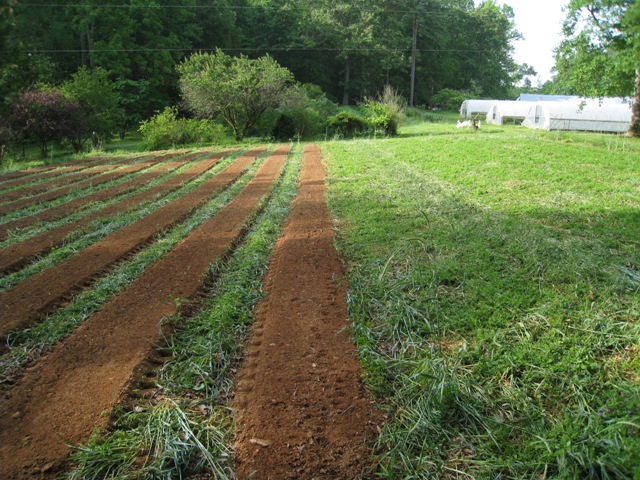
Pepper Field ready to go

7/15/09 Vol. 6 #17

Still reveling in yet another cool July morning, temperatures in the high 50’s and low humidity, what a treat!  We did get a bit of rain on Monday, and I raced around to finish the summer cover crop planting.  A week and a half ago (July 4th weekend) in anticipation of the best chance of rain in weeks I rushed around and seeded an acre of summer covers, as a light rain was falling.  It turned out to be all the rain we would get that day, Arghh!!  Just enough water to get some of them to come up but not all.  Mondays half an inch of rain was hopefully enough to bring the rest up, looks like another chance of rain tomorrow too.

With the drought, the varmits are moving in to take advantage of the juicy plants and fruit.  The squirrels are really out of control in the tomatoes and in some of the transplants for late summer production.  Something, squirrels we think, got up onto the benches where we had lettuce and Brussels sprouts transplants in the seed flats and ate the tops off of all the Brussels sprout plants and much of the lettuce too.  So the hunt continues with daily afternoon rounds, so far the tally is four groundhogs and five squirrels.

Everybody is beginning to ask when we will have peppers and begin roasting at market.  Well the easy answer is the roasting will begin, as usual, the end of August when we have an abundance of colored bell peppers.  The answer to when we will have a good supply of peppers at market is harder.  We have been working in the pepper field this week and the plants look amazing, maybe a good as any crop we have ever grown, but for some reason almost all of the early blossoms made no fruit.  Some times it is a result of high temperatures and resulting bad pollination but we have just not been that hot, my best guess is the heavy pounding rains a month ago actually knocked the blooms off the plants.  That being the case it will be late this month before we have many green bells and the same for anaheims and poblanos.  The good news is that with such vigorous plants we should have more, better quality, fruit later in the summer than usual.

There are a number of Peregrine Farm related dinners coming up in the next month that you might be interested in.  The first is next Tuesday, the 21st, at 18 Seaboard in Raleigh.  A tomato focused event, Jason is coming up with dishes around each of the varieties we grow.  The second is our annual Panzanella farm dinner on the 27th, it looks to be equally divided between tomato dishes and pepper dishes, it is always fun.

The last two are cooking classes at A Southern Season the first is a lunch class on the 28th with Marilyn Markel who runs the cooking school and the second is an evening class on August 6th with Ricky Moore of Glass Half Full, again focused on tomatoes.
Picture of the Week
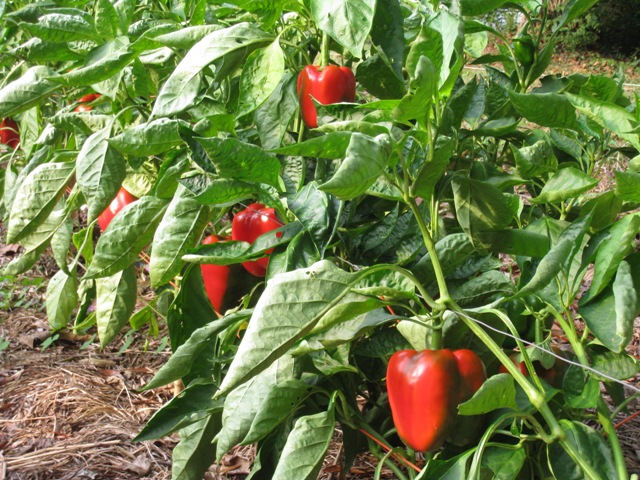
A beautiful field of peppers, some plants shoulder high

8/26/09 Vol. 6 #22

My notes tell me that a year ago today we were having the remnants of Hurricane Fay moving over us and we had 6.75 inches of rain!  It is so hard to imagine that kind of rain event now.  It was good to get the half an inch that we did receive last Saturday and don’t really want to get six inches of rain in one shot, just a bit more now and then.
We’ve had an interesting visitor this week from the ranch at Heifer Project International in Arkansas.  For those of you who are not familiar with their work it is a non-profit organization that works to end world hunger and poverty but in unusual ways.  Based on the concept of “teach them to fish and you will feed them for a lifetime” their original and most known effort is to give a young female animal, a heifer (female cow) for instance, to a family with the understanding that when it has off spring that they then give them to other members of their community and so on.  It has spread to teaching these communities and peoples about how to care for animals, small enterprise development, sustainable agriculture and so on.
Ryan Neal has been the manager of their teaching garden and CSA for three years and hopes to eventually move on to run his own farm.  In that time he has had many interns and help train many of Heifer’s program partners in sustainable/organic vegetable production.  One of his training tools is a CD-ROM that I made with the Southern Sustainable Agriculture Working Group (SSAWG) titled “Organic Vegetable Production and Marketing in the South”.
After viewing it many times and implementing some of it’s contents he wanted to come see the farm in person, so for two days this week he came and worked and visited with us.  A hard time of year for us to have visitors as there is not a lot to see on the farm as most of the crops are quickly disappearing for the season.  Hopefully it was beneficial for him.

Picture of the Week
The peak of pepper season is approaching!

9/9/09 Vol. 6 #24

Look it’s 09, 09, 09 not sure what that all means but some folks think it is significant, to us it means we are in the short rows at the side of the field at the end of the season.  These last few weeks for us, as far as crops go, is all about peppers.  It is the final major crop of the season and one we have been tending for a long, long time.  There are some crops that occupy your attention during planting and growth and not really during the picking, tomatoes are that way, there is so much work in preparing to plant, planting, trellising, suckering, weekly tying up, etc. before you pick the first fruit.  Lettuce and greens on the other hand, you plant, then cultivate for weeds once maybe and then it’s all about, sometimes daily, harvesting and washing and worrying about how perishable they are.
Peppers on the other hand give you some of both, they are more leisurely.  They go in the after the crush of spring planting and are slow growers and while they do require some support they are not reckless floppers like tomatoes.  They are in the ground for so long that advance mulching is the only real weed control option and the trellis is simpler and only needs two layers, usually.  So for three months there is just the occasional foray into the pepper field until picking begins and then it starts in fits.  First a few Jalapenos, then the always eager Cubanelles and Purple bells, finally the rest join in.
Again unlike tomatoes that have to be picked twice a week just to keep them from getting too ripe, peppers have a more relaxed ripening pace and just need a once a week going through, the hot varieties every other week.  Wednesday is hot pepper day, twenty two varieties in just five one hundred foot long rows.  Takes organization and patience to keep them all separated, don’t want to mistake the incendiary Habaneros for the mild Aji Dulces.  The hot types mature so slowly that we only pick one side of the row each week, leaving the other side to get big enough to pick next week.
Colored bells are the bulk of the crop and we save those twelve, hundred foot long rows for Fridays.  Hunched over moving between the rows with five gallon buckets, we look for fully ripe bells in the dark green canopy, pulling up on the fruit to get it to let go.  When the bucket is full it’s back to the tailgate of the truck to sort.  Inevitably there are some that look ripe but when picked the back side still has some green on it.  Sorting entails four containers; full ripe, part ripe, freaks (might have a dry scar but it is sound), got-to-be-dealt-with-in-the-next-few-days (they have a wet spot that will melt down in the box if left with the others) these are the ones we freeze, for us, for the winter.  A calmer, less hurried crop, perfect to end the season with.
Picture of the Week
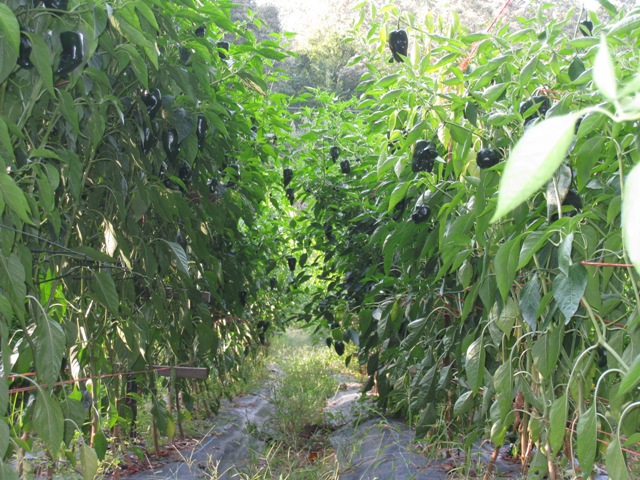
The hall of Poblanos, four layers of trellis this year as some of these plants are seven feet tall