4/27/05 Vol. 2 #8

We are still recovering from the Farm Tour.  We love having folks out to show them what we are up to but Saturday sure does become a long day with Market, then the Tour and then after Tour chores like picking asparagus and dutch iris.  Thank you to everyone who came out especially with such mixed and breezy weather, we feel it is important for the”city folks and the country folks” to get together (isn’t there a song in the musical Oklahoma like this?).  Part of the sustainability equation of environmental-economic-social is that our neighbors and customers are accepting of and in many ways a part of what we do on the farm.  We wouldn’t be successful without your support!

One of the questions we heard a lot over the weekend was why don’t you heat the greenhouses/tunnels?  It is partly for the same reason that we don’t use black plastic for mulch, make as few trips over the field with the tractor as possible, drive efficient vehicles, use a passive solar greenhouse for transplants, use drip irrigation and reuse those drip lines as long as possible….  I guess it all started with the oil embargoes of the 70’s when we realized that this oil thing was a limited resource.  From the beginning of the farm we have tried to use ways of producing crops (and living) that use the least amount of petroleum products as possible.  We knew that eventually the availability and price of oil would become a limiting factor in farming systems and we wanted to not be as dependant on it when that time came.  Sure there is still a lot of plastic on the farm, more that we like but much less than most commercial farms, unfortunately we have to use some of it to be competitive at this time.  There are still more things that we can do.  Hopefully greenhouse films will soon be made from something like corn starch, we can change the tractor over to bio-diesel, maybe we can run the irrigation pump off of solar panels.

It appears as if we missed the bullet again with the cold weather.  It was 30 degrees here on Monday morning without frost but everything we had covered made it through just fine and the asparagus didn’t get frozen!  Today the big round of tomatoes finally goes in the ground, it has taken some time to get ready for planting but we finished it all up yesterday.  We need to get them in because next week is pepper week and it is an even bigger job than tomatoes!  The first round of tomatoes in the sliding tunnels look great and they got pruned and tied up for the first time with lots of quarter sized fruit on them!  Only 5 weeks until we eat the first one!  We of course planted yet more flowers, the last of the spring vegetables and for the first time in a long time, sweet corn.  We haven’t had the room for corn until this year and so I thought let’s see if we can grow a really good sweet corn.  After much research I settled on both a white and a bicolor both with “excellent flavor, sweetness, and eating qualities”.  Now we will see if they actually perform well, you will know if they make it to market!
Picture of the Week
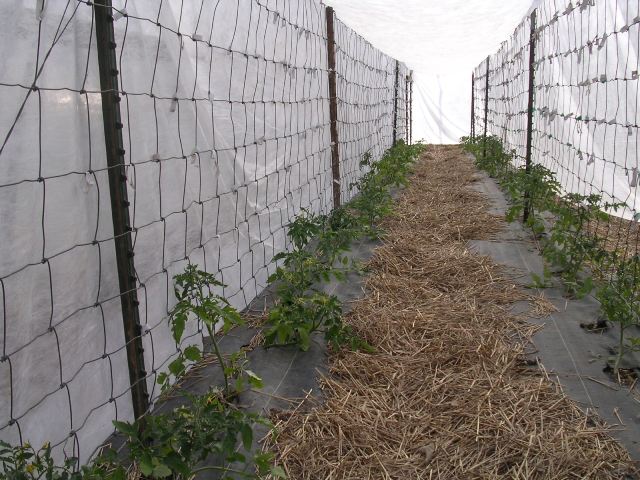
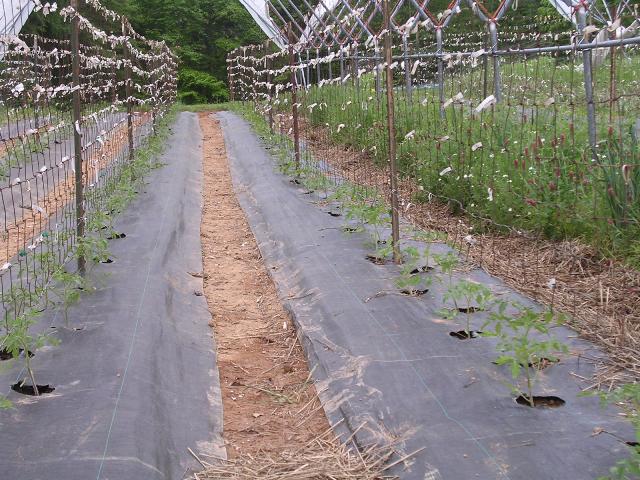
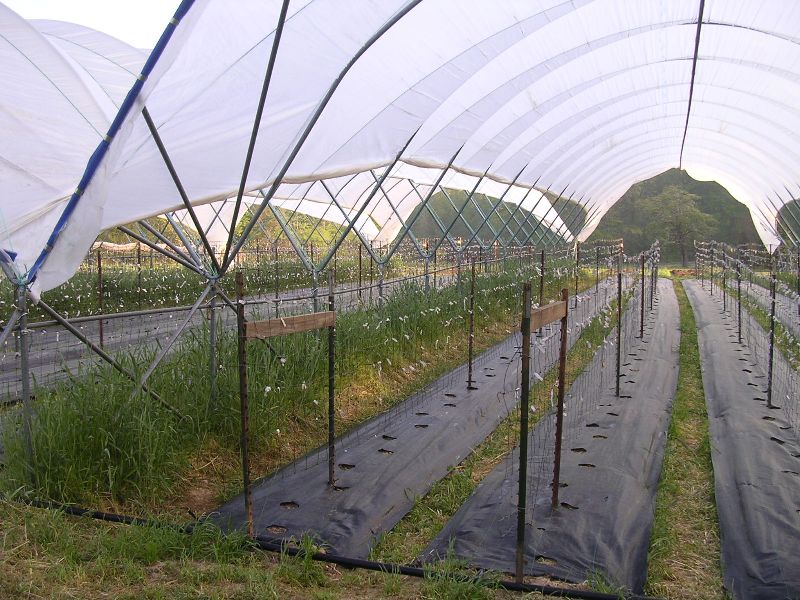
The tomato system- cover crops for good soil and good insects, drip irrigation, reusable fabric mulch, trellis fences and the Big Tops to keep them dry and reduce the dreaded foliage disease.

7/6/05 Vol. 2 #18

What a glorious week to live in central North Carolina!  Not!!!  A little bit of rain every day to keep the humidity up high and the temperatures in the mid to high nineties, the kind of weather that makes me think about moving back out west.  The only thing worse was when we lived in Houston and it rained every day and then the steam would rise off of all the concrete just like a steam bath.

We have been plugging along despite the conditions and getting quite a bit done.  We harvested all of the red onions and while we did not get as many this year the size is much larger which is nice.  We have both the Stockton Sweet Reds and the Long Reds of Tropea which we grow for Ben Barker at Magnolia Grill (he says when cooked they make a great sauce).  Years ago I was in Arkansas for a conference and was impressed by an onion breeder who spoke about the healthy attributes of Red Onions, very high in anti-oxidants, and he was trying to breed varieties high in these compounds.  Red onions are harder to grow than white ones and you cannot store them very long either.   The sweeter the onion the shorter its storage capabilities.  We are limited here also by day length.  Onions are classed as long, intermediate and short day length varieties.  Most of the onions are grown either far south (Texas with short day lengths) or north (New York with long days).  We are smack in the middle of the intermediate zone so are limited by the varieties we can choose.  Fortunately the Stockton Sweet Red is a really good variety.  Enjoy them for the next month or so.

The next batch of turkeys arrived on Thursday and we were able to get the Broad Breasted Bronzes that we wanted and have been trying to get the last several years and couldn’t.  As these are large turkeys they grow much faster than the heritage birds so we want to get them later (closer to Thanksgiving) so they don’t get huge.  The problem is that there is only really one breeder for these Bronzes and the later into the summer you go there are fewer available because the their fertility goes down and so the hatch rate is low.  We have wanted to raise this type because although they are a broad breasted type which means they are prone to the sorts of inbreeding problems associated with large birds we think that they may be hardier than the white kinds and also be more adapted to our outdoor, pasture management system.  We’ll see.  They look great so far!

Picture of the Week
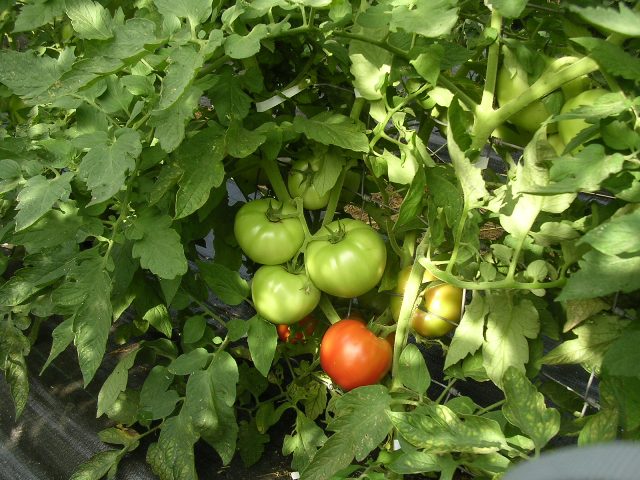
A peek at good things to come, Big Beefs

7/13/05 Vol. 2 #19

Well we survived the wild and long weekend.  We made it to Pittsburgh and to the church with twenty minutes to spare.  It all went beautifully- ceremony, reception, bride, families, etc.   We had a great time but were totally exhausted by the time we hit the bed on Saturday night (Sunday morning) after having been up since 3:30 a.m.!  A few hours of sleep then back on the plane to Raleigh.  We are still trying to recover, oh to be twenty something again!  The staff did a great job at market (and all of the customers did too) and at the farm.  Sure seems like a lot of coordination for only 24 hours gone from the place.  Congratulations Joann and Brian, they, like all good farmers, will be back at market today (honeymoon what honeymoon?).

The dog days of summer are surely here, we are wading through the days, and the air, expending as little energy as we can.  Mornings in the field, harvesting and trying to maintain the crops that are in the ground, then we slink back under the trees into the shade for the afternoon.  Betsy is working with the flowers and making bouquets for the deliveries to Weaver Street Market and the farmers’ markets.  I am carrying the goods to town, delivering to the store or the restaurants or Wednesday market.  The staff only works after noon on Wednesdays and Fridays, I just think that it is too brutal to ask humans to work out in the field, in the sun, when the weather is this beastly.  The afternoons that they do work we keep them in the shade too.  Seeding fall crops in the seed flats, sorting tomatoes and peppers down at the packing shed, getting orders together, etc.  We do have a few fields that become shady as the afternoon progresses so we can work in them if we must.  The peppers are in one of those this year and we can find some shady work there in the late afternoons too.

The chore that punctuates the week right now is the Monday and Thursday tomato harvest.  It takes all morning to pick the 1400 feet of row and then wipe, and sort the 21 varieties into the appropriate boxes.  We sort five ways-ripe, partly ripe (colored but need a few days to be ready to eat), freaks, eat today and compost.  Early in the season it takes time to “calibrate” the eyes as to which boxes a tomato should go in but after a few days it becomes automatic.  Then down to the air-conditioned packing shed for storage.  Stacks of boxes by variety and ripeness, hundreds of pounds.  The ripes go to the next market or delivery, giving the part ripes time to finish up for the next market/eating opportunity.  The freaks waiting for a good home, someone’s salsa or sauce, or the gazpacho at Elaines.  At the end of the morning the staff takes all they want from the “eat today” box and wearily head off to their afternoon endeavors, covered and grubby in tomato vine residue.

Pictures of the Week
These farmers scrub up pretty good
Dragging Brian back to the farm

7/20/05 Vol. 2 #20

How long can this month and weather go on?  A whopper of a storm last night with copious lightning, I just hope that the electric fence charger didn’t get fried with one of those strikes.  The silver lining to the month of July is that it is the best part of the of tomato season and we are at the peak this week and last.  While many folks are asking about when the pepper roaster will come out (not during this hot weather I can assure you!) I always say we have to get through tomato season first.  Sometimes they say “I didn’t know you grew tomatoes?”  Crest fallen I remind them that we grow just a few varieties that they should try.  Tomatoes and their many varieties, colors and shapes were my first vegetable obsession before peppers.  We have grown tomatoes for market since 1986 but just reds with a few cherries and pink German Johnsons because that was what everyone grew around here.  In the early 1990’s we started reading about heirloom tomatoes and started growing a few varieties in 1994 including Cherokee Purple (what a find!).

People often wonder why we grow so many different kinds.  Tomatoes are more than just about flavor.  The range of colors on the plate, the amount of juice, the textures, all contribute to the experience.  People also like different flavors or levels of acidity, or the chefs like to match certain varieties with certain dishes, like wine.  Over the years we have worked on finding the best tasting and producing varieties in each color group.  Then we rely on both our market customers and restaurant chefs to guide us as to what they really like.  For many years we were trying to find a high and low acid variety in each color as well.  Many folks ask for a high acid tomato so we have tried to find them.  I have come to believe that while flavor especially acidity does have have a great deal to do with variety, the way we grow those plants can over ride those genetics at times.  Peoples memories of how tomatoes tasted from there grandmothers garden can also be deceiving but in general I would say that in days past, in the south, the tomato plants didn’t grow as vigorously as we can get them to grow now.  In another correlation to wine, we may do too good a job in building our soils and growing the plants so that they don’t “hurt” enough like grape growers like to refer to wine grapes that make the best wines.  We have grown at least fifteen “high acid” red tomatoes and every time they don’t taste any more acid than our standard red Big Beef (an excellent tomato).  So the active search for a high acid red has ended.  I am sending out our Tomato Guide as a separate attachment.  Let us know what tomatoes you like and how they fall in our listings of flavor.

Picture of the Week
Just a few of the varieties, clockwise from bottom, pink and red Italian Oxhearts, Red Zebra, Big Beef and Early Pick, German Johnson, Cherokee Purple, Paul Robeson, Striped German, Orange Blossom, Sun Gold and Italian Red Cherry

7/27/05 Vol. 2 #21

What can I say, 102 degrees behind the greenhouse in the shade, 99 degrees on the porch, deep in the woods.  We are pumping lots of water to try and keep everything happy.  So far it seems to be working.  We are having some trouble with the tomatoes, especially the large ones like the Striped Germans and Kellogg’s Breakfast.  When ever it is this hot it seems they can’t get enough water and will have hollow areas inside them just beneath the outer layer.  It actually has an official name “Puffy Wall”.  Supposedly caused by a combination of high or low temperatures way back at pollination and a nitrogen:potassium ratio that is out of whack.  All I know is we see it when its extremely hot, it is almost like the tomatoes start to dehydrate from the inside.  They still taste fine but sometimes are not the perfect slicing tomato for the plate.

This has been a week or so of turkey high jinks.  This morning topped it off.  Last night they did not go into their shelters at dark like they always do, so when I went out to close them up they were all down in one corner of the field sleeping in the grass.  I figured it was the heat and just let them stay out for the night.  This morning when Betsy went out at 5:30 for her walk she came back in immediately and rousted me out because forty odd birds were outside the fence and wandering all over the farm!  With not too much herding we got them all back inside the fence, eating and drinking like it was all normal.  This was after a long week or two of “turkey issues”, that started with the big guys picking on one of their own so badly that we had to put the injured bird in the Turkey Hospital.  After a week the bird, now know as Buckwheat, was all healed up and eager to get back with his pals so I carried it down and put it in with the others.  Immediately they started after him again so I took him back to the hospital.  The next night I slipped him in the shelter with the others thinking that they would wake up the next morning not notice another bird amongst the crowd (turkeys seem to have no short term memory).  All went well and when I let them out the next morning they started back in on him.  Puzzled I took him out again and set him up in his own outdoor area, under the figs, as he couldn’t continue to stay in the 4′ X 4′ hospital room.  Maybe when I moved the rest of the group in a day or two they would be so distracted by new turf that I could put him in then and no one would notice.

He was so lonely that he would just sit there and call to his buddies.  At one point he even flew out and ran down to the others pacing up and down the fence wanting to get in, but the bullies were trying to get at him through the fence!  So we put him back under the figs and grabbed one of the others and put it in with him so he would have company.  That bird just sat and called to his friends and eventually flew out and went back to the others.  Nothing was working.  As the “little boys” were now three weeks old and ready to start going outside we decided to put Buckwheat in with them until they graduated out to the field in a few weeks.  When everyone gets integrated after awhile all will be back to normal.  Kind of a Trojan horse trick.  So off we went with Buckwheat under armand put him in with the little guys.  Love at first sight!  He was walking around like the big man on campus and they were all huddled around his legs.  Now almost a week later it is Buckwheat and his posse!

Picture of the Week
Buckwheat and the little boys

3/29/06 Vol. 3 #3

A little stiff today, yesterday was tunnel sliding day.  Not quite an Olympic sport like luge, a bit more like dog sledding.  Our crack team has done this together so many times now that what used to take parts of two days to complete we did in four hours!  Now I will admit that we only moved four out of six tunnels but I am still quite amazed at our efficiency.  One person has to go around and un-bolt everything (twelve bolts per tunnel) while another takes the front walls off.  Then two people take the back walls off while others are attaching the pull straps and spraying linseed oil on the rails to “grease the skids”.  Finally on the count of three the five us us lean into the straps and the thing lurches forward (this it where it is dog sled like).  Tug, pull, tug down to the other end (only 50 feet away), a little fine tuning to align the bolt holes then the re-bolting and end wall re-installation begins.  Once its all done it appears as if they have always been in this position until you notice that the bright lettuces and other crops that had been protected under cover are now outside squinting in the strong sunlight.

Today the early tomatoes go in the ground inside the their newly moved homes.  With this warm forecast they should be really happy and just take off.  A harbinger of changing seasons.  When you plant the last big round of lettuce and the first round of tomatoes and sunflowers in the same week you know that really warm weather is now only 6-8 weeks away.  Betsy’s big planting of Lisianthus went in this week as well, 3600 tiny plants spaced “exactly” four inches apart in three rows on each bed.  It’s like a precision drill team.

We had an interesting experience last Sunday afternoon and again Monday night.  The Renewing America’s Food Traditions (RAFT) committee was meeting in Pittsboro.  RAFT is a collaboration between Slow Food, American Livestock Breeds Conservancy, Chefs Collaborative, Seed Savers Exchange and a few other groups.  The aim is to identify food plant varieties and breeds of animals that are indigenous to the US and in danger of being lost from lack of use in culinary traditions.  Once identified they can then be promoted and hopefully saved.  This is how the heritage turkeys where brought back from the edge of disappearing.  Sunday we participated in a blind tasting of four breeds of chickens.  The principle purpose of the exercise was to develop a tasting protocol that can be used for most poultry and then easily modified for other animals as well.  Once developed then good descriptors of the various breeds can be arrived at so when chefs and consumers want to know the qualities of a breed they can be given a fairly detailed description.  After carefully describing, both numerically and verbally, and tasting the white meat, dark meat and the skin of four different chickens and then the next night having a wonderful full meal prepared with the favored breed, Betsy and I are off chicken for a while!

Picture of the Week
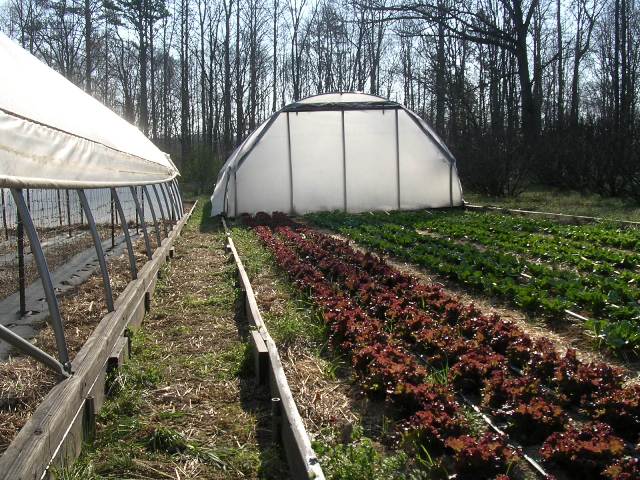
Squinting lettuces next to the new warm home for tomatoes

4/12/06 Vol. 3 #5

Wow!  What beautiful days, this is one of the reasons to live in North Carolina, what seems like weeks of clear blue skies and temperatures in the 70’s.  Even the building pollen storms are not enough to take the luster off.  But spring in North Carolina has one devilish side that most people don’t realize.  Late spring frosts.  We are in one of the worst frost “pockets” in the eastern US here in central North Carolina.  This is why we don’t have much tree fruit at the Carrboro Farmers’ Market.  With all of these beautiful days the fruit trees (and other flowering things) get going like gang busters and then a cold front rolls through and the blossoms get zapped, result- no fruit.  Our neighbor Henry (who grows and sells fruit at market) says he is lucky to get fruit two out of five years, especially peaches.  Our frostiness has to do with soils, latitude and intermediate elevation.  50 miles south in the Sandhills, where the peach industry is, the sandy soils there keep the air just a little warmer at night.  Up in the mountains, where the apple industry is, the slopes and the elevation keep things cooler later so the trees don’t bloom too early.

What does that have to do with Peregrine Farm?  Our fruit trees are tomatoes.  We gamble with the very early ones in the sliding tunnels, putting them in a month before our last frost date of April 21st.  While that one thin sheet of plastic gives them some protection it won’t protect them down to lower than 28 degrees.  When these cold fronts roll through we are always on guard for “the cold night”.  The weather folks are always excited about the first cold night after a front comes through but our experience is that the second night is the worst.  The first night usually still has some air moving around to keep the temperatures from diving.  The second night it usually gets very still and the temperatures drop fast.  Such was the case this last weekend, Saturday night it cleared off late and the temperatures stayed up.  Sunday night-Monday morning it was very clear and still, 26 degrees out here at the farm!  Fortunately we felt it coming and tucked the tomatoes under an additional layer of protection of row cover, suspended over their trellises.  All happy and warm, no damage.  The moral here for most folks is don’t plant those tomatoes into the garden until the last week of April unless you are prepared to cover them.  Our big planting is not slated to go in the ground until the week of April 24th, it should be safe by then but we will be keeping a close eye on the weather for sure!

The most critical job this week was moving the tomato and pepper transplants up into larger containers.  We start them all in small “cells” so we can maximize room in the germinating chamber.  After they have grown for three or four weeks we then move them up to larger size cells so they have bigger root balls to go into the field with.  Large root balls mean stronger, faster growing plants and earlier fruit.  It also gives us a chance to choose only the best of the small seedlings to move up.  The critical part here is not to screw up and mix up all of the varieties.  With 22 varieties of tomatoes and 25 of peppers it is easy to do.  I have a spread sheet of the varieties with the number of plants to move up that I give to the staff and then get out of the way!  I have found that confusing conversation generally leads to Aunt Ruby’s German Green being labeled as Dorothy’s Green or worse.

Picture of the Week
Tomatoes nestled all snug in their beds with visions of BLTs dancing in their heads!

4/26/06 Vol. 3 #7

Well we anticipated waking up to a grey and damp morning.  Basically a rain day.  We had arranged for the staff to come on Thursday instead of today, to take advantage of the weather and to try and snatch a kind of day off.  The sun was out!  Now as I continue on the clouds have rolled in and I feel more secure in our partial sloth this morning.  This is not to say we don’t have plenty to do today with market this afternoon but at least it will start slower.  After the long Farm Tour weekend and the run up to tomato planting it is good to pause for just a moment, after all it may be the last rain day for a long time!

We did have great rain on Saturday, not great for market and it limited the crowd some for the Farm Tour on Saturday afternoon but it was the best rain we have had since maybe January or even December, 1.3″ and a little more last night.  With the rain forecast for today we will be able to finally get both ponds to full pool.  I have been sweating over this for a month or more as we have been trying to increase water flow out of the creek and into the lower pond.  I knew all we needed was a good rain to give us a break from irrigating the crops so we could move that water to the upper pond.  One more good day of pumping and we will have it done!  The race has been against the season, once the leaves are fully out on the trees the creek flow diminishes as it gets hotter because those trees really start sucking moisture out of the ground.  The hotter it gets the more we have to irrigate and then there is no way to get caught up unless it starts to rain.  The good news is that the USDA and National Weather Service has changed us from an “extreme” drought to just “severe” and the forecast for us, through July, is to be on the edge of “some improvement early in the period”.  I think I will still make sure the ponds are full!

The Farm Tour was entertaining as usual.  We always have about the same numbers of folks each year now.  Because we have been on the tour all eleven years and are not as sexy as those farms with lots of animals our visitors are more predictable.  We either have our great Farmers’ Market customers coming out to see what we are up to this year or we get people interested in going into farming and want to ask specific questions about how we do it.  Both groups are fun and we enjoyed seeing all of you!  The main planting of tomatoes were tucked into the ground yesterday!  A careful choreography as there were five of us planting twenty three varieties in ten different rows.  650 plants in all.  The staff want to know my rationale for what kind goes where.  With the Big Tops there is a lot of extra water on the outside rows coming off the plastic roofs, the same result for the down hill ends of the rows.  I carefully put those varieties that need extra water on the outside rows, things like the Green Zebras or Viva Italias who suffer first from too little water.  The interior rows get the kinds that always explode with too much water, like the very sensitive Striped Germans and Sun Golds.  The new test varieties go on the ends of the rows so we can keep an eye on them as we walk by everyday.  It was supposed to only be 18 varieties in this planting but Betsy snuck in five more that we brought back from Italy last fall so I had to find room for them somewhere.  In addition to those we have three new varieties that we are hopeful for, Mule Team (a red), Lillian’s Yellow, and Dorothy’s Green.  I can taste the sandwiches now!

Picture of the Week
Striped German and Green Zebra  tomatoes tucked into their warm raised beds, protected from the wind by the crimson clover cover crop and the rain by the roof of the Big Tops

7/12/06 Vol. 3 #18

Now the weather is returning to more normal summers conditions this week but in general we are all looking at each other and saying “I don’t ever remember a summer like this”.  This, this… not so hot.  No complaining here mind you but it does sort of throw one off balance.  Just as you have your brain programmed to expect one thing and act in a certain way it doesn’t happen.  The only comparison is back in 1991, which we always refer to as the Mt. Pinatubo summer.  That summer that volcano in the Philippines erupted and sent huge amounts of ash into the stratosphere which circulated the globe for months.  The result was a very cool summer in North Carolina,  we barely got into the 90’s.  Back then we were in the midst of the long and expensive “Raspberry Experiment”.  The most noticeable result from that cool summer was that the raspberry canes grew almost twice a tall as normal and the following year we had the best harvest we had ever had.  It turns out that it is too hot here for raspberries to grow vigorously, but that summer it was more like the conditions further north where they produce them in abundance.  Soon there after the raspberries came out of the ground never to be planted here again (under threat of certain penalties from Betsy!).  So while we are not experiencing as dramatic conditions as that year it is still affecting crops here on there farm.  Most noticeably the tomatoes are still not producing at the level we are accustomed to.  Every Monday and Thursday we go out and pick and while we are getting some of all the varieties we are not bringing back the number of boxes that we should be.  Normally this would be the peak week of tomato harvest but it will be at least next week if not later.  Yesterday we were up working in the peppers and the rows that are on black landscape fabric are moving along well but the rows planted no-till are way behind.  The soil is cooler under all that mulch which in hot weather a good thing but this season it is holding those plants back.  Just when your brain is programmed one way…

We did manage to get the cover crops all seeded before the big rains last week and they are up already and looking great, little soybean plants raising there fat heads out of the soil and the millet with one blade pointed straight up towards the sky.  The turkeys have all been rotated around the farm.  The little guys as we call the Broad Breasted Bronzes right now (they will eventually weigh twice a much as the Bourbon Reds) graduated out to the blueberries from the brooder and are extremely happy lazing the days away in the shade of the blueberry bushes and taking group walks around their new grassy enclosure.  The Bourbon Reds have moved into Betsy’s first and now abandoned Zinnia patch (we plant Zinnias five times and she is now cutting off the second batch).  This is the same field that had the leeks, radicchio and the last lettuce among other crops so they are now eating the crab grass and other weeds while hiding out in the four foot tall Zinnia rows like outlaws only to come creeping out when someone walks by the fence.  The last Zinnias get planted this week and the Brussels Sprouts for Thanksgiving went into the ground this week too.  Despite the different weather we still march on with the calendar assuming that normalcy will return.

Picture of the Week
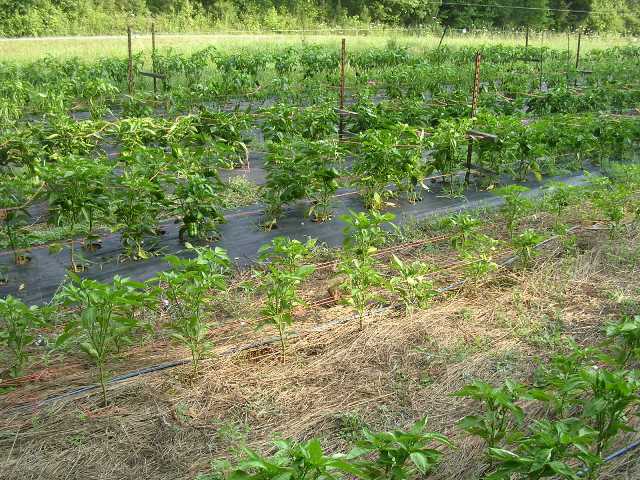
The effects of cool weather.  The same varieties next to each other but the plants on the warmer black fabric are much larger and have large peppers on them.

4/4/07 Vol. 4 #3

Cold weather coming!  Every farmer and gardener is scrambling now.  It’s like a drill on and aircraft carrier, you know it’s coming but really don’t want to have to do it.  It happens every spring but this year is more extreme than most with the record 80 degree days and warm 50 and 60 degree nights.  They say we are going to have four nights below freezing (Thursday through Sunday) which is also more extreme than the usual two.  Now most of the crops out there in the field are cool season types that can take a light freeze so we are not worried about them.  It is the flowering and fruiting crops that most of us are trying to protect.  I know the strawberry growers will not get much sleep the next week, staying up all night either waiting for the temperature to drop low enough to start the irrigation pumps or trying to keep them running.  They spray water over the plants and as that water freezes is releases heat to the plants and flower buds which keeps them from being damaged.  I know it is counter intuitive but thermodynamics always was to me.  They have to keep the water flying until it starts to melt again.  It is an even harder job when the wind is blowing, which it is supposed to do with some vigor.

For us we cover what we can with floating row cover, maybe several layers and hope that is enough.  We don’t have enough water or the equipment to do the overhead sprinkler system the strawberry growers do and our crops are too tall anyway.  The blueberries have been blooming for weeks and should have set enough fruit that won’t be damaged unless it drops really low.  The viburnums which are up to twelve feet tall will just have to stand and bear it.  If we sprayed water on them we would do more damage with broken branches from the weight of the ice than the blooms are worth.  The two crops we are most concerned about are the tomatoes in the sliding tunnels and the dutch iris in the field.  The tomatoes we will drape the floating row cover over the tops of their trellises as a second insulating layer under the greenhouse plastic.  Batten down the plastic as best we can and usually we are good down to the low 20’s.  The iris are another level of difficulty.  Tall, spindly and spiky we will have to construct some kind of structure that will support the row cover and then try and hold that suspended fabric on in the high winds, makes thermodynamics sound easy.

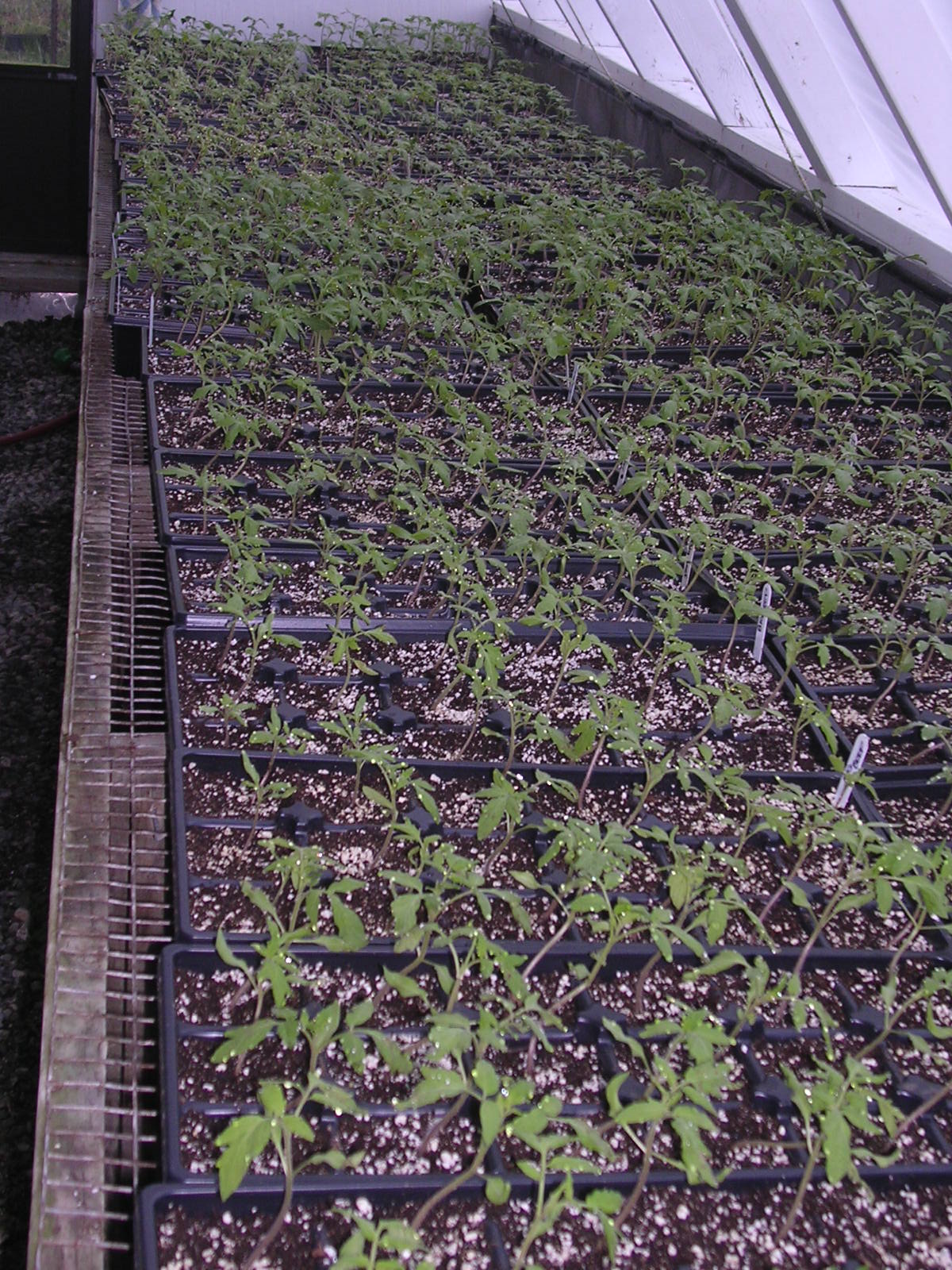
Of course the rest of the farm work must go on.  We now have over 100 beds planted (an acre plus) and have been busy getting them weeded and setting up irrigation.  We should finish that up today and give everything a good drink.  Watering them will not only reduce their stress heading into this cold but wet soil holds more heat than dry soil so it will also help everything through the cold snap.  We moved the 800 tomato seedlings up to their larger four inch pots.  We start them in smaller containers so we can get good germination and then move up only the best looking plants.  It is tedious work especially considering there are eighteen different varieties that one could easily miss label!  This batch of tomatoes will go out into the field in just over two weeks.

Picture of the Week
Hundreds of tomato seedlings