3/29/06 Vol. 3 #3

A little stiff today, yesterday was tunnel sliding day.  Not quite an Olympic sport like luge, a bit more like dog sledding.  Our crack team has done this together so many times now that what used to take parts of two days to complete we did in four hours!  Now I will admit that we only moved four out of six tunnels but I am still quite amazed at our efficiency.  One person has to go around and un-bolt everything (twelve bolts per tunnel) while another takes the front walls off.  Then two people take the back walls off while others are attaching the pull straps and spraying linseed oil on the rails to “grease the skids”.  Finally on the count of three the five us us lean into the straps and the thing lurches forward (this it where it is dog sled like).  Tug, pull, tug down to the other end (only 50 feet away), a little fine tuning to align the bolt holes then the re-bolting and end wall re-installation begins.  Once its all done it appears as if they have always been in this position until you notice that the bright lettuces and other crops that had been protected under cover are now outside squinting in the strong sunlight.

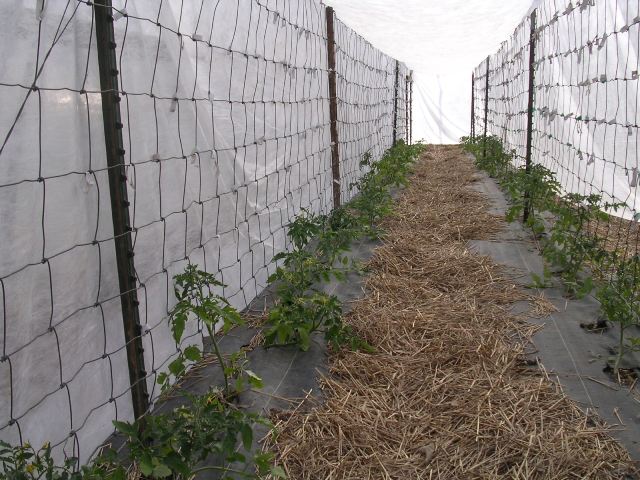
Today the early tomatoes go in the ground inside the their newly moved homes.  With this warm forecast they should be really happy and just take off.  A harbinger of changing seasons.  When you plant the last big round of lettuce and the first round of tomatoes and sunflowers in the same week you know that really warm weather is now only 6-8 weeks away.  Betsy’s big planting of Lisianthus went in this week as well, 3600 tiny plants spaced “exactly” four inches apart in three rows on each bed.  It’s like a precision drill team.

We had an interesting experience last Sunday afternoon and again Monday night.  The Renewing America’s Food Traditions (RAFT) committee was meeting in Pittsboro.  RAFT is a collaboration between Slow Food, American Livestock Breeds Conservancy, Chefs Collaborative, Seed Savers Exchange and a few other groups.  The aim is to identify food plant varieties and breeds of animals that are indigenous to the US and in danger of being lost from lack of use in culinary traditions.  Once identified they can then be promoted and hopefully saved.  This is how the heritage turkeys where brought back from the edge of disappearing.  Sunday we participated in a blind tasting of four breeds of chickens.  The principle purpose of the exercise was to develop a tasting protocol that can be used for most poultry and then easily modified for other animals as well.  Once developed then good descriptors of the various breeds can be arrived at so when chefs and consumers want to know the qualities of a breed they can be given a fairly detailed description.  After carefully describing, both numerically and verbally, and tasting the white meat, dark meat and the skin of four different chickens and then the next night having a wonderful full meal prepared with the favored breed, Betsy and I are off chicken for a while!
Picture of the Week
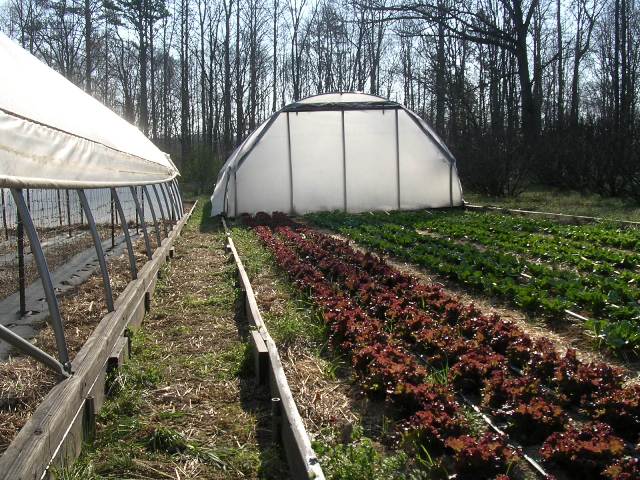
Squinting lettuces next to the new warm home for tomatoes

4/6/06 Vol. 3 #4

The one good thing about a drought, the weeds don’t grow very fast!  This week has been busy with a combination of cultivating for weeds and then setting up the rest of the irrigation in the newly “weeded” beds.  Cultivation can mean a lot of things when describing the process of growing crops but for us it means using “stirrup” hoes.  Like a stirrup on a horses saddle, the blade slices just under the soil surface no more than a inch deep.  The perfect timing is just before the weeds come up or have just germinated, otherwise it is a lot more work and less effective for those weeds that now have large root systems.  We joke around here that I am the straight line police because all of the plants run in exact parallel rows, usually three to a bed.  The main reason for the straight rows is that it makes the cultivation much easier than if everything was a crazy zigzag.  Our secret weapon is a Swiss made “wheel hoe”, this is the Ferrari of wheel hoes.  Made with multi adjustable handles on a small pneumatic tire it handles like a dream.  Attached to this can be may different implements but the best is an eight inch wide stirrup.  A person can walk up and down the rows and cultivate with ease.  If the rows are straight and the timing correct a person can cover a quarter acre in hour or so.  Rett is the king of the wheel hoe around here, no bending over!

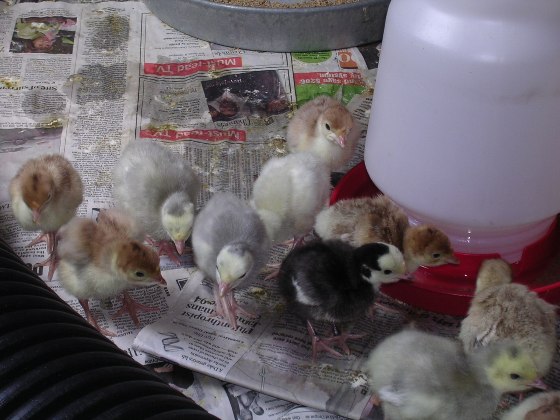
As Betsy now says in Italian “I bambini tacchini sono aravati ieri mattina!”  The turkeys arrived yesterday morning!  This first batch are all the slower growing heritage birds.  This year we decided to do all Bourbon Reds as we like their ease of handling.  The handful of Blue Slates that we have had the last two years have been “a handful”.  While they generally get to be a few pounds larger they have always been the bad actors, flying out of the fence, showing the others how to misbehave, you know smoking cigarettes and hanging out on street corners.  It is still always hard to believe that they were hatched two days ago, put into a box and sent in the mail.  They have enough reserves inside them from the egg yolk to not need food or water for several days but they can’t go too long.  We notify the post office which day they will arrive and we have them call us as soon as they come in.  Usually the call comes about 7:00 a.m. and one of us rushes up to retrieve them.  As soon as we get them back to the farm we put them into the prepared and warm brooder house.  Each bird gets its beak dipped into the water and then plopped down into the feed pan so they begin to learn where their feed and water is.  Everyone asks are they really dumb birds.  My reply is if you were taken away from your mother at birth, without anyone to show you how to do things, you might look dumb too!  Once they have done something once then they get the hang of it, I’m not saying they are rocket scientists but…

Picture of the Week
Eating, Drinking, all singing, all dancing

4/12/06 Vol. 3 #5

Wow!  What beautiful days, this is one of the reasons to live in North Carolina, what seems like weeks of clear blue skies and temperatures in the 70’s.  Even the building pollen storms are not enough to take the luster off.  But spring in North Carolina has one devilish side that most people don’t realize.  Late spring frosts.  We are in one of the worst frost “pockets” in the eastern US here in central North Carolina.  This is why we don’t have much tree fruit at the Carrboro Farmers’ Market.  With all of these beautiful days the fruit trees (and other flowering things) get going like gang busters and then a cold front rolls through and the blossoms get zapped, result- no fruit.  Our neighbor Henry (who grows and sells fruit at market) says he is lucky to get fruit two out of five years, especially peaches.  Our frostiness has to do with soils, latitude and intermediate elevation.  50 miles south in the Sandhills, where the peach industry is, the sandy soils there keep the air just a little warmer at night.  Up in the mountains, where the apple industry is, the slopes and the elevation keep things cooler later so the trees don’t bloom too early.

What does that have to do with Peregrine Farm?  Our fruit trees are tomatoes.  We gamble with the very early ones in the sliding tunnels, putting them in a month before our last frost date of April 21st.  While that one thin sheet of plastic gives them some protection it won’t protect them down to lower than 28 degrees.  When these cold fronts roll through we are always on guard for “the cold night”.  The weather folks are always excited about the first cold night after a front comes through but our experience is that the second night is the worst.  The first night usually still has some air moving around to keep the temperatures from diving.  The second night it usually gets very still and the temperatures drop fast.  Such was the case this last weekend, Saturday night it cleared off late and the temperatures stayed up.  Sunday night-Monday morning it was very clear and still, 26 degrees out here at the farm!  Fortunately we felt it coming and tucked the tomatoes under an additional layer of protection of row cover, suspended over their trellises.  All happy and warm, no damage.  The moral here for most folks is don’t plant those tomatoes into the garden until the last week of April unless you are prepared to cover them.  Our big planting is not slated to go in the ground until the week of April 24th, it should be safe by then but we will be keeping a close eye on the weather for sure!

The most critical job this week was moving the tomato and pepper transplants up into larger containers.  We start them all in small “cells” so we can maximize room in the germinating chamber.  After they have grown for three or four weeks we then move them up to larger size cells so they have bigger root balls to go into the field with.  Large root balls mean stronger, faster growing plants and earlier fruit.  It also gives us a chance to choose only the best of the small seedlings to move up.  The critical part here is not to screw up and mix up all of the varieties.  With 22 varieties of tomatoes and 25 of peppers it is easy to do.  I have a spread sheet of the varieties with the number of plants to move up that I give to the staff and then get out of the way!  I have found that confusing conversation generally leads to Aunt Ruby’s German Green being labeled as Dorothy’s Green or worse.

Picture of the Week
Tomatoes nestled all snug in their beds with visions of BLTs dancing in their heads!

4/19/06 Vol. 3 #6

Betsy has a saying for when things really start to get crazy busy.  “We feel like chickens on a hot plate”.   It comes from old county fair sideshows and of course I have never witnessed such a thing but the visual image is appropriate for how we feel at this point in the season.  Part of the problem is that we are short a few “chickens” right now as Joann and Rett are only working a few mornings a week so that they can work on their own farms.  Rachel is also here just a few mornings a week until school is out, then she comes on full time.  Our newest staff, Will, starts next Monday, I hope he is a fast dancing chicken!  That means we have less than half the help we normally have at this time of year.  I can tell you that these old chickens are dancing as fast as we can.

None the less we are keeping the big balls in the air (and occasionally letting the little balls hit the ground).  The inexorable march towards getting the main planting of tomatoes in the ground moves apace.  The beds are tilled and ready.  Yesterday we pulled the plastic covers over the Big Tops so that tomorrow we can put down irrigation line, lay the landscape fabric mulch and build the 1000′ feet of trellis that will support the plants.  Next Monday or Tuesday we will plant the crop, right on schedule.  So while we are we are out of control busy the Farm Tour is this weekend too! Saturday and Sunday is the Farm Tour 1:00-5:00 each day.  Our annual opening of the doors to the general public to come see the farm.  Many of you have been on the Farm Tour before and it is a great opportunity to see many of the folks who sell and the Carrboro Market.  Now in it’s eleventh year thousands of people go on the tour and it raises thousands of dollars for the work Carolina Farm Stewardship Association does.  Sponsored by Weaver Street Market, who does an incredible amount of work to promote the tour and local agriculture, it is easy to go on the tour.  Just pick up a map at market or Weaver St. or many other local businesses and go to first farm that you want.  The best deal is to buy a button which will be your pass for as many people as you can stuff into one vehicle, for as many farms as you want.  31 farms this year so you will have to choose, it is hard to do more than 3 maybe 4 farms in a day.  In the mean time we will be mowing and picking up around the place, nothing like have hundreds of house guests all at once to make you buff up the joint!

Picture of the Week
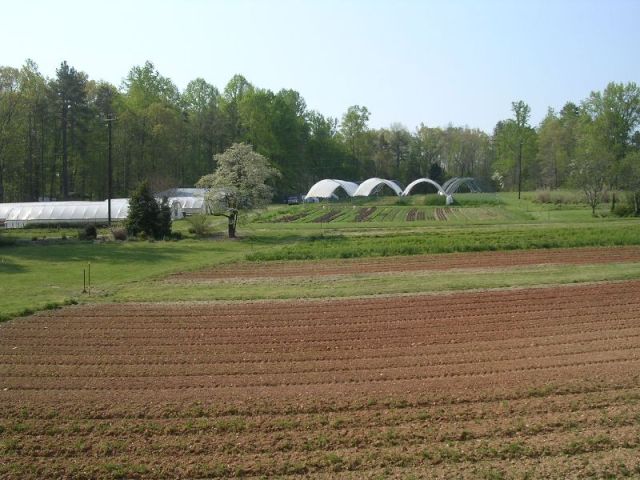
Just about the whole top of the farm, the little sliding tunnels on the left, lettuce in the middle and the Big Tops in the back, come and see it all on the tour.

4/26/06 Vol. 3 #7

Well we anticipated waking up to a grey and damp morning.  Basically a rain day.  We had arranged for the staff to come on Thursday instead of today, to take advantage of the weather and to try and snatch a kind of day off.  The sun was out!  Now as I continue on the clouds have rolled in and I feel more secure in our partial sloth this morning.  This is not to say we don’t have plenty to do today with market this afternoon but at least it will start slower.  After the long Farm Tour weekend and the run up to tomato planting it is good to pause for just a moment, after all it may be the last rain day for a long time!

We did have great rain on Saturday, not great for market and it limited the crowd some for the Farm Tour on Saturday afternoon but it was the best rain we have had since maybe January or even December, 1.3″ and a little more last night.  With the rain forecast for today we will be able to finally get both ponds to full pool.  I have been sweating over this for a month or more as we have been trying to increase water flow out of the creek and into the lower pond.  I knew all we needed was a good rain to give us a break from irrigating the crops so we could move that water to the upper pond.  One more good day of pumping and we will have it done!  The race has been against the season, once the leaves are fully out on the trees the creek flow diminishes as it gets hotter because those trees really start sucking moisture out of the ground.  The hotter it gets the more we have to irrigate and then there is no way to get caught up unless it starts to rain.  The good news is that the USDA and National Weather Service has changed us from an “extreme” drought to just “severe” and the forecast for us, through July, is to be on the edge of “some improvement early in the period”.  I think I will still make sure the ponds are full!

The Farm Tour was entertaining as usual.  We always have about the same numbers of folks each year now.  Because we have been on the tour all eleven years and are not as sexy as those farms with lots of animals our visitors are more predictable.  We either have our great Farmers’ Market customers coming out to see what we are up to this year or we get people interested in going into farming and want to ask specific questions about how we do it.  Both groups are fun and we enjoyed seeing all of you!  The main planting of tomatoes were tucked into the ground yesterday!  A careful choreography as there were five of us planting twenty three varieties in ten different rows.  650 plants in all.  The staff want to know my rationale for what kind goes where.  With the Big Tops there is a lot of extra water on the outside rows coming off the plastic roofs, the same result for the down hill ends of the rows.  I carefully put those varieties that need extra water on the outside rows, things like the Green Zebras or Viva Italias who suffer first from too little water.  The interior rows get the kinds that always explode with too much water, like the very sensitive Striped Germans and Sun Golds.  The new test varieties go on the ends of the rows so we can keep an eye on them as we walk by everyday.  It was supposed to only be 18 varieties in this planting but Betsy snuck in five more that we brought back from Italy last fall so I had to find room for them somewhere.  In addition to those we have three new varieties that we are hopeful for, Mule Team (a red), Lillian’s Yellow, and Dorothy’s Green.  I can taste the sandwiches now!

Picture of the Week
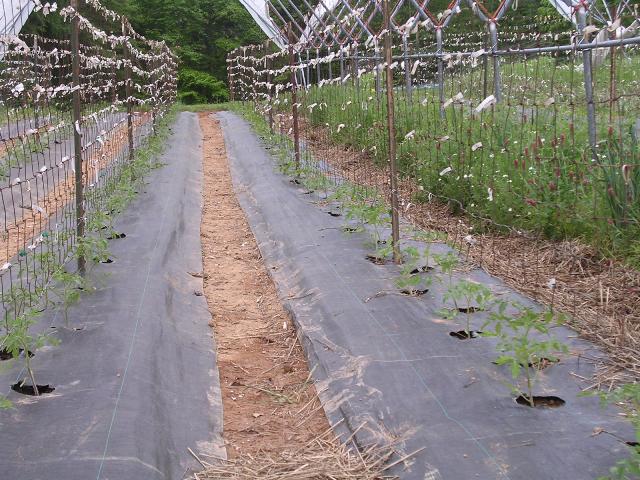
Striped German and Green Zebra  tomatoes tucked into their warm raised beds, protected from the wind by the crimson clover cover crop and the rain by the roof of the Big Tops

5/3/06 Vol. 3 #8

Rain, rain, rain marvelous rain!  Another 1.8 inches last Wednesday and Thursday.  Everything looks great, the weeds are growing too but the ponds are full now!  Of course there are always downsides to everything but considering the need for the water I won’t whine too much.  We are in the middle of lettuce season and when the plants are getting big enough to harvest lots of rain makes them very fragile and susceptible to disease.  We plant the lettuce three rows to the bed twelve inches apart so there is not much air flow around the plants when they get to harvest stage.  It is like your closet in the middle of the humid summer, fungus and mold loves to grow in these conditions.  There is a soil borne lettuce disease appropriately called “bottom rot” because that is what it does.  Our strategy for control is raised beds, many years in the crop rotation, and careful watering at the late stages.  Well just before the rains started I irrigated, as I get to where I never believe we will actually get rain, then we got over three inches in the last week.  We have seen a fair amount of the problem but I think have worked through all the bad beds.  Adding insult to injury I had to cut Weaver Street Market’s lettuce in the rain last Thursday.  I waited as long into the afternoon as I could hoping the rain would stop as wet lettuce is very tender and frankly cutting in the rain is not much fun.  Finally I gave up and spent two hours hunched over with lettuce knife in hand.  Of course by the time I got to Weaver Street’s back door the rain had ended but they had the lettuce they needed, such is the life of a produce grower.

Yesterday was the second installment of covering the Big Tops.  This time it was the set that covers Betsy’s flowers that don’t like to be wet when it’s time to cut them.  Four bays each covered with 30′ X 100′ sheets of plastic.  We had the perfect windless morning and the A team on hand to perform.  After three years of trying different approaches we now have settled on a four person system.  Two people control the corners on one end and we pull the plastic over the top from one end to the other.  Betsy is working a long push pole moving down the length of the tunnel helping the plastic over the top and I scamper around, some on a step ladder, some on the ground pulling the leading edge down as we make progress down the tunnel.  Finally with it all draped over the top we clip the starting end on to the end bow and then got to the opposite end and pull the excess down that way and clip that end off.  With these tunnels the clips just hold the ends in position.  The plastic is really held on with a roping system that criss crosses over the top of the tunnels and are anchored on the legs.  It is quite a show as Betsy and Joann pull the rope back and forth over the top as Rett and I follow tightening it.  We approached a new world record, covering four bays clipped and roped in three and a half hours!  We may be heading out on the road to make the big money!

Pictures of the Week

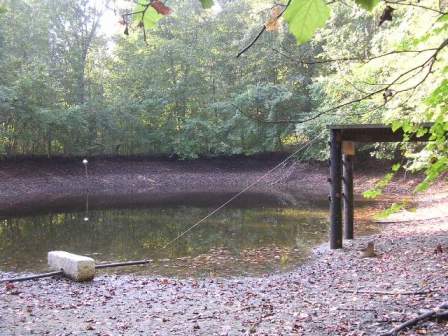
The upper pond last fall is now finally full!  This is two months worth of irrigation water.

5/10/06 Vol. 3 #9

So busy yesterday that I couldn’t get this done until this morning (after chasing yet more roaming turkeys), see you at market!

The big pepper plant is today and I hope we are ready for it.  It is a challenge this year as we are planting into maybe the most difficult field we have, as far as soil is concerned.  This is the field that we call “the Top” as it is the highest point on the farm and the farthest away from everything.  When we started going to Farmers’ Market in 1986 this was the only piece of ground that wasn’t planted to blackberries and raspberries so we turned it over and began the experiment with vegetables and cut flowers.  My brother Jon was here at that time and vegetables were his area of expertise.  He and Betsy borrowed a neighbors plow and turned over this far corner of the farm and found a mixed bag.  The field is long and irregular in shape (you know those of use who are members of the straight line police hate that) and the soil changes from one end to the other.  Marvelous sandy loam on the bottom end but the top end is the most difficult red clay we own, very slow to dry out and almost impossible to work into a good seed bed.  Joann is still scarred from having to plant tomatoes into that red clay and having to stack what amounted to pieces of brick around the root balls.  This spring, however, the beds worked up as nicely as they ever have so we don’t have to fight that problem, at least on half of the 1600 feet of pepper beds.  The other half we always plant without tilling the soil, right into thick cover crop of grain rye and hairy vetch that we have killed and flattened down by rolling it.  It is like growing our fertilizer and mulch right in place.  After we roll it down we cut slits into the mulch and the soil, with the the tractor, to set the plants into.  If it is too dry the cutting wheels can’t cut through.  If it is too wet, especially in red clay, it can make a mess that is hard to plant into.  With all of the rain in the last two weeks I am a bit worried that it could be a bit too wet.  We’ll find out later today if that is the case!  None-the-less Rachel and Will (the newest staff member) will be charged with carefully interpreting my diagram of which pepper varieties go where.  Just like the tomatoes there is a strategy as to which ones like or will do better in the different soil types.  The hot peppers definitely need to be in the warmer sandy loam soil while the more disease resistant sweet bells can stand up better to the red clay.  No matter what it will be one at time until the over 2000 plants are tucked into the ground whether it be sandy or clayey.

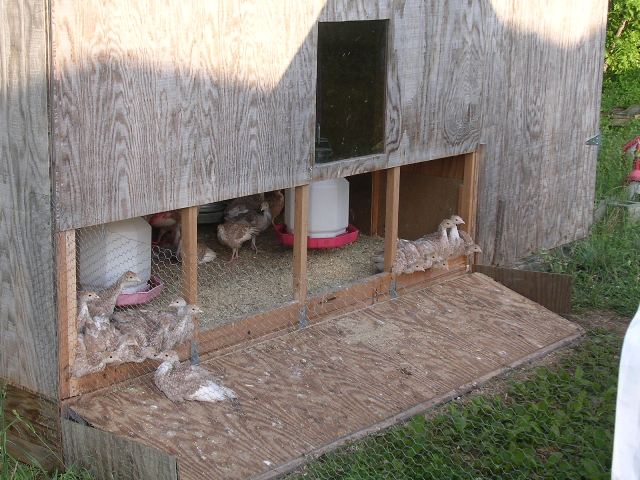
Late graduation day for the turkeys this week.  Usually we start letting them out to get used to the idea at three weeks of age.  This year because we got them earlier and it has been cold we just let them out yesterday for the first time.  Now five weeks old and full of extra energy from being cooped up they have been acting up already!  We pull one of the shelters up in front of the brooder building, about five feet away and then put up some chicken wire between the two.  There is a ramp/door on the front of the brooder so they can come in and out.  Usually they are very tentative and take a day or so to get used to going out, into the new shelter, and eating grass.  These guys came out and started flying over the chicken wire almost immediately.  I had to chase some down into the woods to catch them.  We clipped the wing feathers on these bad actors after they flew out a second time.  I hope we can get them calmed down or it will be a long summer of rounding up escapees.

Picture of the Week
Tentative about the outdoors just before going wild in flight

5/17/06 Vol. 3 #10

The endless lettuce season rolls on.  At least it feels endless these days as I go out to cut four mornings a week.  The staff arrives each morning and I brief them on the days jobs and end with “of course I will be cutting lettuce if you need me”.  Mondays and Thursdays I cut for delivery to Weaver Street Market, Wednesdays and Fridays I cut for the markets and the restaurants.  Usually two, sometimes three, hours each morning.  We are now into the fourth week with one big week left to go.  Lettuce is one crop that I do all the harvesting of.  It is such and ephemeral plant that it takes sometime to develop an eye for which head is large enough and tender enough to cut.  In a few days the heads that I pass over will be big enough to then take, in a few more days they will be too far gone, getting tough and bitter.  The hotter it gets the faster this progression occurs.  The weather of the past few weeks has been about as ideal as we get in North Carolina as far as lettuce is concerned so the pressure has been off a bit.  It is easy for me to train the staff on what is the right size of turnip to pick and how big a bunch is but the lettuce thing is more like “is this flower at the right stage to harvest?”, it is subjective (hence the reason why Betsy cuts almost every flower stem on the farm).  Twenty four heads to a case, six cases and hour if I have to search around, ten cases and hour if the planting is really uniform, that is one head every fifteen seconds!  I am counting the seconds until the season is done.

Big event at the Market this Saturday.  The Market is having a fundraiser for our sister market in New Orleans and all of the farmers and fishers who where devastated by hurricane Katrina last fall.  Like the Carrboro Market which was open two days after hurricane Fran crippled this area in 1996, the Crescent City Market was up and running only weeks after the water receded in New Orleans.  Markets are an important social component for towns and cities as well as sources of food.  Muffulettas and Gumbo prepared by a dozen Triangle chefs will be available to go for $10/serving, for more details go to the Carrboro Market websiteAll proceeds will go to the Crescent City Markets and their efforts to bring their vendors back into production.  Come on out for the good food!

It has been the normal orchestrated chaos this week with more planting of summer crops, more zinnias, sunflowers, celosia, cucumbers and another planting of Cherokee Purple tomatoes.  Weeding, trellising of flowers and vegetables, mowing, harvesting and on and on.  The turkeys got so wild last week that we had to trim the wing feathers on all of them.  After chasing the little miscreants all over the farm, including one that spent the night out because we couldn’t catch him at all, we decided we had to make sure none of them could fly until they learned better behavior, maybe this is where the term “grounded” came from that our parents threatened us with as kids.  Well this was no idle threat for these birds!  They go out to the field permanently tomorrow.

Picture of the Week
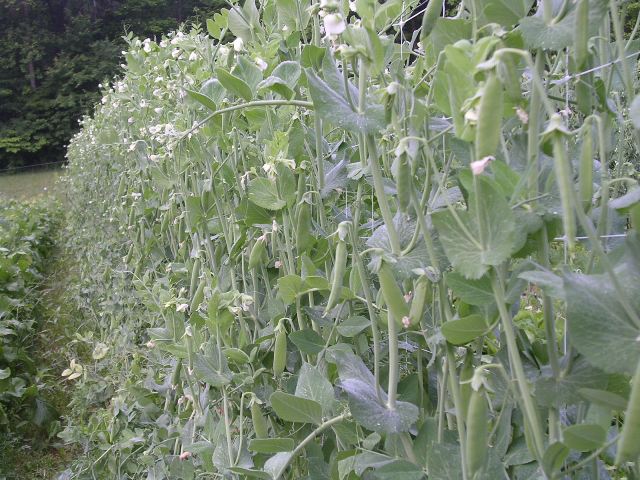
Sugar Snap Peas already loaded up with many more blooms on the top of the plants

5/24/06 Vol. 3 #11

It is the season for picking tiny objects.  Most folks think about temperature, day length and other weather related things when it comes to “seasons” but for us, sometimes, it is much more relevant to equate seasons with the task at hand.  Spring is filled with the harvest of crops that are either very close to the ground or down in it.  Spinach, lettuces, broccoli raab, radishes, turnips and the farthest down, carrots.  Strong backs are required for the hours and hours of bending over searching for the correct size of root vegetable to pull and bunch.  Even then there are only so many of these relatively large objects to pull, on a good day maybe 400 individual turnips to be harvested in an hour.  Beginning this week we started the change of seasons to more stand up pursuits  but with more tedious consequences.  What is he talking about?  Sugar Snap Peas and Blueberries.

While we do get to stand up while picking them, the harvest time goes on and on.  We (five of us) picked peas for two solid hours on Monday morning.  Yesterday was the first shot over the bow of Blueberry season with four people picking for several hours, thousands of tiny blue orbs.  For the next three weeks our lives will be consumed by the harvest of blueberries.  When it overlaps with something else like peas it can be mind numbing.  When we first began the transition from mostly blackberries (we had two acres in production at one point) to vegetables and flowers we designed June to be “berry” month.  We have never grown the traditional crops that begin in June; squash, beans, cucumbers, potatoes.  So I needed something to occupy me from the end of lettuce season and the other cool weather crops, at the end of May, until the beginning of tomato season at the beginning of July.  Betsy just won’t let me lounge around the farm without something to do.  Our original plan was to have blackberries and blueberries.  Several years ago when the last of the large blackberry plantings was waning and the blueberries where beginning to really produce, we had that overlap.  We learned that season that there were not enough people on the face of the earth to pick all those tiny objects.  When that planting of blackberries was plowed under we decided that June would be Blueberry month only!  As it is we still hire an additional four or five people to help us get them all off the bushes and into those little green pint containers.

Finally the turkeys got moved to the field.  Seven weeks old and tired of hanging around that old brooder building.  Now turkeys herd pretty well once they get used to it (they actually used to have “turkey drives” to get large numbers to market) but as I have said, the first time you introduce something new to them is always exciting.  After several years of trying to herd them from the brooder, the several hundred yards, to their first stop in the fields and having it get out of hand we now carry them over, two in each hand.  Yesterday we had six of us to make the job easier.  Two catching and four walking them over.  They are much happier now, lots of interesting bugs and weed seeds to eat and bushes to run around.  Every year we have a misfit in the bunch.  Last year it was Buckwheat and the half blind Blue Slate, the year before it was a broad breasted white with a crooked beak that made him look like a pirate.  This year it is Shrimpy.  Shrimpy is a quarter the size of the others, with shorter legs, but she runs with the rest of them as if there is no difference.  No one seems to notice and she is growing just fine only she will never catch up with the others.  Some one will be getting a five pound bird for Thanksgiving.

Picture of the Week
Happy but cold turkeys this morning

5/31/06 Vol. 3 #12

The heat has arrived and with it the big flush of blueberries.  We started out with plenty of picking help last Thursday and then spiraled out of control at the beginning of this week.  I always try and line up enough extra help so we can pick and get other chores done on the farm.  We need to have six to eight people every day for the next two weeks to keep the berries picked on time.  With fewer than this we fall behind on all the other things on the farm.  Tying the tomatoes up to the trellis, cultivating and weeding, building trellis in the peppers and flowers and more.  Every year it is the same, so I don’t know why I am surprised and it always works out.  I try to get out and help pick too but end up spending most of my mornings taking care of the other duties, irrigating, picking the other vegetables for market the rest of the show must go on too.  Blueberry picking is really the most enjoyable job on the farm and the staff has fun doing it as there gets to be quite a banter out in the field.  At least the wholesale lettuce season is over, I cut the last of Weaver Street’s lettuce on Monday so now I can have my mornings free to chase the other items around.

One of yesterdays tasks was to clean out the turkey brooder to get ready for the next batch of birds, which come tomorrow.  The shavings and droppings are shoveled out and spread on the beds of one of the sliding tunnels, great stuff for that soil that we use so intensively.  A thorough cleaning including spraying down the walls and floor with chlorine to disinfect a bit.  After it dries out well we put in a new batch of shavings about three inches deep.  Over that goes a layer of newspaper that they will be on for the first three days while they learn to eat (and read I’m sure) the right food instead of the wood chips.  Finally a draft ring goes in and the newly disinfected feeders and waterers.  Now we are ready for that early morning call from the post office.  Forty broad breasted Bronzes to eventually join the Bourbon Reds out in the field.  We get this group later because they grow so fast, they would be forty pounds if we got them at the same time as the others.  This way everyone runs together and finishes up at the same time.

We had an interesting group of visitors last week from the EPA.  These are some of the folks who are responsible for registering pesticides for farmers to use.  Now we don’t use many pesticides (remember that a pesticide is anything that kills a pest, even organically approved materials) seeing as how we are committed to sustainability and organic practices, so we wondered why they would want to come see us.  Turns out that while they have pretty good data and an idea of how soybeans and corn grow they don’t have a clue as to how an intensive horticultural operation works, how the crops actually grow and how one could grow them without pesticides.  There were entomologists, biologists, pathologists and the much maligned agricultural economist.  We described how we maintain soil fertility, rotate crops and what strategies we use to deal with pest problems.  They seemed genuinely interested and as a sign of how things are changing in the world of big Ag and regulation they actually are trying to measure the costs and risks of using a pesticide over using other techniques such as we us.

Picture of the Week
Dark and threatening rain this morning, but the Campanula brightens up the day