8/19/09 Vol. 6 #21

Betsy says that Colombia is not ready for tourism yet.  A beautiful place with beautiful, friendly people but it was hard to get around in.  She took every kind of transport around the country (they don’t have rental cars and she wouldn’t want to drive there anyway) short of a horse drawn cart even though there were plenty of them even in the big cities.  She declared that many of the roads were worse than any in Kenya, even when the Kenyans just took off and drove cross country, so travel was difficult.  Like her trip to Ecuador, the cut flower industry is a dichotomy between huge operations (like a 2200 acre mum farm) to small family places (like the two brothers who had 4 acres and grew many different crops) but all of it for export to the US and Europe.  She came back glad we grow and sell the way we do, with more pictures for our “carts of the world” collection and happy we don’t have to grow mums!
This must be a record fig year for everyone, even with minimal attention, our bushes have been loaded up with fruit.  We planted our ten bushes really just to have some for us and if there was an excess we would take them to market, which we do.  One of the reasons we got out of the blackberry business was they are the most perishable thing we could possibly grow, if they didn’t have a place to be sold when we picked them it was a loss.  At least with the blackberries we could hold them in the cooler for a day or two and they would be fine.  With the figs we have tried many ways to hold them and they just don’t like it.  So they may be the new “most perishable” champion.  Our current method is to pick them ripe, Wednesday morning just before market and Friday before the Saturday market.  Seems to be working but the soft, sugary fruit are noticeably different on Saturdays when they have been off the bush just three quarters of a day longer than Wednesdays figs.  Enjoy them while they are available.
Leeks for Thanksgiving went in the ground yesterday, another sign that fall really is coming.  Next week we will seed carrots, beets and more for Thanksgiving and later fall and over winter eating.  The first tomatoes in the little sliding tunnels were taken out this week, clearing the way for even later planted spinach, beets and carrots for early next spring.  We have rounded the corner and can see the end of the summer season, now we just need some more cool weather to show up.

Picture of the Week

My father told stories of sitting under the fig bushes and eating until you couldn’t, the perfect ripe figs
8/26/09 Vol. 6 #22

My notes tell me that a year ago today we were having the remnants of Hurricane Fay moving over us and we had 6.75 inches of rain!  It is so hard to imagine that kind of rain event now.  It was good to get the half an inch that we did receive last Saturday and don’t really want to get six inches of rain in one shot, just a bit more now and then.
We’ve had an interesting visitor this week from the ranch at Heifer Project International in Arkansas.  For those of you who are not familiar with their work it is a non-profit organization that works to end world hunger and poverty but in unusual ways.  Based on the concept of “teach them to fish and you will feed them for a lifetime” their original and most known effort is to give a young female animal, a heifer (female cow) for instance, to a family with the understanding that when it has off spring that they then give them to other members of their community and so on.  It has spread to teaching these communities and peoples about how to care for animals, small enterprise development, sustainable agriculture and so on.
Ryan Neal has been the manager of their teaching garden and CSA for three years and hopes to eventually move on to run his own farm.  In that time he has had many interns and help train many of Heifer’s program partners in sustainable/organic vegetable production.  One of his training tools is a CD-ROM that I made with the Southern Sustainable Agriculture Working Group (SSAWG) titled “Organic Vegetable Production and Marketing in the South”.
After viewing it many times and implementing some of it’s contents he wanted to come see the farm in person, so for two days this week he came and worked and visited with us.  A hard time of year for us to have visitors as there is not a lot to see on the farm as most of the crops are quickly disappearing for the season.  Hopefully it was beneficial for him.

Picture of the Week
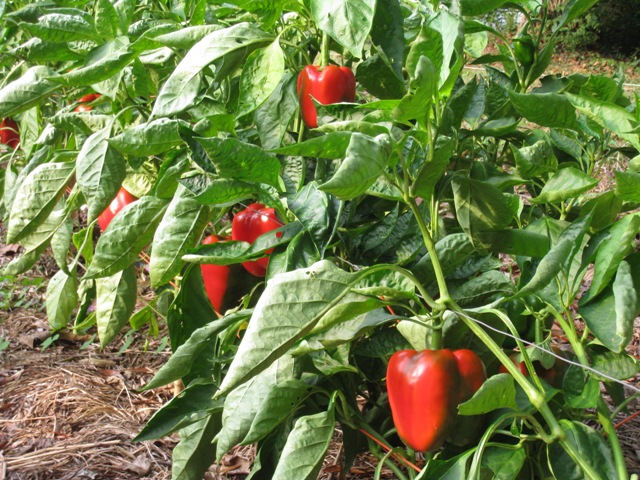
The peak of pepper season is approaching!

9/2/09 Vol. 6 #23

Whoopee!  We made it to September!  As you know we don’t usually, instantaneously, go right into fall when the calendar flips months but it sure feels that way this week.  Our farming friends in Texas are celebrating too as the temperature finally fell below 100 degrees after months above it, now if they can just get some rain, makes one realize that our summer has not been too bad.  The lowering angle of the sun and the darker mornings are the first signs that fall is really around the corner.
We have had shade cloth on the transplant greenhouse and some of the little sliding tunnels all summer to try and moderate the temperature a bit.  The lettuce we have had for the last few weeks is only possible with some shade cloth and consistent irrigation.  Likewise the celery and Brussels sprouts for Thanksgiving, that have been in the ground since late July are only really possible with the help of shade cloth (in my opinion anyway).  But now the amount of daylight is so much different than just a few weeks ago that, today, we are taking all of the shade off for the rest of the season.  Too much shade and the lettuce, in particular, gets wacky and starts to twist as it grows.  We have learned this one the hard way when we first tried to grow lettuce in the late summer and had an entire hoop house cork screw up and didn’t harvest a single head.
Soon we will be mowing down what cover crops we have and the remains of the other summer crops and begin the preparation of the soil for next years crops.  It is a slow process this dismantling of the summer farm but one that feels good as it goes along.  Tomatoes and trellises out.  Lisianthus and Celosia trellises out.  Irrigation lines taken up bed by bed as they are no longer needed.  The Big Tops uncovered, rolled and stored for another winter.  Soil amendments spread to help feed next seasons crops.  Finally by mid October it is all seeded to cover crops for the winter and another market season comes to a close for us.  Breath deep, you can smell fall just around the bend!

Picture of the Week
The lengthening morning shadows of September, celery and Brussels sprouts under shade

9/9/09 Vol. 6 #24

Look it’s 09, 09, 09 not sure what that all means but some folks think it is significant, to us it means we are in the short rows at the side of the field at the end of the season.  These last few weeks for us, as far as crops go, is all about peppers.  It is the final major crop of the season and one we have been tending for a long, long time.  There are some crops that occupy your attention during planting and growth and not really during the picking, tomatoes are that way, there is so much work in preparing to plant, planting, trellising, suckering, weekly tying up, etc. before you pick the first fruit.  Lettuce and greens on the other hand, you plant, then cultivate for weeds once maybe and then it’s all about, sometimes daily, harvesting and washing and worrying about how perishable they are.
Peppers on the other hand give you some of both, they are more leisurely.  They go in the after the crush of spring planting and are slow growers and while they do require some support they are not reckless floppers like tomatoes.  They are in the ground for so long that advance mulching is the only real weed control option and the trellis is simpler and only needs two layers, usually.  So for three months there is just the occasional foray into the pepper field until picking begins and then it starts in fits.  First a few Jalapenos, then the always eager Cubanelles and Purple bells, finally the rest join in.
Again unlike tomatoes that have to be picked twice a week just to keep them from getting too ripe, peppers have a more relaxed ripening pace and just need a once a week going through, the hot varieties every other week.  Wednesday is hot pepper day, twenty two varieties in just five one hundred foot long rows.  Takes organization and patience to keep them all separated, don’t want to mistake the incendiary Habaneros for the mild Aji Dulces.  The hot types mature so slowly that we only pick one side of the row each week, leaving the other side to get big enough to pick next week.
Colored bells are the bulk of the crop and we save those twelve, hundred foot long rows for Fridays.  Hunched over moving between the rows with five gallon buckets, we look for fully ripe bells in the dark green canopy, pulling up on the fruit to get it to let go.  When the bucket is full it’s back to the tailgate of the truck to sort.  Inevitably there are some that look ripe but when picked the back side still has some green on it.  Sorting entails four containers; full ripe, part ripe, freaks (might have a dry scar but it is sound), got-to-be-dealt-with-in-the-next-few-days (they have a wet spot that will melt down in the box if left with the others) these are the ones we freeze, for us, for the winter.  A calmer, less hurried crop, perfect to end the season with.
Picture of the Week
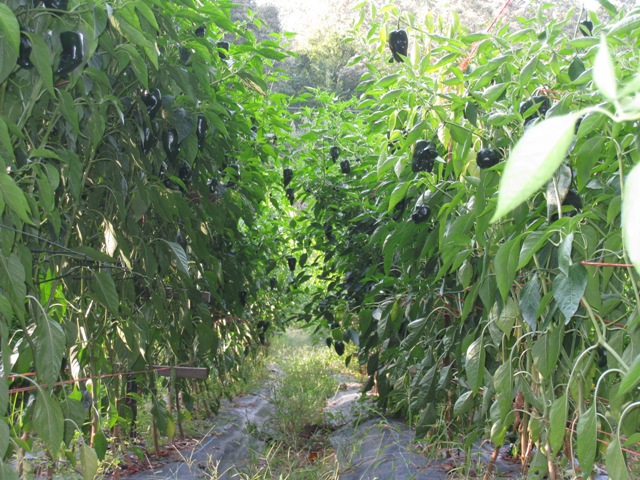
The hall of Poblanos, four layers of trellis this year as some of these plants are seven feet tall

9/16/09 Vol. 6 #25

Just returned yesterday afternoon from a teaching event in Virginia.  This was a training for “Agricultural Professionals” in organic vegetable production and marketing.  Now I have done a lot of workshops for extension agents and as my father would say “university types” but these Ag professionals were mostly Natural Resources Conservation Service, Farm Services Agency and others related to the USDA farm bill programs.  Most of my audiences are farmers growing vegetables or those Ag professionals who work directly with those growing vegetables.  These folks manage money or work with farmers to get federal program money, a carrot and stick approach to helping farmers improve their farming operations.
A very pleasant group but a difficult crowd to figure out how to talk about organic vegetable production from their point of view.  I think we were successful but the post training survey will tell the tale.  Two observations that always tickle me.  The first is if they are “ag professionals” then what do I call myself as their teacher and the one who actually makes his living from agriculture?  The second is essentially every vegetable farm in the US has never gotten any of the classic federal farm program payments as they don’t apply to vegetables.  Sure they may have gotten some money to help build a pond or something like that but not the kind of monies that most folks associate with the farm bill.  So it is hard to relate to what their jobs entail.
The reason for all of this training is just another sign of the changing of the times in agriculture.  As we as a nation and as farmers move towards a more sustainable existence then the ways we reward people for doing good things or give them incentive to do so is different than just giving them payments to make sure they can continue to make a living from farming.  Green payments based, not on how many bushels of corn you produced (or didn’t) but on how well you manage your soil or forests.  As I always say, it is an interesting time to be in agriculture, even if I am not a “professional”.
OK, on a practical note, you may remember three months ago I was agonizing over whether to get the turkeys or not, mostly because they would be arriving too late for us the get them up to size before we had planned to leave the farm for an extended period.  Since then I have talked to many of you at market about the decision.  I realized, mostly due to a recent increase in inquiries, that I have never officially announced that we will not have any turkeys this year.  I know, it is sad and will change folks Thanksgiving plans some but it just was not to be this year.  We are planting (and it all looks great) all kinds of vegetables to go with the Thanksgiving meal so you will at least have a little Peregrine Farm on the plate if not the table centerpiece.
Picture of the Week
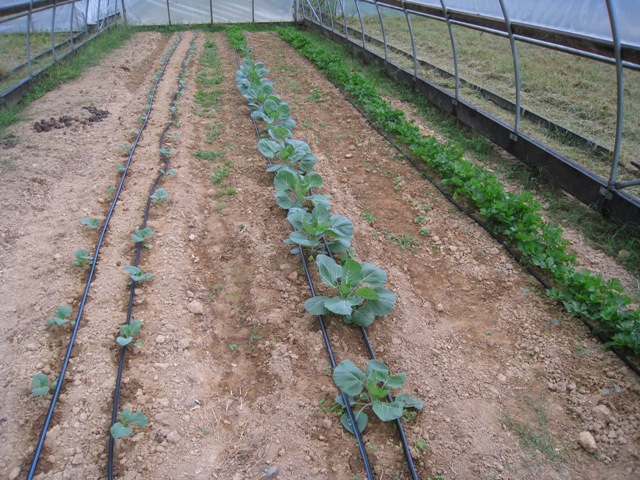
Thanksgiving fare, collards, Brussels sprouts, celery, lacinato kale

9/23/09 Vol. 6 #26

It has been one of those weeks where you just have to go with the flow, hence the newsletter a day late.  Betsy and I live a pretty quiet, paced life, really.  People would not believe it with this past weeks schedule.  As I was returning home from Virginia last week, Betsy tells me a group of Uruquayan agricultural researchers was coming the next day (Wednesday), OK fine.  In the end they went to see another farm as they had been here two years ago, also fine.  Thursday was a group of 25 Chinese civil servants, with interpreter, in the light rain, all in suits and smoking like chimneys.  They were very interested in how the government affected our lives.  How much tax do you pay?  How much does the land cost?  Can you cut down all the trees if you want too?  This is a common question from foreign visitors amazed we have all these huge trees and don’t really plan to cut them down and use them.

Friday was a film crew from UNC Public TV.  We had been having erratic conversations about them coming out to shoot for a piece to be on North Carolina Now (it is supposed to air in early December) but hadn’t heard from them in the last few days and thought maybe with the chance of rain they might not show.  As we went out to start the harvest for market there was a van and two cars, cameras at work.  All day and at market on Saturday morning they were omnipresent including when I went to cut lettuce and found the ground hog had helped himself to what was left, under the breath swearing was involved but not caught on camera.

Saturday my brother Jon, from Missouri, rolled into town on the way to the beach.  We had a family meal and then the next day they headed to the beach for a week.  We were going to go down for Monday and Tuesday but I had forgotten I was supposed to do a round table book review for the Independent on Monday afternoon.  Just Food by James McWilliams subtitled “Where Locavores get it wrong and how we can truly eat responsibly”.  He has lots of interesting points and references but in many ways missed the point on sustainable agriculture and how it works.  The review is supposed to be in the first week of Octobers issue.

Tuesday and Wednesday we just gave it up and went to the beach, sure it rained but we got to visit with family, eat a lot and take a few quality naps.  Now we are back in the saddle, with the end of the season in our sights.  This is our last Saturday market for the season.  There are tears of joy and sadness.  We are always ready to change into our off season personas but at the same time we miss seeing everyone at market.  We cannot thank all of you enough for supporting us, the market and local agriculture.  Without you we would not be able to farm the way we do, thank you.

Picture of the Week

This sums up the week, a little blurry with lots of cameras looking at us

11/19/09 Vol. 6 #27

Just a week to go until that finest of American holidays, Thanksgiving.  I think it is really the anticipation of all the great food but the food does seem to mark the entry into the “in the house” months.  That time of year when it seems right and comfortable to be inside more than out.  Long cooking sessions, a constant fire in the woodstove, catching up on a years worth of reading.
We have been busy both here on the farm and off.  The cover crops look great and that nearly five inches of rain last week finally got the creek flowing again.  We have gotten almost all of Betsy’s overwintered flowers in the ground and they look fantastic, Dutch iris, anemones, ranunculus, gloriosa daisy, larkspur and others.  With our decision not to leave the country this fall, we have been invigorated and motivated towards projects around here.  I have finally had time to finish up the rest of the exterior trim on the house and will actually start painting tomorrow!  Betsy has been working in the recreational flower beds, pruning, planting and mulching.  The glorious fall weather has made it even more enjoyable.
Away from the place we have had the usual fall meetings to attend.  Betsy made a quick trip to New York for the Cut Flower growers national meeting and we both have had plenty of local meetings to attend including a couple of very pleasant dinners with Eliot Coleman and Will Allen (who was here to speak last week).  I have even managed a few early season hiking trips including a once in a lifetime trip down the Paria river canyon in Utah.  So no we are back for the holiday season before we head off after the New Year for more events.
I just came in from harvesting carrots and leeks for next Monday night’s Panzanella Local Thanksgiving Dinner.  This farm dinner is featuring multiple farms and the menu looks really good but no turkey, just to spare us before the big day.  Here is the menu, we will be there Monday night as well.
Pictures of the Week

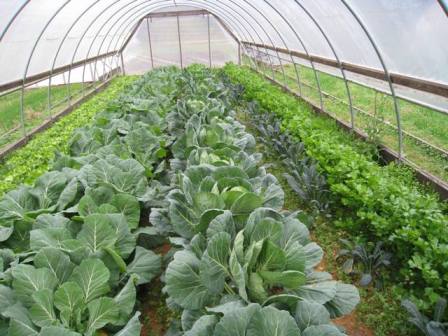
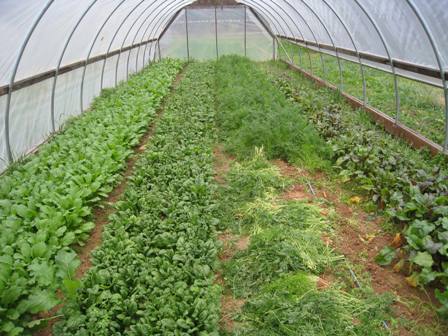
Beautiful stuff for Thanksgiving, Boston lettuce, Collards, Lacinato Kale, Celery, Turnips, Spinach, Carrots, Beets