5/2/07 Vol. 4 #7

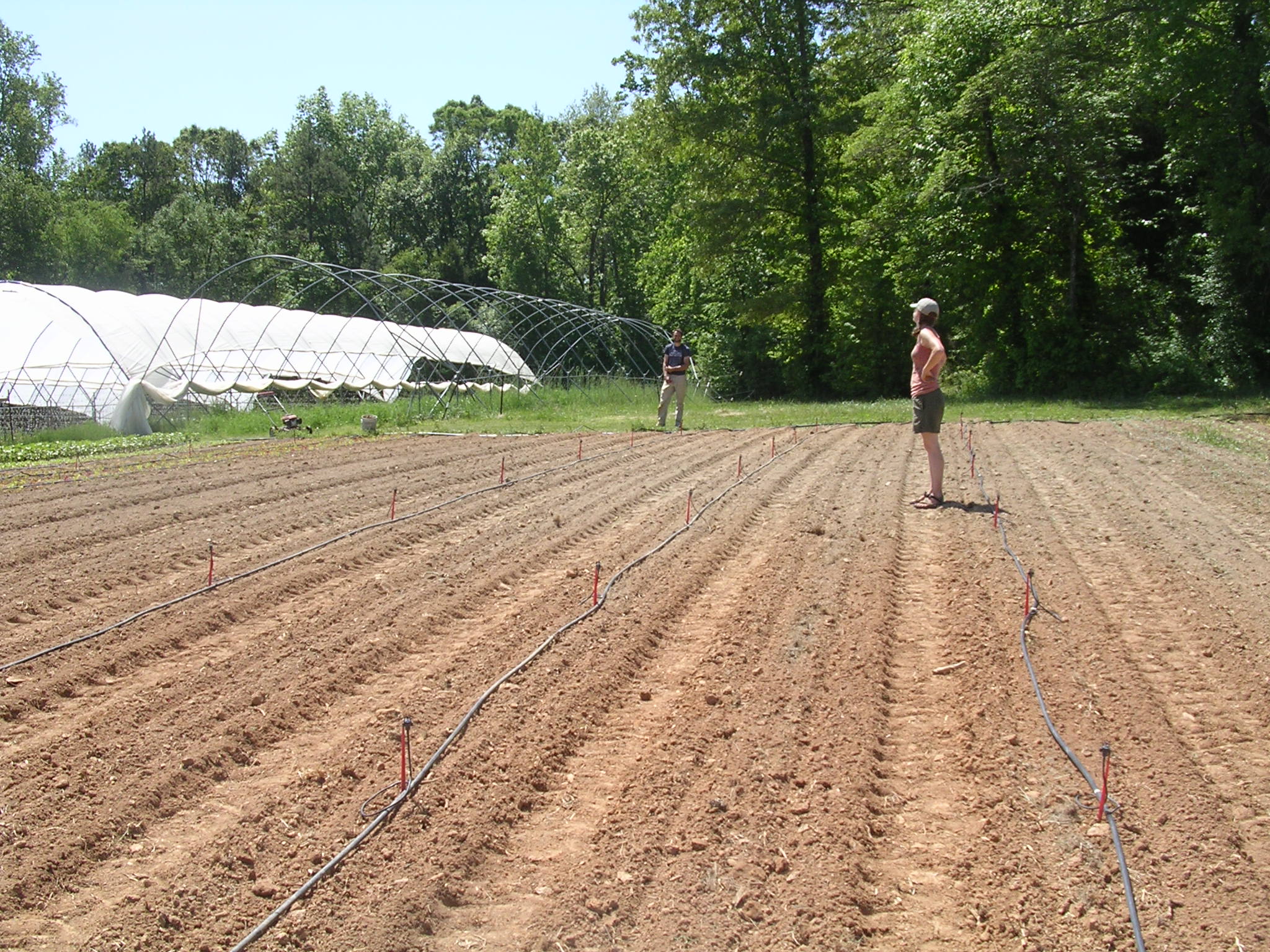
After two straight Wednesdays of early starts to cover the Big Tops I am finally back on schedule with the news from the farm.  It’s hot and getting dry, dry, dry and we are working to get enough water on everything but the newly transplanted small seedlings would really like a rain to get them established.  Our standard spring planting procedure is to plant on days just before a rain is due to arrive so everything gets a good drink of water.  The past few weeks the weather has not cooperated in that way so we move to our summer dry weather system of preparing the planting bed and then burying a drip irrigation line right down the middle of the bed.  We then plant the bed and drag a hose along to water the little plants in well and then let the buried irrigation take over.  This irrigation line is buried just a few inches deep so we can weed over it but it also makes it so the water, that slowly drips out of its openings, moves out through the soil soaking the bed and the plants roots.  That’s the theory and generally it works.  When the top few inches of the soil is as dry as it is now and a hot dry wind blows it is almost impossible to get the whole bed wet with the irrigation line.  We would have to run it for hours and hours to wet it completely and then the established plants in neighboring beds would be too wet.  So the next move, if the rains don’t come and the little plants are drying out, is to roll out the micro-sprinklers to artificially rain on them.  These little sprinklers run on low pressure like the drip irrigation lines do but can throw a fine spray up to ten feet but then we irrigate up the all the weeds too.  No easy solution other than a little rain, maybe tomorrow?

For the second year in a row we are working with NC State on an interesting research project with grafted tomatoes.  In other parts of the world with limited agricultural land and intensive plantings it can be very easy to begin to have problems with soil-borne diseases from planting the same kinds of crops in the same place year after year.  One solution is to use a disease resistant rootstock and graft the variety of vegetable you want on top of it.  Just like fruit trees where they use rootstocks to control the size of the tree and then put say a Golden Delicious on top.  In places like Korea and Japan and Israel a large percentage of their tomatoes, melons and other fruiting vegetable crops are now grafted.  Last year we/they tested two rows of tomatoes here on our farm, just out in the field, testing three different rootstocks just to see the growth and yield differences.  This year they wanted to have the research plot under the Big Tops just like the rest of our tomatoes and to use one of our usual varieties.  So we decided on testing our favorite tomato, Cherokee Purple.  We grow more Cherokee Purples than red tomatoes and so it is a very important crop for us.  Just in case they had trouble producing the grafted transplants in the lab at NC State we started a whole set ourselves so we wouldn’t be without our favorite kind, assuming we would just give those plants away if the graduate student ended up with enough plants.  Then we got nervous and decided to plant those plants anyway just in case there was other difficulties with the grafted plants, this is research after all, things can happen.  So now we have twice as many Cherokee Purples than ever before!  It could make for a very tasty July!
Picture of the Week
Setting up the micro-sprinklers to try and water up the new zinnias

7/18/07 Vol. 4 #18

An extremely pleasant meal last evening at Panzanella.  What a huge turn out, I don’t think I have ever seen the place so full.  The dishes Chris made from our produce were simple yet full of great flavors, the risotto with the sweet corn was my favorite but the pasta was also outstanding with just the right amount of Italian parsley coming through the tomato sauce.  It was good to see all of you who came out.  We drove home through a good rain so I won’t have to irrigate this morning either, what a bonus!

I was thinking about the sweet corn experiment and continue to be amazed at those farmers who consistently grow sweet corn.  We have not grown it in the past for several reasons.  First corn takes a lot of room and we just didn’t have any spare ground to put it in.  The second major reason is that you just don’t make the money per foot of row that we feel you need to make on a farm as intensive as ours, even at 50 cents an ear much less the old days when it was two dollars a dozen.  We use a rough rule of thumb that we need to gross $200 a bed (that is a planting strip 4′ X 100′) or the crop probably isn’t carrying it’s weight here on the farm.  In theory you have a corn plant every eight inches in the row, with two rows per bed, that is 300 plants per bed and, usually, you get one ear per plant so at 50 cents an ear that is $150 a bed.  That is in theory though, before the ones that don’t pollinate well, the corn ear worms, the Japanese beetles, and finally the raccoons that seem to be able to levitate over the electric fence and help themselves to all of the perfect ears that are just now full and ripe.  With this last planting we pulled about 80 ears a bed, $40 hmmm…  But corn at least is fairly easy to grow in some aspects as it is a large vigorous plant once you get it germinated and past the crows who love to pull up the tiny seedlings.  One good cultivation and as long it rains, it takes care of itself until picking time, no transplanting, no pruning, or trellising.  The good corn growers of course do it on a large scale, with tractors, so their labor is minimal until picking time.  Then to have a consistent supply requires planting every ten days or so.  So my hat’s off to those corn growers at market who have corn for weeks at a time.  We will continue to mess around with the corn experiment, for a while anyway, it is so good when it does behave, and it gives me something else to tinker with.

Picture of the Week
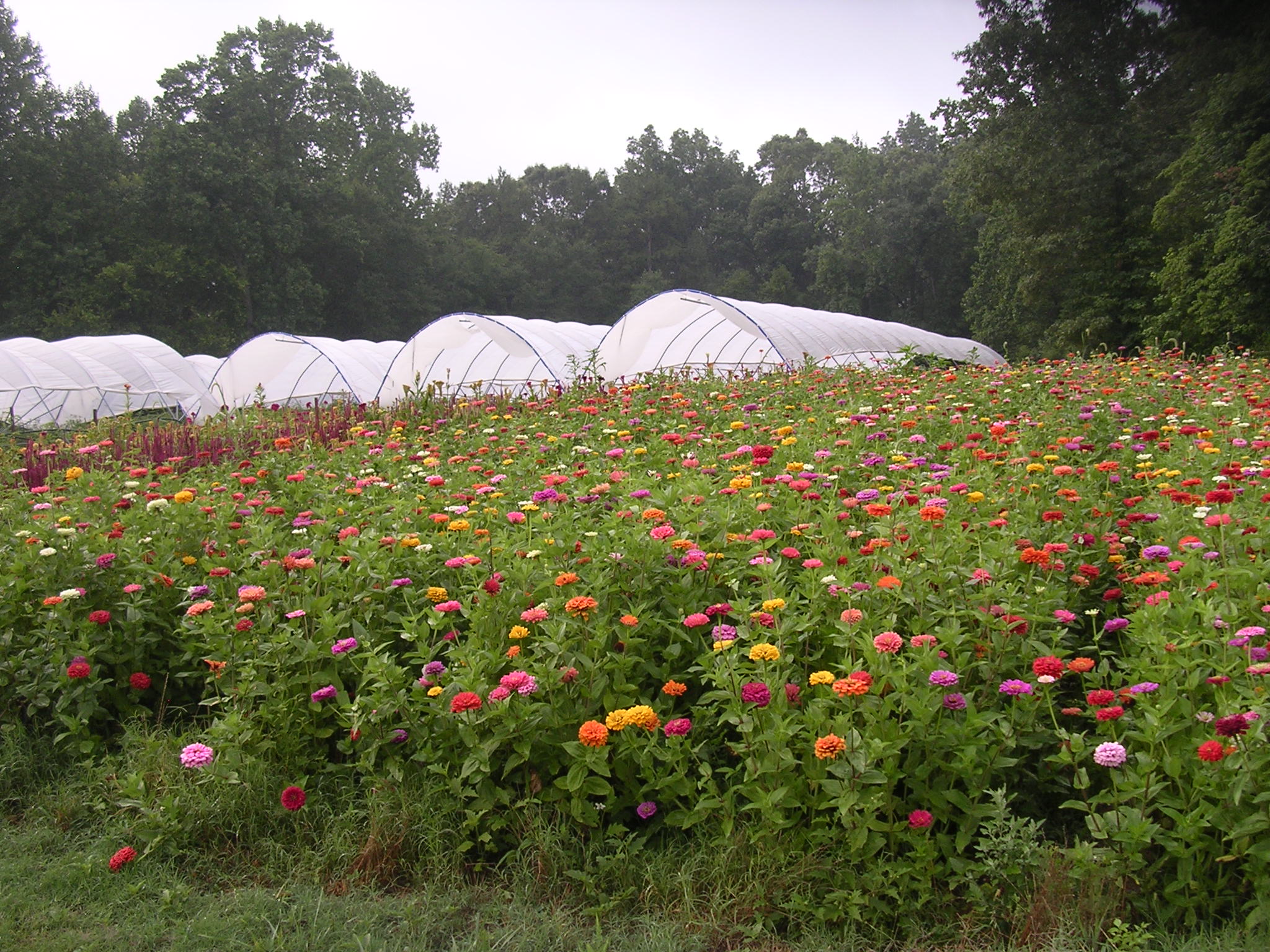
Brilliant Zinnias in front of the Big Tops

4/8/08 Vol. 5 #4

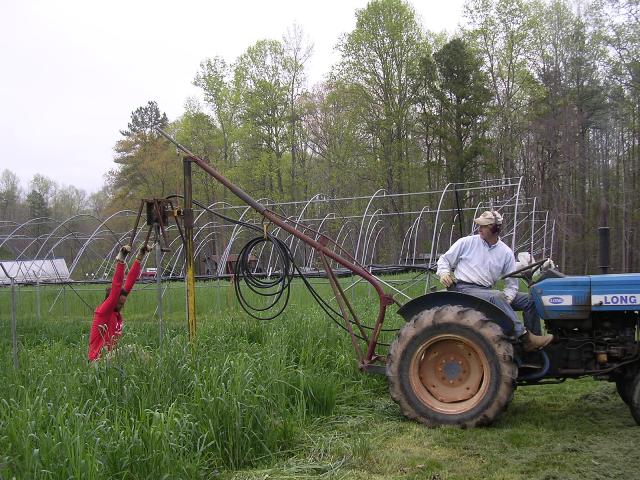
OK so the rain has officially put us behind as far as field work is concerned.  Plants are backing up in the greenhouse and hopefully we will get them all in Thursday and Friday.  We also really need to get some cover crops turned under so they can decompose in time for us to plant the cash crops that will need their nutrients to grow.  The scariest thing is the main planting of tomatoes is to be planted in two weeks and we have to get the Big Tops built over the field they are going into, and fast!  The most difficult part of the process is drilling the legs into the ground.  They go in, or are supposed to go in, thirty inches deep.  You till a field for a quarter of a century and you think you know where all the rocks are but it turns out that you only know where the rocks are in the top twelve inches, there are parts of the planet down there that you can only hope you miss.  We started with the legs yesterday and so far not too bad, 15% have hit rocks we couldn’t work around.  We knew this field would be a trial and feel if it stays about the same we will be fine.  Big rocks mean we have to get a BIG jackhammer to bust them up.  We will drill or attempt to drill in all 95 legs and anchors first and then go rent the jackhammer and finish up the troublesome holes all in one day.  If we can get the rest of the legs in today then we can quickly finish it up early next week.  Let’s hope, because tomatoes wait for no one!

The rest of the water pumping went well last week and now both ponds are essentially full.  Lets hope they stay that way and the only use for that water will be to swim in this summer when it’s hot!  Things are really greening up fast now and with all this rain and warm temperatures it will all move really quickly, crops and weeds.  We need to get the last of the lettuces in the ground as well as seeding of the last spinach, and radishes.  Believe it or not we need to seed the first Zinnias and plant the first Celosias too.  Betsy even started mowing this week, you know that the last frost date is approaching when the first summer crops go in and the weedeater comes out!

Picture of the Week
Cov hanging on for dear life while we drill in legs for the Big Tops

4/16/08 Vol. 5 #5

Welcome to last frost/freeze day!  28 degrees this morning and by the look of the forecast this should be the last night below freezing this spring (don’t borrow money based on this prediction).  In Chapel Hill most folks use April 15th (April 11th is the official date at the RDU airport) as the average last frost date but out here along the Haw river we are always three to five degrees colder and I use April 21st as our safe date. We’ve had too many close calls in the early years, sleepless nights worrying about tender plants.  Polar Cap Farms we call it in the spring, our staff always complains about how much colder it is out here in the mornings as compared to their houses in town.  Now it’s safe to plant the tomatoes outdoors.  It’s not that we are risk averse, hell we’re farmers after all, but we just don’t roll the dice the way we used to in the past.  I guess it’s the benefit of having weathered so many growing seasons, might as well not fight it and just wait until it’s right for the tomatoes needs, not our calendars.

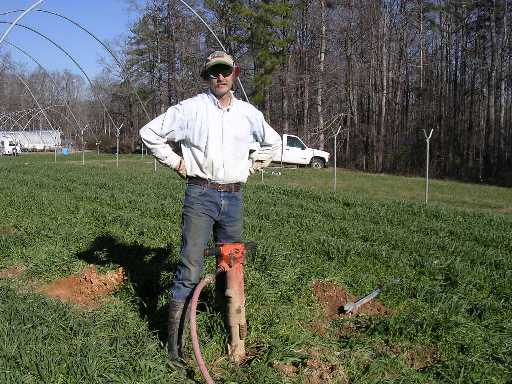
The construction of the Big Tops is going well.  We did get all the legs screwed into the ground last week except a dozen.  Monday we rented the BIG jackhammer and busted up the parts of the planet that stood in the way.  Having done this before, I was not looking forward to it but it actually went well and only took a morning to do.  This years staff, Cov and Dan, had never had the pleasure of running such a beast so after I worked the first six holes I turned the last six over to them.  They started the morning in their early 30’s and ended it in their late 30’s.  So now the legs and anchors are all in and most of the attendant braces.  By the end of today the frame should all be finished and maybe we can pull the plastic over by the end of the week.  Right on schedule to get the tomatoes planted early next week, whew!  Late last week we turned our attentions to getting caught up on planting and managed to get almost all the backed up plants into the ground.  We even got a little rain to help water them in but I am afraid I will have to get the irrigation set up this week too.  Why does it happen all at the same time?

Farm Tour this weekend, Saturday and Sunday, 1:00-6:00 each day (who added an additional hour?).  Our annual opening of the doors to the general public to come see the farm.  Many of you have been on the Farm Tour before and it is a great opportunity to see many of the folks who sell at the Carrboro Market.  Now in it’s thirteenth year, thousands of people go on the tour and it raises thousands of dollars for the work Carolina Farm Stewardship Association does.  Sponsored by Weaver Street Market, who does an incredible amount of work to promote the tour and local agriculture, it is easy to go on the tour.  Just pick up a map at the Carrboro Farmers’ Market or Weaver St. Market or many other local businesses and go to first farm that you want to see.  The best deal is to buy a button ($30) which will be your pass for as many people as you can stuff into one vehicle, for as many farms as you want.  35 farms this year so you will have to choose, it is hard to do more than 3 maybe 4 farms in a day.  In the mean time we will be mowing and picking up around the place, nothing like have hundreds of house guests all at once to make you buff up the joint!  Come on out and see what we have been up to, the weather looks to be a bit mixed but it goes on rain or shine!

Picture of the Week
As they say, this is a “file” photo from the last time but you get the idea

4/23/08 Vol. 5 #6

The Farm Tour weekend went beautifully but not without some excitement!  Saturday was it’s usual long day, up before 5:00 a.m. to go to market and then rushing home to throw the gates open for the visitors.  The afternoon was warm but pleasant and it was great to have time to visit with everyone.  Sunday was cooler and overcast to start but the folks came on anyway.  About 4:00 p.m. the sky looked very threatening and Betsy reported the radar showed a nasty line of storms coming at us.  Sure enough it pounded down for about a half an hour and then continued to rain for another half an hour or so.  Betsy and I were pinned down in the transplant greenhouse with some folks and our worst nightmare began, HAIL.  For about five minutes pea sized hail and larger came down.  I scampered out, as the lightning flashed, and rolled down the cold frame cover over the hundreds of tomato transplants and protected them.  Now we waited helplessly as we knew the potential damage that could be happening, a quarter acre of lettuce flashed through my mind, all of Betsy’s early season flowers.  In the end all looked not too worse for wear.  The lettuce does have some holes in the leaves from the hail stones but everything else looks fine.  Produce with a story Betsy says.

In our early years, 1984 or ’85, we had a tremendous storm come through in May.  All of our neighbors crops were hit hard.  Corn was blown down, tomatoes stripped of all their leaves, greens turned to paste by the hail.  We were in the blackberry business then and the new canes were growing vigorously at that time of year.  Even though they were up to five feet tall, they were still tender like an asparagus stalk.  The hail stones were big and hit with such force that many canes were broken off and others looked like we had beaten them with sticks.  Every one that was broken then sent out side shoots to compensate and those side shoots could grow up to 30 feet in a season!  All summer we worked to prune and manage those two acres of blackberries onto the trellises, trying to make a frame work that would make the next years harvest as easy as possible.  In the end it all turned out fine but the memory of that hail still haunts us to this day.

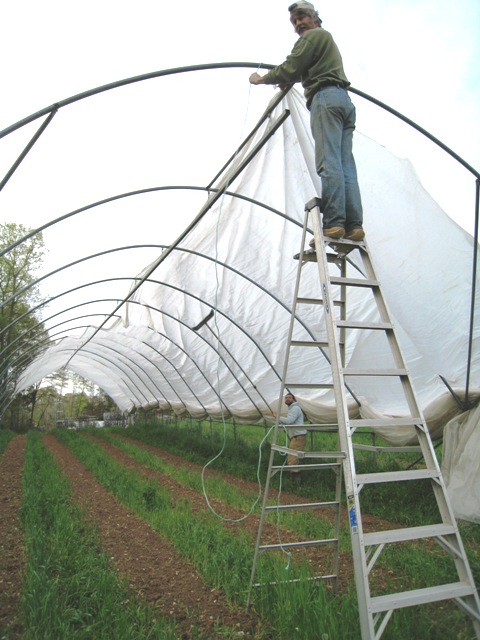
Busy week as we are still trying to catch up from Big Top construction.  The tomato Big Tops are done and covered!  This morning we have to cover two more bays, one for Betsy’s lisianthus and the other where NC State is planting their research tomatoes, tomorrow!  This afternoon the staff will be building the 1200 feet of trellis to hold up all the tomatoes.  Hopefully by tomorrow we can begin to tuck all the tomato plants into there respective beds.  The rains and warm temperatures really made things jump this week.  We did set up irrigation in the spring vegetables and the lettuce last week as they really needed it but the rains have really brought everything else around.  We moved up the thousands of pepper seedlings yesterday, a perfect overcast day to do it as it reduces the stress to the little plants as they work to send out roots into the new soil surrounding them.

Picture of the Week
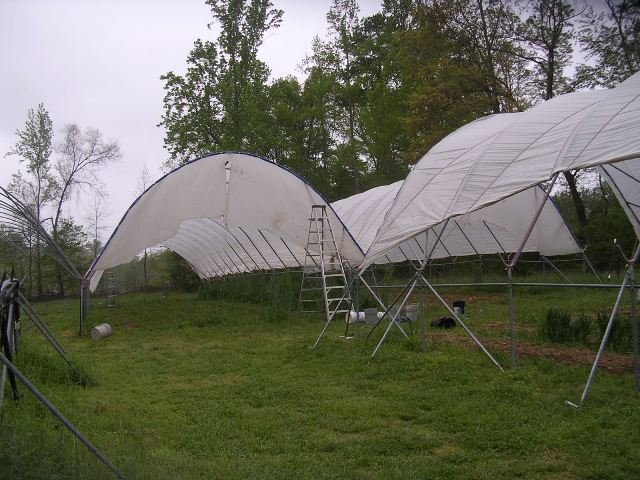
Just covered Big Tops with the ladder still in place

4/15/09 Vol. 6 #4

Today we are supposed to begin pulling the plastic over the Big Tops, the giant greenhouse structures that we grow tomatoes and some flowers under.  As I sit here looking out the window I can see a slight breeze in the tops of the trees which may mean no covering this morning.  30 by 100 foot sheets of plastic make great sails and any breeze gets exciting when you think you could be carried across the river unless you let go.  The Big Tops cannot take a snow load so we uncover them every fall, this also allows us to grow the important soil improving cover crops and recharge the soil with rainfall.  We wait until as late as we can to cover them so we can get all the natural water into the soil possible before we have to start irrigating.

This is all part of the inexorable march toward planting the main crop of tomatoes.  The cover crop of wheat and crimson clover was turned under a month ago to give it time to decompose and begin to release its nutrients for the tomatoes to use.  Last Friday we tilled the beds again, almost ready to cover with landscape fabric and build trellis but first we must pull the plastic roofs over as it is too hard to do with all the tomato trellises in the way.  Once covered we can proceed with these preparations so that sometime next week we can tuck the plants into the ground.  Timed to make sure we are after the last danger of frost, the transplants have been “in the system” for five weeks so that when they are planted they are at the best stage of growth so they can just take off without a pause.  The first sungolds six weeks later, if the wind will hold off.

With all of this rainy weather it is getting difficult to keep the guys busy but we keep having enough dry days to keep on schedule with planting.  This week more lettuce and spinach and flowers made it into the ground.  The pea trellises went up too.  The big spring clean up push began with brush burning, all of the limbs that fall in the winter plus various prunings of the perennial plantings.  Not only do we have to get ready to plant tomatoes but next week is the Farm Tour so we have to get buffed up for that too, lots to do.

Picture of the Week
We were successful in getting the tomato Big Tops covered!

6/17/09 Vol. 6 #13

Rain, rain, rain, rain, rain.  Good thing we had a rain day yesterday as we are all just now recovering from the Farm to Fork picnic on Sunday.  It looked like a good time was had by all despite the heat.  Not so hot that you just stood there panting but definitely the sweat was running down my brow.  70 plus farmers and chefs cooked and served up an amazing array of small bites from every kind of vegetable pickle to collard green kimchi and barbecued shrimp with bloody Mary sauce to cabrito tacos with heritage corn tortillas.  A pre-event estimate of 650 people were signed up to attend, including the farmers and chefs, not sure if they all showed but a nice chunk of money was raised for the new farmer programs at the Breeze Farm and the Center for Environmental Farming Systems.

We had fun, as always, working with Amy Tornquist and Glenn Lozuke from Watts Grocery and Sage and Swift Catering.  We presented a beautiful trifecta of Treviso radicchio leaves with a small piece of Glenn’s house made pancetta topped with some of the first tomatoes of the season; a colorful hand held bitter, salty, sweet salad.  Glenn had boned out an entire pig, stuffed it with herbs and hot roasted it, all night, in a traditional porchetta style and it was amazing.  The third part of the trifecta was a lemon ice cream with a blueberry swirl in tiny little corn meal cones, each with a blueberry in the bottom.

Back here in farm land the rain is holding us up from getting things done.  Blueberry picking was canceled for yesterday and I hope we can get a full morning in today.  We began the onion harvest on Monday but it is too wet to continue until maybe Thursday, it is bad to harvest them when wet and muddy, too much danger of ending up with rotting onions later.  We need to cover the last of the Big Tops this week so we can plant the late tomatoes, the transplants of which are really ready to get into the ground.  Looks like we will blast into summer on Friday when it goes straight to the high 90’s, that’ll dry it out for sure!

Picture of the Week
Pig with snout on the left, radicchio salads in the middle, tiny little ice cream cones on the right.

7/1/09 Vol. 6 #15

We have made it to July and the heart of tomato season is upon us.  We pick tomatoes twice a week, slowly going up and down the rows hunched over coaxing the now knee height fruit from the vines that are currently nearing six feet tall.  Both the very early rows in the little sliding tunnels and the main planting in the Big Tops are all giving us fruit from the nineteen varieties we have this year.  But not all is well in tomato land, we have a silent thief which will ultimately steal many of the heirloom varieties we all love.  It has been four years since we had tomatoes in this Big Top location and we had forgotten that the same thief visited us then as well, but that year we thought it was an aberration, never having had this kind of problem before.

Fusarium Wilt is the culprit and there is nothing we can do about it, at least for this year.  It is a soil borne fungus that can live in the soil for years and attacks only tomatoes.  Most of the hybrid tomatoes are bred for resistance to it and if you have looked for tomatoes in a seed catalog and seen abbreviations next to a variety description like V, F, N the F is for fusarium resistance.  The heirlooms are generally not resistant to it but some are or partly are and that is what we are seeing in the field this year.  The yellowing and wilting doesn’t become apparent until hot weather arrives so if there is a silver lining, it is that the plants grew large and set some fruit before it showed up.  The bad news is we will have a very short season for some varieties.

The most affected are the high acid yellow Azoychka and the huge, fruity, red and yellow Striped Germans.  Next are the green when ripe Aunt Ruby’s German Green and the Green Zebras, they won’t give us much fruit at all.  Showing signs but still producing fine are the pink German Johnsons and the beautiful yellow Kellogg’s Breakfast.  Fortunately our favorite, the Cherokee Purple, appears to be resistant.  All of the red varieties are hybrids and mostly look great except for the Italian Oxhearts that we introduced here three years ago.  So enjoy them while we can, there will be tomatoes all season long but less variety as time goes on as the different kinds succumb to the thief.

Picture of the Week
Resistant healthy hybrids on either side of the yellowing German Johnsons