8/2/06 Vol. 3 #21

Just when you are at your weakest they always pour it on!  Last weeks weather was bad but this week is just grinding it in.  Good thing we are going on break next week to recover.  After 21 straight weeks at market we are crawling into the mid summer break, and this heat just reinforces why we take it.  We have taken the second week in August off for years now, as a way to get some recharge for the end of the harvest and marketing season.  It is planned for when the first tomatoes crash and before the colored bell peppers really get going.  Now I always refer to it as a “break” and not a vacation because Betsy and I don’t really get to check out.  We give the staff the week off with pay and they usually leave town.  That leaves us here to water, and irrigate, keep and eye on the turkeys, pick a little bit of stuff that has to be harvested, etc.  The break is in not going to markets and doing regular deliveries.  We usually do a few hours of chores in the cool of the morning and then find some kind of diversion in the afternoons, eat a lot, take naps, read and other general sloth.  To that end there will be no newsletter next week and we will not be at market Wednesday 8/9 and Saturday 8/12.

In preparation for all of this we have been mowing old crops down and generally tidying up the place.  Earlier in the year, when I wasn’t thinking clearly, we agreed to have an open house for the company who manufactures the Big Tops (Haygrove).  Well it is today!  Hottest day of the year!  We have tried to gussie up the joint as much as we can but what they really want to see is how well crops do growing under the covers.  Well on top of it being time for the tomatoes to expire we also have those unusual diseases in them as well so it is not exactly a beauty pageant in the tomatoes.  We are so tired and it is so hot that it is hard to muster enthusiasm for having a group of folks here this afternoon, maybe the 100 degree forecast will limit the crowd, only the truly insane will come out to look at the tunnels and with the sweat running down into their eyes maybe they will think it all looks great!  Now the stuff that they don’t want to look at does look good.  The late flowers are doing really well in this heat and the peppers look respectable along with the limelight hydrangeas.  It is so hot that the turnips, radishes and other crops that we need to plant this week will have to wait until early next week to go in so that they don’t just vaporize in the hot soil.

Picture of the Week
Celosias and Asclepias and the proper distance for viewing the quality of the crops in the Big Tops

3/23/07 Vol. 4 #1

Oh my!  The first market is tomorrow!  Every fall I say I will put out a newsletter once a month to keep you all up to date on our off season antics and somewhere in December I get distracted and drop the ball.  That usually means we are so busy doing off-farm things, that when we are here, it is difficult to find time to get a newsletter out.  This winter has been just such a time.

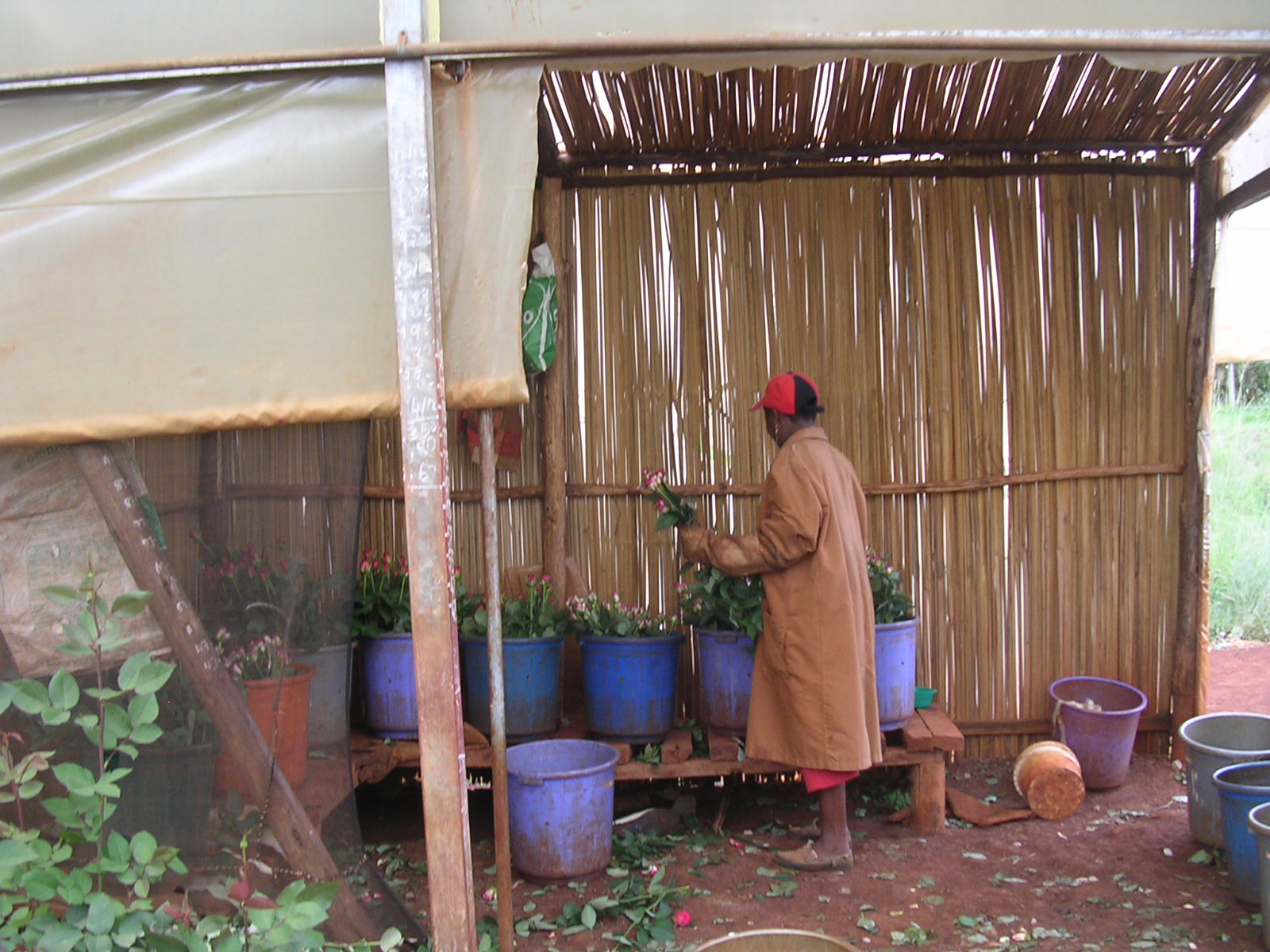
Betsy’s trip to Kenya, in December, to look at the cut flower industry there was thought provoking.  Some of the largest cut flower farms in the world, including the largest rose farm, are clustered around Lake Naivasha, northwest of Nairobi.  Primarily run by Europeans they were big, but not with the infrastructure or the diversity we have found on farms in Europe.  Primarily for export, they concentrate on a few crops and use a lot of hand labor in sometimes very rudimentary facilities.
Kenyan post harvest facility

The fact that they paid their help $1.50 a day was appalling to Betsy.  When she was in Ecuador a few years ago they also used a lot of local labor but treated them very well.  At the end of their trip they toured the Rift Valley and the Central Highlands around Mt. Kenya, with a guide, and saw many amazing natural things.

The unusual warmth of January threw us off our usual deep winter pattern of time in the house reading and doing desk related tasks.  We knew it was too early to plant in the fields even though it was very tempting.  Between meetings we puttered around on various small projects including, of course, getting seedlings started in the greenhouse.  Early in the month I was the keynote speaker at a sustainable ag conference in Maryland, a good group that I had not experienced before.  The end of January Betsy and I both went to Louisville, KY for the Southern Sustainable Agriculture Working Group (SSAWG) conference.  This is one of the best farming conferences in the country and the best in the south.  Over 1200 attendees made for a very active time.  I presented at several workshops including giving a day long short course on organic vegetable production.

We came home, ready to get to work in the fields and the weather decided to change to winter.  That threw us off balance again as we held back on planting some crops out into the fields until it warmed up a bit.  The extended cold weather and dry conditions also made it hard to get soil prepared in a timely manner as the cover crops that we depend on so much for soil improvement grew larger than normal in the warm early winter and then wouldn’t decompose when turned into the dry cool soil.  We would turn them under a month in advance, as usual, and then a month later on planting day till the bed again to prepare for seeding and they looked like we had just turned them under the day before.  In the end all the early crops look pretty good just behind where they were at this time last year.  The rest of the leviathan rolls forward as always.  The sliding tunnels are all moved as of yesterday and the first tomatoes go in the ground on Monday.  The huge array of tomatoes and peppers have been seeded in the greenhouse and are beginning to come up, 22 varieties of toms and 25 of pepper this year!

On a sad note we lost a dear friend last week just as market is ready to start again.  Faye Pickard passed away unexpectedly.  Miss Faye as we called her (and that was her email address too) has been one of our diehard regulars since our first market in 1986.  One of the early shoppers (you know who you are, there before 8:30) on Saturdays she always was there unless she was off to be with her grand kids.  She loved Cherokee Purple tomatoes the most and we always saved the first ones for her, sometimes even before we had a chance to eat one!  As a true southern lady she grew up eating out of the garden and was determined to introduce her kids and grand kids to the pleasures of eating good fresh food.  She had succeeded as she would tell us stories of her kids asking her to bring tomatoes from the market or the grand kids eating cucumbers right out of the bag as she would come in the door!  I try to impress upon audiences when I speak about markets that it is more than just selling your products, it is really about the relationships you build with your customers, they become a part of your farm too.  Miss Faye was certainly a part of ours.

Picture of the Week
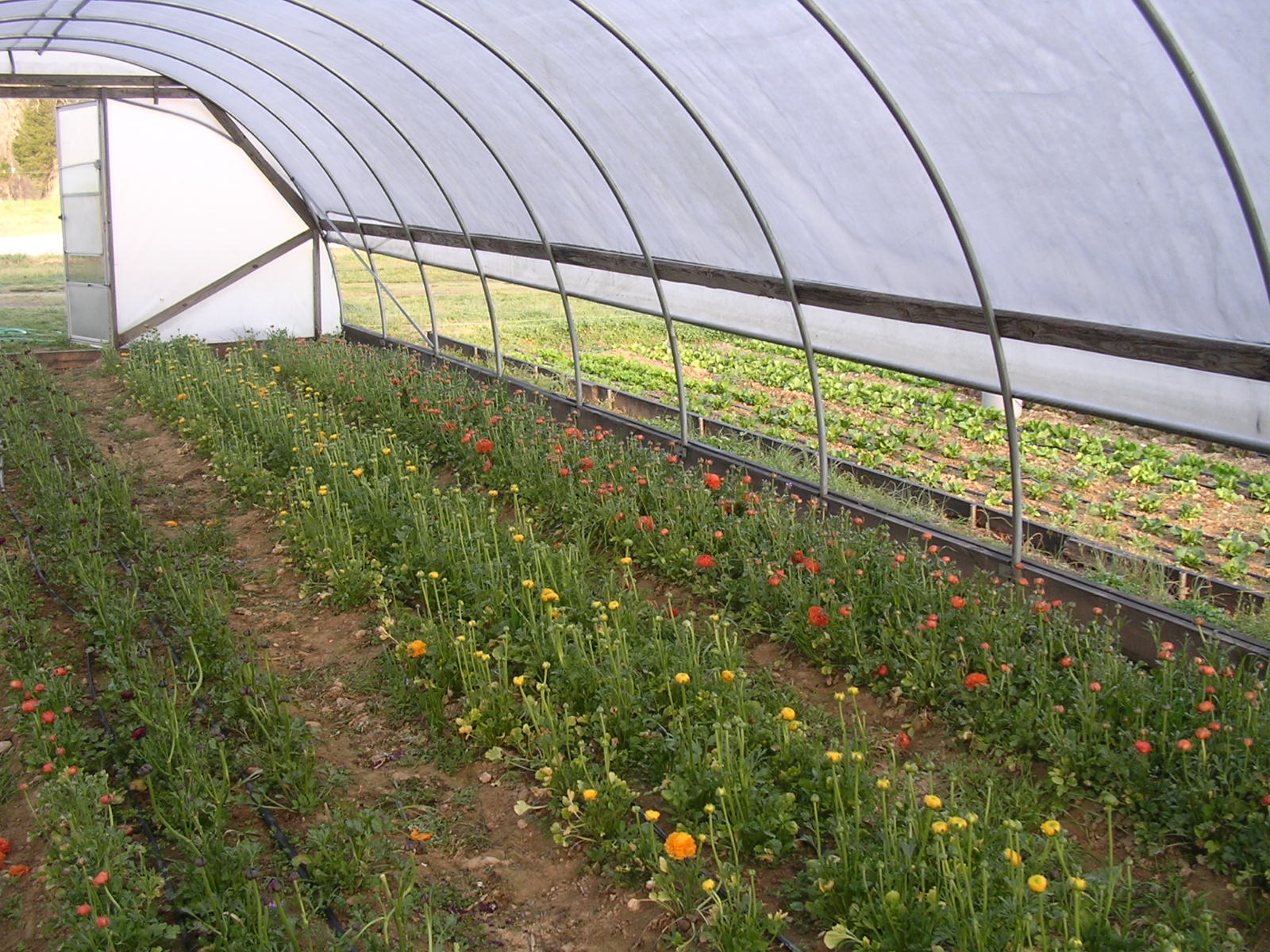
Italian Ranunculus inside one of the sliding tunnels with Lettuce outside

7/18/07 Vol. 4 #18

An extremely pleasant meal last evening at Panzanella.  What a huge turn out, I don’t think I have ever seen the place so full.  The dishes Chris made from our produce were simple yet full of great flavors, the risotto with the sweet corn was my favorite but the pasta was also outstanding with just the right amount of Italian parsley coming through the tomato sauce.  It was good to see all of you who came out.  We drove home through a good rain so I won’t have to irrigate this morning either, what a bonus!

I was thinking about the sweet corn experiment and continue to be amazed at those farmers who consistently grow sweet corn.  We have not grown it in the past for several reasons.  First corn takes a lot of room and we just didn’t have any spare ground to put it in.  The second major reason is that you just don’t make the money per foot of row that we feel you need to make on a farm as intensive as ours, even at 50 cents an ear much less the old days when it was two dollars a dozen.  We use a rough rule of thumb that we need to gross $200 a bed (that is a planting strip 4′ X 100′) or the crop probably isn’t carrying it’s weight here on the farm.  In theory you have a corn plant every eight inches in the row, with two rows per bed, that is 300 plants per bed and, usually, you get one ear per plant so at 50 cents an ear that is $150 a bed.  That is in theory though, before the ones that don’t pollinate well, the corn ear worms, the Japanese beetles, and finally the raccoons that seem to be able to levitate over the electric fence and help themselves to all of the perfect ears that are just now full and ripe.  With this last planting we pulled about 80 ears a bed, $40 hmmm…  But corn at least is fairly easy to grow in some aspects as it is a large vigorous plant once you get it germinated and past the crows who love to pull up the tiny seedlings.  One good cultivation and as long it rains, it takes care of itself until picking time, no transplanting, no pruning, or trellising.  The good corn growers of course do it on a large scale, with tractors, so their labor is minimal until picking time.  Then to have a consistent supply requires planting every ten days or so.  So my hat’s off to those corn growers at market who have corn for weeks at a time.  We will continue to mess around with the corn experiment, for a while anyway, it is so good when it does behave, and it gives me something else to tinker with.

Picture of the Week
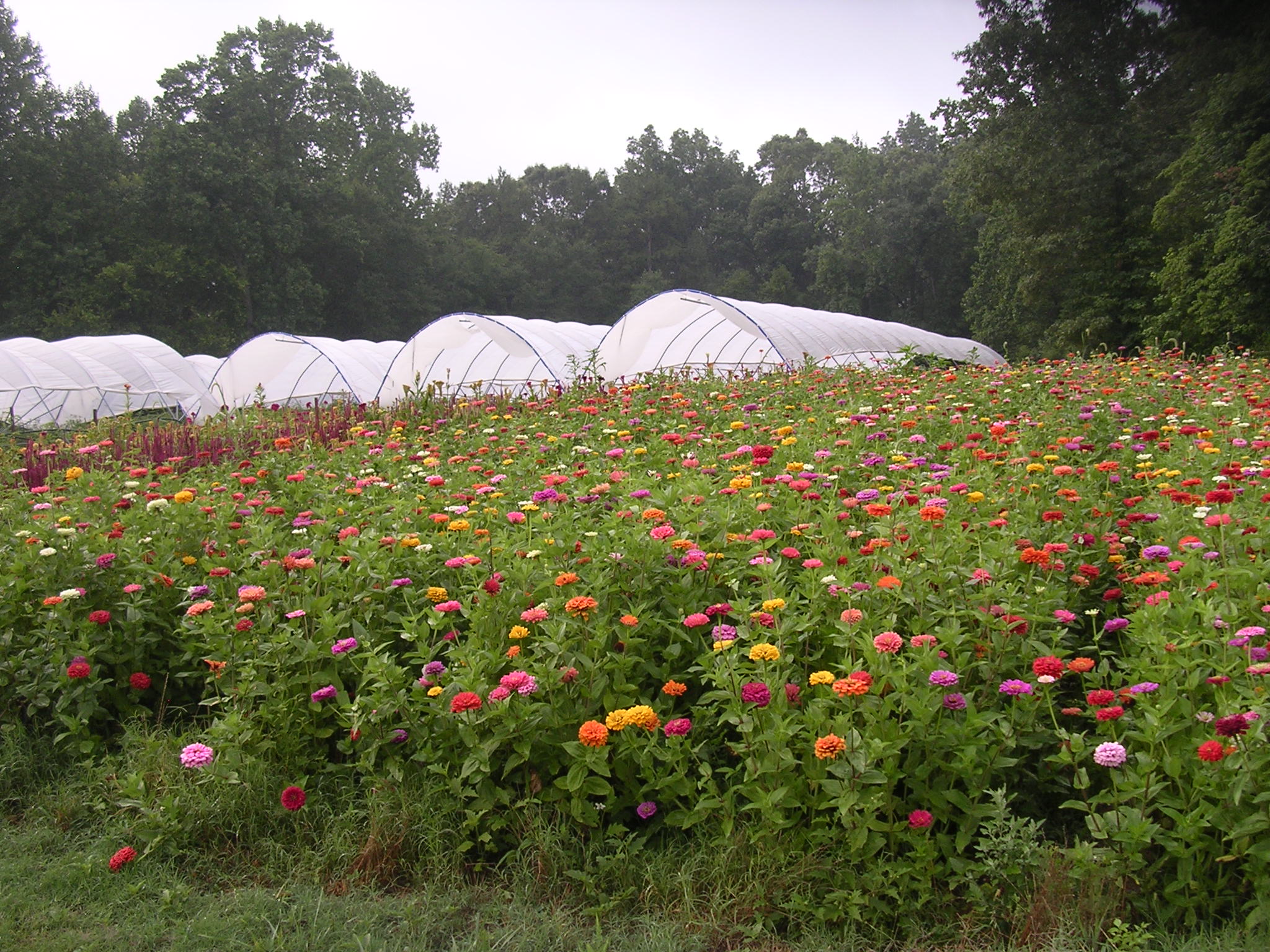
Brilliant Zinnias in front of the Big Tops

8/1/07 Vol. 4 #20

We made it to August!  To me August always signals fall and the end of the season.  Yes it is still hot and sometimes it is a very wet month with thunderstorms but the lushness of early summer is gone and the farm begins to look tired after months of full production.  The tomatoes have given us their best and Betsy is into the third planting of zinnias as the first two look shabby as the diseases and insects gain the upper hand.  Even the weeds begin to mark the end of their run with big old seed heads and yellowing leaves, if we have let them get to that stage.  After 20 straight weeks at market, we are feeling shabby too so it is time for the summer break.  We will be at the markets this week and then will miss the markets on the 8th and 11th.  No newsletter either as we will be hiding somewhere cool with minimal human contact!  I know many of you will be taking a last bit of time off too before school and other fall things start the end of the month.

I have been thinking a lot this week about last Wednesdays radio show “The State of Things” on WUNC.  If you heard it you know they came to the market and recorded a piece on the Tomato Tasting event that the market held on the 21st of July.  It was a fairly interesting piece and they did a pretty good job of getting the feel of what the Tomato Tasting is like but there was one thing that got many of us market members hackles up and that was the comments about how food at Farmers’ Markets is expensive.  Excuse me, but IT’S NOT!  It used to be that prices at markets were ridiculously cheap and as I speak around the country to farmers I always say “Who ever started the concept that Farmers’ Markets are the place to buy cheap produce I want to grab them by the neck!”  Why would fresher, better tasting food, grown in better way, many varieties which you can’t find anywhere else be priced low?  Now the misunderstanding has swung the other way and I hear these “experts” say shopping at Farmers’ Market is expensive.  I want to grab them by the neck too.  Now I know there are exceptions to everything and some markets around the country are more expensive but by and large they are retail affairs with prices generally the same or cheaper than the grocery store.  I know for us at Peregrine Farm our vegetable prices are right in line with the local groceries because I check on a weekly basis.  The cheapest red tomato at Food Lion has not been below $2.29 this year and almost all of their tomatoes are $3.00 and up.  Food Lion!  Don’t even get me started on what they taste like.  Makes our delicious red tomatoes at $2.50 seem like a bargain not to mention all of our different heirlooms.  Same with lettuce and on and on.  With Betsy’s incredible flowers, that you can’t even get unless you work with a really good florist, it is even worse, our prices are wholesale- what the florist would pay before they charge the public at least twice as much.  Of course you all know that the Farmers’ Market is much more than just a place to buy and sell things, it is the town square where we all slow down and get to see and visit each other, let the kids run around and get some really beautiful food and flowers to enrich our lives even further.  That is worth a lot too and makes those incredibly flavorful sungold tomatoes seem really inexpensive!

Picture of the Week
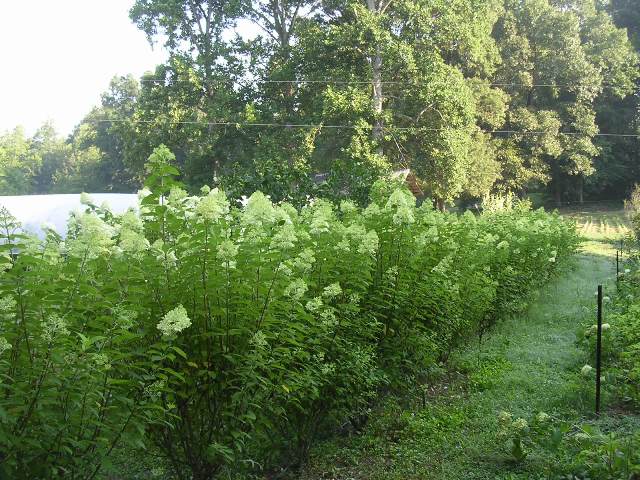
Limelight Hydrangeas

5/7/08 Vol. 5 #8

What a great day it was last Saturday.  The celebration of the 30th season of the Carrboro Farmers’ Market brought out a huge crowd to enjoy the festivities and shop.  I know that there had to have been ten thousand of those raffle coupons handed out to all the shoppers.  We enjoy such great support both from all of you who come to market but also all of the surrounding businesses that donated for the raffles.  And a big thank you to Sarah Blacklin (our market manager) and all of the volunteers who helped put it on.  This is what the market founders envisioned all those years ago when they stated the goals of the market to be (from the By-Laws)  “The goal of the corporation is to operate farmers’ markets in the Chapel Hill-Carrboro area which serve the dual purpose of providing (1) a direct retail outlet for local farmers thereby promoting local agriculture, and (2) an alternative buying arrangement for consumers where high quality fresh products are available at reasonable prices in an atmosphere conducive to the exchange of information and ideas between the original producer and the consumer.” and the town of Carrboro wanted to bring more people into downtown to help keep it vibrant and working.  I would say that all of that has happened and more.

I rarely talk about “the seamy underbelly of the market” as we want most people to have the feeling that we all just happen to show up on Saturdays, Wednesdays and Thursdays and what a wonderful coincidence it is.  Yeah sure there are always glitches along the way, issues between vendors, between the market and the town and surrounding businesses, sometimes it’s difficult to park but we all have worked together to solve those problems so we can enjoy the benefits.  It’s called community.  As members of the market for 23 seasons now we are extremely proud and defensive of the market and it’s organization.  It has been a model for many of the markets in North Carolina and around the country too.  It is unusual for a market to be farmer run and farmer controlled, it takes a lot of time to run such a large organization when you have to farm as well.  I tell folks that it is as close to democracy as you can get when 80 plus individual businesses come together to agree on how their market place will be organized and then elect a board of their peers to make policy and run the day to day business of the market.  Farmers working together making decisions that work for farmers, not some other organization.  So we thank all of you for rewarding us with your support all these years, it takes all of us to have a dance!

Picture of the Week

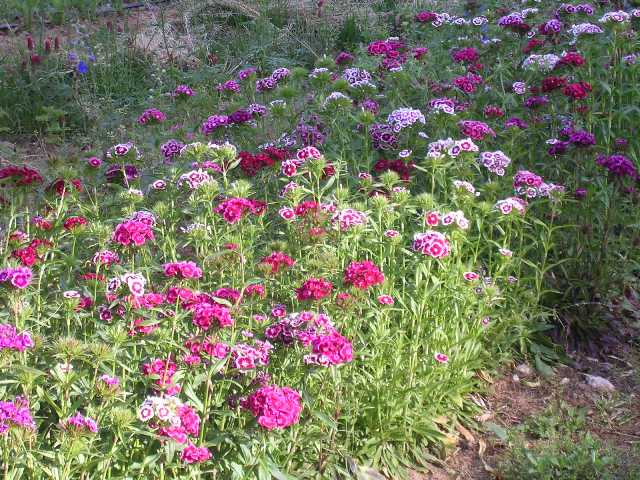
Sweet William in the first morning light

6/18/08 Vol. 5 #14

What a glorious morning, just came back in from my morning perambulation (letting the turkeys out, turning on irrigation, general perusal of the place) and the 50 degree temperature that greeted me was almost shocking.  Thank goodness we are near the longest day of the year (and the first day of summer) because this waking up at 5:00 a.m. is not natural.  I always wake with the light and it is just not right to be up this early in the day!  The change of seasons is truly upon us as we are mowing down the spring vegetable and flower crops and planting more of what will be the late summer crops.  Under the tiller go the beet, carrot, spinach and lettuce beds making room for more zinnias, sunflowers and celosia.  We covered the last bay of the Big Tops last week and the guys built their last tomato trellis of the year.  Today we will plant the last round of tomatoes, the ones for August and September.  We do this planting no-till into a rolled down cover crop of grain rye and this year Austrian winter peas, just like all of the sweet peppers.  When we plant the sweet peppers we are always pushing the front end of using this no-till system because the cover crops are just barely mature enough to kill and the soil is still almost too cool under the insulating layer of mulch.  With the late tomatoes it is just right because the cover is well dead and the soil is warm but not hot.  Most farmers will plant their late tomatoes into white plastic in an attempt to keep the soil and the plants a little cooler, besides my disdain for using plastic mulch, we already have those conditions using the no-till.  Even with these more ideal planting conditions we only plant a limited selection of varieties because tomatoes don’t pollinate well in the hot nights of July and August so we only plant five beds and four varieties, a red, a pink, a yellow and of course Sun Gold cherries.

We really need some rain right now, not only is the pond going down but it is time to seed the summer cover crops.  As I was tilling yesterday the soil is getting very dry making it hard to incorporate the crop residues and difficult to germinate the new seeds.  This is beginning to look like last year where it was almost impossible to get the summer cover crops going.  Now that blueberry picking is almost over we are turning our attentions to catching up on all this planting, trellising and spring crop clean up, hopefully today we will also start the pepper trellising as those poblanos are getting tall and susceptible to being knocked over in a storm.  Friday we will begin the annual red onion harvest another sign of summer as right on cue the onion tops are flopping over, telling us it is time to get them out of the ground too.  As Betsy says, it’s like being a chicken on a hot plate, how fast can you dance?

Picture of the Week
Dan marking the beds, Cov planting celosia in the former spring lettuce beds

7/16/08 Vol. 5 #18

Well we seem to be in the tourist season now.  Last week the National Academy of Sciences, today a bus load of extension agents here in North Carolina for the National Association of County Agricultural Agents meeting.  Next week we have an all day turkey production workshop for 50, put on by our friends at the American Livestock Breeds Conservancy.  They were going to hold it down at the Center for Environmental Farming Systems in Goldsboro but all their turkeys got eaten by coyotes and they needed a new location that had heritage turkeys on pasture!  In two weeks we might be hosting a big press conference to announce two new endowed chairs in Sustainable Food Systems at NC A&T and NC State.  In three weeks we have 90 civil servants from India coming to see what farming techniques we use.  In four weeks we will be taking our summer break to rest up from all of this activity!  So we have been mowing and cleaning up the place.  Not that we don’t constantly do this kind of maintenance but usually not all at once.  All of the rain has made the mowing more critical as stuff is growing like wildfire.

The rest of our days are as usual, a steady pace of harvesting, planting and crop control.  I had predicted this week to be the peak week of tomato harvest but it appears as if last week actually was.  That week of 100 degree temperatures in early June is probably part of the reason.  When it’s that hot tomatoes don’t pollinate well.  That combined with not a lot of sun last week to help ripen the fruit and we seem to have a drop in production this week over last.  Still we have tomato plants to tie up, peppers and lisianthus to trellis, zinnias to be weeded and lots of flowers to be seeded for next years early crops (already?).  The last planting of zinnias and sunflowers went in the ground this week and the first of the fall lettuce too.  The little turkeys graduated yesterday, their first time out of doors.  It is always surprising how fast these broad breasted turkeys grow compared to the heritage birds and these guys are looking good.  In two weeks they will join the older birds out in the field.

Picture of the Week
Limelight Hydrangeas

8/20/08 Vol. 5 #22

Wow, I almost forgot to write the newsletter this morning!  I woke up thinking about the turkeys and then just forgot that it was Wednesday.  We had one of those turkey events yesterday that makes one question why we raise them.  Most of the time the birds are well behaved and get along fine, but as they get older they become teenagers and lose all common sense occasionally.  Just like teenage boys the toms get full of themselves and can start picking on each other.  The problem with turkeys is once they draw blood they just keep at it until their victim is dead or disappears.  Such was the case as I went out yesterday evening to feed and water them.  I found two birds cowering under the roosts with the backs of their heads all bloodied, one seriously.  I separated them out to the hospital pen to heal and the others don’t even know that they are gone.  It is one of the things about raising any livestock; injuries, sickness and death occur more often than one likes.  It is something that you have to get used to, ready for and become somewhat hardened about.  It is just not the same kind of emotion as when a hail storm comes or a disease kills your tomatoes.  Fortunately these two should recover completely and will be reintegrated with the flock with no further troubles.  From now on though we have to keep a closer eye on them as you never know when they will get crazy.

We had a good evening on Monday at the Panzanella farm dinner.  Great turn out and the dishes they made with our produce were very nice.  It is hard to beat a good tomato and mozzarella salad or pasta with a fresh tomato sauce, just two of the dishes they offered up.  For us one of the best parts is seeing everyone who came out to eat food with our produce and to spend time with our own assembled group.  We always end up with a large table surrounded with our current staff, some former staff and other friends.  We carried on, told stories and hopefully weren’t too loud.  The next farm dinner features Chapel Hill Creamery and their great cheeses.

Picture of the Week
Dan and Cov cleaning up the lisianthus for the last time

9/17/08 Vol. 5 #25

OK enough with the rain for a minute!  Thirteen inches over the last few weeks but at least the forecast for the next week looks sublime and maybe fall is really here.  We had a great time in Portland last week with the cut flower growers where they kept us on the move.  Up every morning at 5:00 to get on a bus for another tour.  The first day we went out to the misty coast and saw acres of colored calla lilies, hydrangeas and the largest artichoke producer in Oregon, beautiful huge purple chokes.  The second day we went to the Portland Wholesale Flower Market for a short visit but it is always good to see how the larger farmers send their product through the system.  In our only real free time Betsy and I made it downtown to a really great small farmers’ market (the size of the Carrboro Wednesday market) with some of the finest produce displays we have ever seen anywhere.  We took lots of pictures and brought home some new ideas for our set up at market.

The last day we headed south of Portland into the Willamette valley to see four farms including the largest dahlia grower in the US with an amazing 40 acres in full bloom!  We also visited maybe the largest producer of dried flowers in the US with something like 30 acres including their huge drying rooms and processing facilities.  Just when we thought the bus rides were over we got back on the bus that evening and went up the Columbia river gorge for a dinner cruise on an old paddle wheel boat.  Beautiful night on the decks with the moon rising over the river.  Friday we were up again at 5:00 to start the long flight back home.  Back to the farm with just enough daylight to cut some lettuce, feed the turkeys and finish loading the truck.  Dan and Cov did a great job taking care of the place and had us ready for market but by the time market was over on Saturday we were ready for a rest!

Things here on the farm are winding up smoothly despite the rain.  Most of the irrigation is up and put away (don’t seem to really need it anymore) and the Big Tops are uncovered except the last bay with the last tomatoes.  Soon we will be ready to begin to turn under all the fields.  The little sliding tunnels are all cleaned out and several already planted with crops for Thanksgiving.  The Brussels Sprouts are maybe the best looking we have ever grown, at least at this point.  If the grass would just stop growing so fast from all the rain, the end would even be closer.

Pictures of the Week
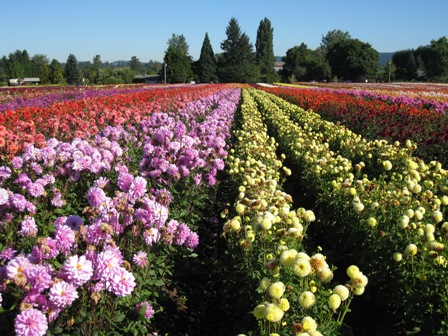
Acres of Calla lilies and Dahlias

5/6/09 Vol. 6 #7

This is the kind of weather that berry and lettuce growers fear.  In the winter and early spring we hope for plenty of wet days to keep things cool and help the little plants grow.  During harvest season we prefer to have widely spaced rains with brilliant sun in between so the berries and lettuce can dry before the dreaded molds get a foot hold.  When we were in the wholesale blackberry business this kind of weather would give us sleepless nights.  We just knew that the beautiful glossy black berries we sent to the grocery stores would all be turning white with mold in the produce coolers and we would have to give them credit for many dollars worth of hard earned/picked fruit.  Because we were not going to spray fungicides it is one of the reasons we got out of the blackberry business.

On the lettuce side there is a soil borne fungus that is commonly called bottom rot and the lettuce heads just melt down.  Not all heads and just in places here and there in the field.  When the lettuce is at harvest stage and densely packed together on the beds the soil underneath them never sees the sun and stays moist, perfect for molds to grow.  We compounded the situation with this rainy period by irrigating Monday afternoon because we had to and weren’t sure if the storms would come, water on water.  Our only defense now is when we harvest, to try and cut the middle row out of the three on each bed to give them better airflow and hope the sun comes out.  Looks like we have a few more days to wait for the sun to appear.  Just when we are in the early weeks of delivering lettuce to Weaver Street Market, classic.

On the rest of the farm this is clearly a changing of the seasons.  The last of the lettuces are being planted while the first tomatoes and zinnias are in the ground and the peppers are going in next week.  In preparation for the peppers and other warm season crops the last of the huge winter cover crops went under the mower or the roller this week.  Some of the rye and vetch combos were mowed to turn under for the following crops but most were rolled down to provide mulch and slow release fertility for the sweet peppers, late tomatoes and winter squash all to be planted in the next few weeks.  The last pass through weeding the onions and other late spring crops, have to get all of these chores rounded up before the end of the month and the beginning of blueberry season.

Picture of the Week
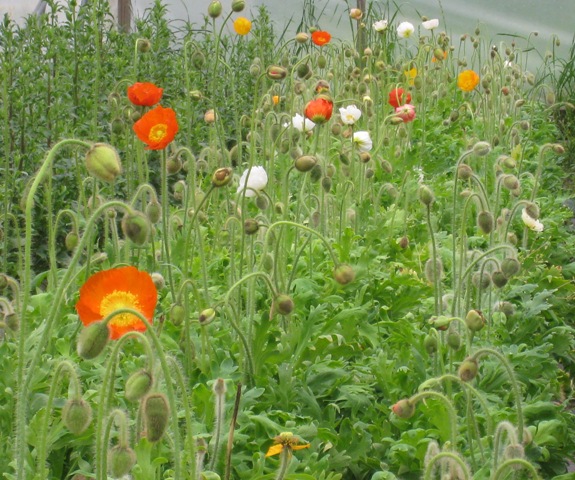
Bright Poppies on a dreary day