7/9/08 Vol. 5 #17

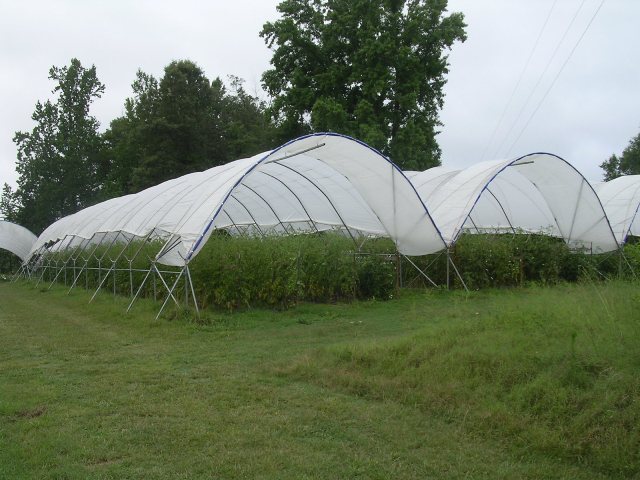
It has been so long since we have had a wet period like this, one almost forgets what it can be like.  It used to be that every July we would have a monsoon period right in the middle of tomato season, generally near the peak.  We feared these wet times as all of our hard work in tending the plants was literally washed away.  Two things were guaranteed to happen.  First the tender skinned ripe heirloom varieties would split and explode from too much water.  Tomatoes are not like balloons that you can just keep pumping up, once they begin to turn color that is as big as their skin will get, excess water has to go somewhere.  We would pick buckets and buckets full of huge Striped Germans and Cherokee Purples split across the bottom from side to side and just throw them away, every Sungold cherry would be split.  The second insult was that  the foliar disease, that haunts us, would run up the plants like someone light a match to them, exposing the remaining fruits to sunscald and increasing the chances of those fruits exploding because when there are no leaves to transpire (breath) water out of the plant any excess water makes the fruit splitting worse.  Once the disease started up the plants it was only a matter of a week or two until that crop was finished for good.  To counter act this we would plant tomatoes three times in the field to try and have some tomatoes all summer.  In reality the best tomatoes are the ones planted in late April right after frost because they grow the biggest plants to support great fruit with great taste.  Plants grown later in the summer just never get as big or set fruit as well.  As the days get shorter in August and then the nights begin to cool off in September it affects the flavor of the tomatoes too, never as intense as fruit ripened in the middle of the summer.  Enter the Big Tops, the cathedrals of tomato production.  We knew if we could keep those plants dry and control the water to their roots we could grow incredible tomatoes.  The trick was that smaller greenhouse structures can’t hold enough plants and get too hot in the middle of the summer.  The huge size of the Big Tops (24 feet wide and 13 feet high) makes it just like growing the plants out in the open but with a thin plastic roof just over the plants.  Now instead of only producing for four or five weeks, that April planted crop will produce for eight or nine weeks or longer and the fruit quality is nearly perfect.  So now when these rainy periods come, I just smile and sleep well, it’s a miracle!

Interesting day yesterday.  We spent most of the day being interviewed by a pair from the National Academy of Sciences for a study being funded by the Bill and Melinda Gates and Kellogg Foundations titled “Twenty-First Century Systems Agriculture”.  Twenty years ago the National Academies released a ground breaking report “Alternative Agriculture” that showed, definitively for the first time, that sustainable and organic approaches to farming actually worked and were as profitable as conventional agriculture.  Now two decades later they are doing it again but with a broader scope than just economics.  Using fact-finding workshops, data analysis and case studies to identify the scientific foundations of sustainable farming systems.  Somehow (it’s always a mystery to us) we were chosen to be one of the nine farms nationwide as one of the “real world” case studies.  They sent seven pages of questions that they wanted to cover (enough to scare anyone) but it turned out to be a wide ranging conversation about how we farm.  As Betsy said, “We had the easy part, they have to try and make a report out of that conversation!”
Picture of the Week
Happy tomatoes under gray skies

4/15/09 Vol. 6 #4

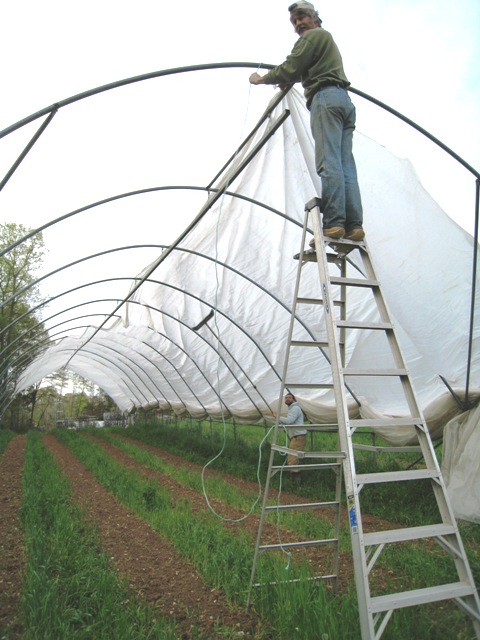
Today we are supposed to begin pulling the plastic over the Big Tops, the giant greenhouse structures that we grow tomatoes and some flowers under.  As I sit here looking out the window I can see a slight breeze in the tops of the trees which may mean no covering this morning.  30 by 100 foot sheets of plastic make great sails and any breeze gets exciting when you think you could be carried across the river unless you let go.  The Big Tops cannot take a snow load so we uncover them every fall, this also allows us to grow the important soil improving cover crops and recharge the soil with rainfall.  We wait until as late as we can to cover them so we can get all the natural water into the soil possible before we have to start irrigating.

This is all part of the inexorable march toward planting the main crop of tomatoes.  The cover crop of wheat and crimson clover was turned under a month ago to give it time to decompose and begin to release its nutrients for the tomatoes to use.  Last Friday we tilled the beds again, almost ready to cover with landscape fabric and build trellis but first we must pull the plastic roofs over as it is too hard to do with all the tomato trellises in the way.  Once covered we can proceed with these preparations so that sometime next week we can tuck the plants into the ground.  Timed to make sure we are after the last danger of frost, the transplants have been “in the system” for five weeks so that when they are planted they are at the best stage of growth so they can just take off without a pause.  The first sungolds six weeks later, if the wind will hold off.

With all of this rainy weather it is getting difficult to keep the guys busy but we keep having enough dry days to keep on schedule with planting.  This week more lettuce and spinach and flowers made it into the ground.  The pea trellises went up too.  The big spring clean up push began with brush burning, all of the limbs that fall in the winter plus various prunings of the perennial plantings.  Not only do we have to get ready to plant tomatoes but next week is the Farm Tour so we have to get buffed up for that too, lots to do.

Picture of the Week
We were successful in getting the tomato Big Tops covered!

4/29/09 Vol. 6 #6

We survived the Farm Tour but just barely, it was damn hot!  We had good and interesting tourees as always and despite the heat they seemed to enjoy them themselves and the farm.  We spent so much time late last week getting irrigation set up that we didn’t get tomatoes planted until Monday of this week but the big planting is now in the ground.  “Only” fifteen varieties this year, sometimes you just have to go back to your base and do what you do best, plus it gives us a few more plants of all the kinds we all love best.  Plenty of Cherokee Purples, Kellogg’s Breakfast, Aunt Ruby’s German Green and more, can’t wait.  With this dive straight into summer we are now running hard to get things planted and keep up with what has been in the ground and waiting for some heat to really start to grow, weeds included.

Just wanted to let you all know about a meeting you might be interested in next Monday the 4th.  For some years now we, at the Carrboro Farmers’ market, have been talking about forming our own “Friends” organization like many markets around the country, to help support the market and work on community issues around sustainable agriculture. The Friends of The Carrboro Farmer’s Market is being developed as a tax exempt organization to undertake charitable and educational activities related to agricultural issues.  We want to hear your ideas of what you would like to see from a Friends organization and explore opportunities for you to be involved in its formative stages and future projects. Come join us for fun evening and help build greater support for sustainable agriculture!  The meeting is going to be held at the Carrboro Town Hall (where market is held) at 7:30 p.m.  This meeting is open to all, so if you have some ideas you’d like to share, please come and bring a friend. If you’re interested in attending , please email info@carrborofarmersmarket.com

On another farm front, as you know we are very proud of the people who have worked for us and especially the ones who have gone on to start their own farms.  You may also know that we have helped several get started by letting them use part of our land to grow their first crops.  We are pleased to announce yet another farm start up with Cov’s debut at the Wednesday Farmers’ Market last week.  He is using a half an acre in our bottom field and is producing some beautiful stuff down there.  Look for him in the other shelter on Wednesdays.

Picture of the Week
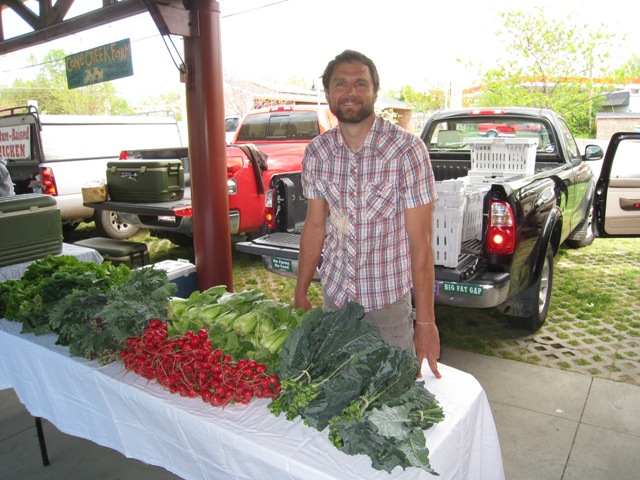
Cov at his first market, farm name yet to be determined

6/3/09 Vol. 6 #11

We finally made it to June, seemed like May lasted longer than usual for some reason.  I spent most of the morning yesterday on the tractor doing defensive mowing of the vigorously growing grasses around the edges of the field.  Defensive because the ticks are amazing this year if you have to venture into that tall grass and because the ground hogs are back and I makes it easier to see them if the grass is short.

Ground hogs are our most feared pest, more than deer.  They can and will eat entire plantings of stuff in a day, deer just nibble here and there, if they get past the electric deer fence.  We noticed last week that some lettuce had been eaten on the edges of the rows in the field and then some lettuce transplants in the flats in front of the greenhouse had been eaten too.  Finally Cov went down to trellis his own pole beans in the bottom field and some critter had wiped out the entire row and had helped themselves to the golden beets too.  Several days later we finally spied both the hilltop and the bottom culprits.  The ground hogs never seem to show up until it is warm enough in the spring, usually about now, and in the past few years we have not seen one here on the farm as they move around from den to den.  We can’t fence them out without huge logistical and maintenance headaches and they just laugh at the traps so I am now on afternoon rounds to see if I can get a shot at them.

In less than two weeks, June 14th,  we will be participating in the second Farm to Fork picnic,  put on by the Slow Food Triangle chapter and the Center for Environmental Farming Systems.  The proceeds will benefit new and young farmer programs in Orange county and down at CEFS.  Last time it was great fun as chefs and farms are paired to come up with great food.  There are something like 26 restaurants participating and we are paired with Watts Grocery this time around, should be entertaining and delicious.

While the mower was on I mowed down the early spring flowers (larkspur, bachelors buttons, etc.) soon it will be summer cover crop time.  The blueberry picking rolls on with many hands on deck.  Monday we had possibly the largest crew ever with nine in the field, still didn’t put a dent in the massive crop.  The third planting of zinnias and celosia are going in the ground just as the first zinnia bloom has been spotted.  We ate our first BLT sandwiches on Monday so summer is officially here!

Picture of the Week
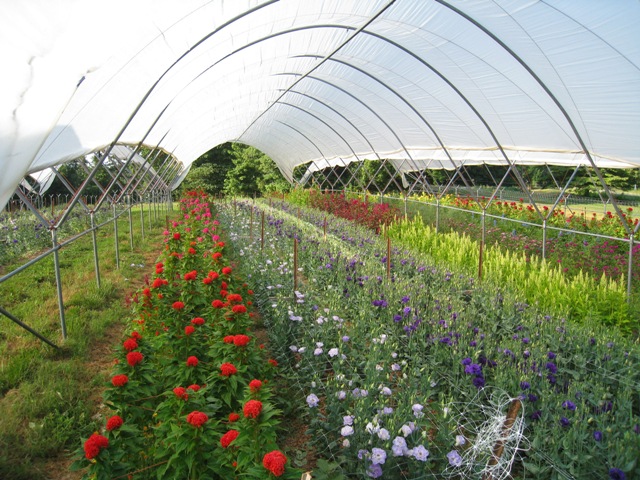
Beautiful Campanula and other flowers under the Big Tops

6/17/09 Vol. 6 #13

Rain, rain, rain, rain, rain.  Good thing we had a rain day yesterday as we are all just now recovering from the Farm to Fork picnic on Sunday.  It looked like a good time was had by all despite the heat.  Not so hot that you just stood there panting but definitely the sweat was running down my brow.  70 plus farmers and chefs cooked and served up an amazing array of small bites from every kind of vegetable pickle to collard green kimchi and barbecued shrimp with bloody Mary sauce to cabrito tacos with heritage corn tortillas.  A pre-event estimate of 650 people were signed up to attend, including the farmers and chefs, not sure if they all showed but a nice chunk of money was raised for the new farmer programs at the Breeze Farm and the Center for Environmental Farming Systems.

We had fun, as always, working with Amy Tornquist and Glenn Lozuke from Watts Grocery and Sage and Swift Catering.  We presented a beautiful trifecta of Treviso radicchio leaves with a small piece of Glenn’s house made pancetta topped with some of the first tomatoes of the season; a colorful hand held bitter, salty, sweet salad.  Glenn had boned out an entire pig, stuffed it with herbs and hot roasted it, all night, in a traditional porchetta style and it was amazing.  The third part of the trifecta was a lemon ice cream with a blueberry swirl in tiny little corn meal cones, each with a blueberry in the bottom.

Back here in farm land the rain is holding us up from getting things done.  Blueberry picking was canceled for yesterday and I hope we can get a full morning in today.  We began the onion harvest on Monday but it is too wet to continue until maybe Thursday, it is bad to harvest them when wet and muddy, too much danger of ending up with rotting onions later.  We need to cover the last of the Big Tops this week so we can plant the late tomatoes, the transplants of which are really ready to get into the ground.  Looks like we will blast into summer on Friday when it goes straight to the high 90’s, that’ll dry it out for sure!

Picture of the Week
Pig with snout on the left, radicchio salads in the middle, tiny little ice cream cones on the right.

7/1/09 Vol. 6 #15

We have made it to July and the heart of tomato season is upon us.  We pick tomatoes twice a week, slowly going up and down the rows hunched over coaxing the now knee height fruit from the vines that are currently nearing six feet tall.  Both the very early rows in the little sliding tunnels and the main planting in the Big Tops are all giving us fruit from the nineteen varieties we have this year.  But not all is well in tomato land, we have a silent thief which will ultimately steal many of the heirloom varieties we all love.  It has been four years since we had tomatoes in this Big Top location and we had forgotten that the same thief visited us then as well, but that year we thought it was an aberration, never having had this kind of problem before.

Fusarium Wilt is the culprit and there is nothing we can do about it, at least for this year.  It is a soil borne fungus that can live in the soil for years and attacks only tomatoes.  Most of the hybrid tomatoes are bred for resistance to it and if you have looked for tomatoes in a seed catalog and seen abbreviations next to a variety description like V, F, N the F is for fusarium resistance.  The heirlooms are generally not resistant to it but some are or partly are and that is what we are seeing in the field this year.  The yellowing and wilting doesn’t become apparent until hot weather arrives so if there is a silver lining, it is that the plants grew large and set some fruit before it showed up.  The bad news is we will have a very short season for some varieties.

The most affected are the high acid yellow Azoychka and the huge, fruity, red and yellow Striped Germans.  Next are the green when ripe Aunt Ruby’s German Green and the Green Zebras, they won’t give us much fruit at all.  Showing signs but still producing fine are the pink German Johnsons and the beautiful yellow Kellogg’s Breakfast.  Fortunately our favorite, the Cherokee Purple, appears to be resistant.  All of the red varieties are hybrids and mostly look great except for the Italian Oxhearts that we introduced here three years ago.  So enjoy them while we can, there will be tomatoes all season long but less variety as time goes on as the different kinds succumb to the thief.

Picture of the Week
Resistant healthy hybrids on either side of the yellowing German Johnsons

7/8/09 Vol. 6 #16

What glorious weather for July (except that lack of rain thing), can’t remember summer weather so delightful for such an extended period of time.  I am sure we will return to the normal steamy hot days before it’s over but we are really enjoying it for the time being.  We are into the “easy” days of summer where we have designed the program to have everything in the field done by noon and then hide out in the shade (or air conditioning) the rest of the day.

Some of this means fewer crops to manage and less planting going on but what ever is in the field now needs to be established and/or tough enough to handle the conditions.  Betsy is in the thick of Lisianthus harvest, it is a daily process of cutting truck loads of stems, taking them back to the packing shed (in the shade) and then processing them for later use.  The big job for the staff is the Monday and Thursday tomato harvest which takes all morning to complete.  The rest of the week is filled with a little harvesting of other crops, a little planting, a little trellising, a little mowing, a little weeding, a little irrigating.

Fusarium Wilt (chapter two).  I want to thank everyone who has expressed on their sorrow for our problem with this disease in the heirloom tomatoes.  It is a damn shame but it is just the kind of thing that happens in farming that you become used to and learn to adapt.  The good news is we have several things we can do about it for the future and it appears to only really be in this one area in the Big Tops field.  I have already taken the first steps this week by saving seed from plants that showed no signs of the wilt or at least a strong resistance.  The seed for the Cherokee Purples we are growing is some we saved two years ago, from plants grown in the same field.  They are showing no signs of the wilt and producing lots of great fruit.

The other two things we can do are to solarize the soil in that area by covering the bare, moist soil with clear plastic in the hottest part of the summer and basically cooking the fungus spores out of the top few inches of the soil.  That process will have to wait until year after next when we have a rest year planned for that spot.  The last thing we can do is to take advantage of the research we have done with NC State over the last few years and use grafted tomato plants.  I have mentioned this in the past and didn’t really think we needed to use this technique until now.  It is just like fruit trees where you graft what ever tomato variety you want onto a wilt resistant rootstock.  So next year we may actually have to graft some of our own plants.  There’s always something when farming.
Picture of the Week
Beautiful Lisianthus beds flanked by brilliant Celosia