5/17/06 Vol. 3 #10

The endless lettuce season rolls on.  At least it feels endless these days as I go out to cut four mornings a week.  The staff arrives each morning and I brief them on the days jobs and end with “of course I will be cutting lettuce if you need me”.  Mondays and Thursdays I cut for delivery to Weaver Street Market, Wednesdays and Fridays I cut for the markets and the restaurants.  Usually two, sometimes three, hours each morning.  We are now into the fourth week with one big week left to go.  Lettuce is one crop that I do all the harvesting of.  It is such and ephemeral plant that it takes sometime to develop an eye for which head is large enough and tender enough to cut.  In a few days the heads that I pass over will be big enough to then take, in a few more days they will be too far gone, getting tough and bitter.  The hotter it gets the faster this progression occurs.  The weather of the past few weeks has been about as ideal as we get in North Carolina as far as lettuce is concerned so the pressure has been off a bit.  It is easy for me to train the staff on what is the right size of turnip to pick and how big a bunch is but the lettuce thing is more like “is this flower at the right stage to harvest?”, it is subjective (hence the reason why Betsy cuts almost every flower stem on the farm).  Twenty four heads to a case, six cases and hour if I have to search around, ten cases and hour if the planting is really uniform, that is one head every fifteen seconds!  I am counting the seconds until the season is done.

Big event at the Market this Saturday.  The Market is having a fundraiser for our sister market in New Orleans and all of the farmers and fishers who where devastated by hurricane Katrina last fall.  Like the Carrboro Market which was open two days after hurricane Fran crippled this area in 1996, the Crescent City Market was up and running only weeks after the water receded in New Orleans.  Markets are an important social component for towns and cities as well as sources of food.  Muffulettas and Gumbo prepared by a dozen Triangle chefs will be available to go for $10/serving, for more details go to the Carrboro Market websiteAll proceeds will go to the Crescent City Markets and their efforts to bring their vendors back into production.  Come on out for the good food!

It has been the normal orchestrated chaos this week with more planting of summer crops, more zinnias, sunflowers, celosia, cucumbers and another planting of Cherokee Purple tomatoes.  Weeding, trellising of flowers and vegetables, mowing, harvesting and on and on.  The turkeys got so wild last week that we had to trim the wing feathers on all of them.  After chasing the little miscreants all over the farm, including one that spent the night out because we couldn’t catch him at all, we decided we had to make sure none of them could fly until they learned better behavior, maybe this is where the term “grounded” came from that our parents threatened us with as kids.  Well this was no idle threat for these birds!  They go out to the field permanently tomorrow.
Picture of the Week
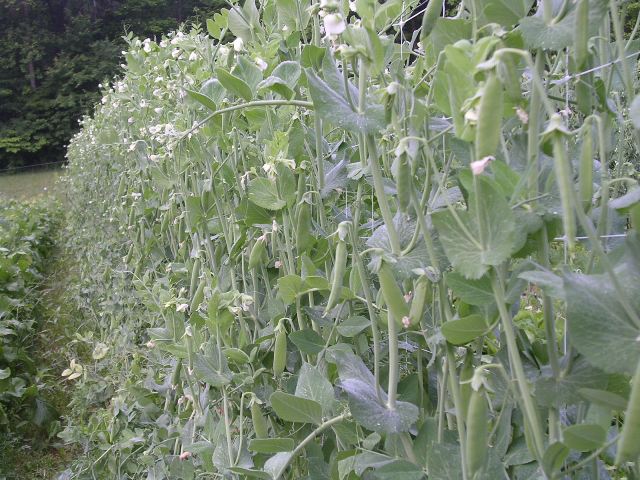
Sugar Snap Peas already loaded up with many more blooms on the top of the plants

5/24/06 Vol. 3 #11

It is the season for picking tiny objects.  Most folks think about temperature, day length and other weather related things when it comes to “seasons” but for us, sometimes, it is much more relevant to equate seasons with the task at hand.  Spring is filled with the harvest of crops that are either very close to the ground or down in it.  Spinach, lettuces, broccoli raab, radishes, turnips and the farthest down, carrots.  Strong backs are required for the hours and hours of bending over searching for the correct size of root vegetable to pull and bunch.  Even then there are only so many of these relatively large objects to pull, on a good day maybe 400 individual turnips to be harvested in an hour.  Beginning this week we started the change of seasons to more stand up pursuits  but with more tedious consequences.  What is he talking about?  Sugar Snap Peas and Blueberries.

While we do get to stand up while picking them, the harvest time goes on and on.  We (five of us) picked peas for two solid hours on Monday morning.  Yesterday was the first shot over the bow of Blueberry season with four people picking for several hours, thousands of tiny blue orbs.  For the next three weeks our lives will be consumed by the harvest of blueberries.  When it overlaps with something else like peas it can be mind numbing.  When we first began the transition from mostly blackberries (we had two acres in production at one point) to vegetables and flowers we designed June to be “berry” month.  We have never grown the traditional crops that begin in June; squash, beans, cucumbers, potatoes.  So I needed something to occupy me from the end of lettuce season and the other cool weather crops, at the end of May, until the beginning of tomato season at the beginning of July.  Betsy just won’t let me lounge around the farm without something to do.  Our original plan was to have blackberries and blueberries.  Several years ago when the last of the large blackberry plantings was waning and the blueberries where beginning to really produce, we had that overlap.  We learned that season that there were not enough people on the face of the earth to pick all those tiny objects.  When that planting of blackberries was plowed under we decided that June would be Blueberry month only!  As it is we still hire an additional four or five people to help us get them all off the bushes and into those little green pint containers.

Finally the turkeys got moved to the field.  Seven weeks old and tired of hanging around that old brooder building.  Now turkeys herd pretty well once they get used to it (they actually used to have “turkey drives” to get large numbers to market) but as I have said, the first time you introduce something new to them is always exciting.  After several years of trying to herd them from the brooder, the several hundred yards, to their first stop in the fields and having it get out of hand we now carry them over, two in each hand.  Yesterday we had six of us to make the job easier.  Two catching and four walking them over.  They are much happier now, lots of interesting bugs and weed seeds to eat and bushes to run around.  Every year we have a misfit in the bunch.  Last year it was Buckwheat and the half blind Blue Slate, the year before it was a broad breasted white with a crooked beak that made him look like a pirate.  This year it is Shrimpy.  Shrimpy is a quarter the size of the others, with shorter legs, but she runs with the rest of them as if there is no difference.  No one seems to notice and she is growing just fine only she will never catch up with the others.  Some one will be getting a five pound bird for Thanksgiving.

Picture of the Week
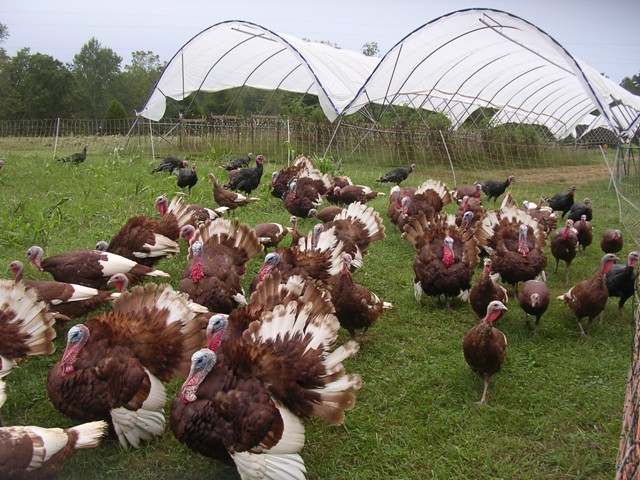
Happy but cold turkeys this morning

5/31/06 Vol. 3 #12

The heat has arrived and with it the big flush of blueberries.  We started out with plenty of picking help last Thursday and then spiraled out of control at the beginning of this week.  I always try and line up enough extra help so we can pick and get other chores done on the farm.  We need to have six to eight people every day for the next two weeks to keep the berries picked on time.  With fewer than this we fall behind on all the other things on the farm.  Tying the tomatoes up to the trellis, cultivating and weeding, building trellis in the peppers and flowers and more.  Every year it is the same, so I don’t know why I am surprised and it always works out.  I try to get out and help pick too but end up spending most of my mornings taking care of the other duties, irrigating, picking the other vegetables for market the rest of the show must go on too.  Blueberry picking is really the most enjoyable job on the farm and the staff has fun doing it as there gets to be quite a banter out in the field.  At least the wholesale lettuce season is over, I cut the last of Weaver Street’s lettuce on Monday so now I can have my mornings free to chase the other items around.

One of yesterdays tasks was to clean out the turkey brooder to get ready for the next batch of birds, which come tomorrow.  The shavings and droppings are shoveled out and spread on the beds of one of the sliding tunnels, great stuff for that soil that we use so intensively.  A thorough cleaning including spraying down the walls and floor with chlorine to disinfect a bit.  After it dries out well we put in a new batch of shavings about three inches deep.  Over that goes a layer of newspaper that they will be on for the first three days while they learn to eat (and read I’m sure) the right food instead of the wood chips.  Finally a draft ring goes in and the newly disinfected feeders and waterers.  Now we are ready for that early morning call from the post office.  Forty broad breasted Bronzes to eventually join the Bourbon Reds out in the field.  We get this group later because they grow so fast, they would be forty pounds if we got them at the same time as the others.  This way everyone runs together and finishes up at the same time.

We had an interesting group of visitors last week from the EPA.  These are some of the folks who are responsible for registering pesticides for farmers to use.  Now we don’t use many pesticides (remember that a pesticide is anything that kills a pest, even organically approved materials) seeing as how we are committed to sustainability and organic practices, so we wondered why they would want to come see us.  Turns out that while they have pretty good data and an idea of how soybeans and corn grow they don’t have a clue as to how an intensive horticultural operation works, how the crops actually grow and how one could grow them without pesticides.  There were entomologists, biologists, pathologists and the much maligned agricultural economist.  We described how we maintain soil fertility, rotate crops and what strategies we use to deal with pest problems.  They seemed genuinely interested and as a sign of how things are changing in the world of big Ag and regulation they actually are trying to measure the costs and risks of using a pesticide over using other techniques such as we us.

Picture of the Week
Dark and threatening rain this morning, but the Campanula brightens up the day

6/7/06 Vol. 3 #13

One more shot of beautiful cool weather with occasional rain.  I always feel like we are cheating or escaping from something when the weather is like this in June.  I know full well that the relentless heat of summer is hiding just around the corner and then we have to settle into a more measured pace just to make it through until September.  Having been born and raised mostly in the South you would think that I would be used to the heat and humidity but that gene never got passed to me.  When we moved here twenty six years ago from Utah, we lived in a tiny duplex in the middle of a field in Bynum while we crafted the plan for Peregrine Farm.  That first summer, in that non-air conditioned box, was hot as hell and we thought we were going to die!  We would lie awake at night with the tiny window high on the wall above, a box fan feebly trying to move hot air around us.  Thoughts of cool nights in the mountain west would somehow coax us to sleep.  I always assumed that I would acclimate and get used to the heat and while it did happen, somewhat, I still cower when the forecast reads in the 90’s.

The blueberries roll on.  After last years record crop it is hard to judge just how this years will end up.  My best estimate is that we have about a third of last years harvest, maybe half a normal year.  It is hard to say exactly why.  My best theory is that it was so warm this late winter it caused the bushes to bloom very early.  They started in late February and consequently many blooms and fruit were lost to frosts that came afterward.  It makes the fruit that is left a bit larger and maybe more flavorful because they get all the good stuff they don’t have to share when there are too many berries on the plant.  I was told yesterday that our berries were served last week to the former White House pastry chef, of twenty five years, and he said they were some of the best he had ever had!  With not so many berries to pick we are actually able to get other things done on the farm like critical weeding and tying up the tomatoes.  We are also beginning the process of taking out the spring crops to be replaced by summer cover crops or more summer flowers.  Out come the irrigation lines, mow down the weeds and what is left of the spring crop, turn under the residue.  If we are planting another crop then a little feather meal is spread for nitrogen, the bed is tilled again, then a drip irrigation line is buried right down the middle of the bed.  Planting follows quickly behind.  Last week more sunflowers and seven more beds of zinnias (the third planting of the year).  Soon those fields that don’t go on to summer crops will be turned under and sown to big summer soil improving crops.  The next batch of turkeys arrived on cue last Thursday morning.  Forty broad breasted bronzes, all happy and running around in the brooder.

Picture of the Week
Purple Bouquet Dianthus flanked by Campanula and Safflower

6/14/06 Vol. 3 #14

Well I’ve been up since 4:00 a.m. trying to reserve plane tickets to Italy.  As these things go on the Internet sometimes, I have yet to successfully complete the transaction (it is now 6:30).  We have finally heard, quasi-officially, from the Slow Food people that we have been accepted to attend the second Terra Madre conference in Turin Italy!  Some of you may remember that we were very fortunate to have been nominated to attend the first ever world gathering of food producers two years ago.  That experience of convening with 5000 other farmers, ranchers, herders, gatherers, etc. and the on farm housing has colored many of the new things we do here on the farm.  The exposure to cultures steeped in artisanal foods and old breeds has made us explore new (to us) varieties and food production ideas.  The on going attempt to form a successful poultry and meat processing cooperative has partly sprung out of the knowledge that with out it, local farmers will not be able to move towards further sustainability of their operations.  So we are off again to Turin the end of October.  This time not only with 5000 food producers but also with 1000 chefs and over 150 academics from around the world.  Slow Food is correctly expanding their aim to include the professional people who cook with local foods and can most quickly affect peoples palates and minds.  Our local chapter (convivium in Slow Food parlance) put forth an ambitious slate of people to attend and it appears as if almost all were accepted to go.  This includes our good friends, chefs and customers Ben and Karen Barker of Magnolia Grill and Andrea Ruesing of Lantern Restaurant.  Our delegation will also consist of at least eight animal producers and eight representatives of the seven local producer-only farmers’ markets.  We see this as a great opportunity to help move our local food system to a new level of understanding and cooperation.

The Slow Food organization and it’s mission resounds closely with what Betsy and I have been trying to do for the past twenty five years.  In the words of it’s founder, Carlo Petrini, producing food that is “good, clean and fair”.  We have always tried to grow products with great flavor and eye appeal (good), in a way that is sustainable (clean) and treats us, our employees and our customers well (fair).  With over 80,000 members world wide there appears to be lots of folks who think similarly.

Otherwise it is a rain day as the remnants of Alberto pour down.  We now appear to be in the monsoon season.  In preparation for todays storms we did cover the last of the Big Tops under which the late tomatoes are to be planted.  The trellis is up and probably tomorrow the plants will be slipped into the ground.  We also got the first layer of trellis on the hot peppers.  Unfortunately the huge storms on Sunday had laid over many of the tall Poblano and Anaheim plants.  So we stood them back up and secured them with the trellis strings before any more damage occurs today.  In general the peppers look really good but need a little more heat to really get going.  The eggplant and tomatillos are now in as well.  The turkeys are wearing trench coats and rubber boots, it was hard to find some small enough for Shrimpy.

Picture of the Week
On a sunny day the birds are eyeing Betsy’s lush Zinnias

7/12/06 Vol. 3 #18

Now the weather is returning to more normal summers conditions this week but in general we are all looking at each other and saying “I don’t ever remember a summer like this”.  This, this… not so hot.  No complaining here mind you but it does sort of throw one off balance.  Just as you have your brain programmed to expect one thing and act in a certain way it doesn’t happen.  The only comparison is back in 1991, which we always refer to as the Mt. Pinatubo summer.  That summer that volcano in the Philippines erupted and sent huge amounts of ash into the stratosphere which circulated the globe for months.  The result was a very cool summer in North Carolina,  we barely got into the 90’s.  Back then we were in the midst of the long and expensive “Raspberry Experiment”.  The most noticeable result from that cool summer was that the raspberry canes grew almost twice a tall as normal and the following year we had the best harvest we had ever had.  It turns out that it is too hot here for raspberries to grow vigorously, but that summer it was more like the conditions further north where they produce them in abundance.  Soon there after the raspberries came out of the ground never to be planted here again (under threat of certain penalties from Betsy!).  So while we are not experiencing as dramatic conditions as that year it is still affecting crops here on there farm.  Most noticeably the tomatoes are still not producing at the level we are accustomed to.  Every Monday and Thursday we go out and pick and while we are getting some of all the varieties we are not bringing back the number of boxes that we should be.  Normally this would be the peak week of tomato harvest but it will be at least next week if not later.  Yesterday we were up working in the peppers and the rows that are on black landscape fabric are moving along well but the rows planted no-till are way behind.  The soil is cooler under all that mulch which in hot weather a good thing but this season it is holding those plants back.  Just when your brain is programmed one way…

We did manage to get the cover crops all seeded before the big rains last week and they are up already and looking great, little soybean plants raising there fat heads out of the soil and the millet with one blade pointed straight up towards the sky.  The turkeys have all been rotated around the farm.  The little guys as we call the Broad Breasted Bronzes right now (they will eventually weigh twice a much as the Bourbon Reds) graduated out to the blueberries from the brooder and are extremely happy lazing the days away in the shade of the blueberry bushes and taking group walks around their new grassy enclosure.  The Bourbon Reds have moved into Betsy’s first and now abandoned Zinnia patch (we plant Zinnias five times and she is now cutting off the second batch).  This is the same field that had the leeks, radicchio and the last lettuce among other crops so they are now eating the crab grass and other weeds while hiding out in the four foot tall Zinnia rows like outlaws only to come creeping out when someone walks by the fence.  The last Zinnias get planted this week and the Brussels Sprouts for Thanksgiving went into the ground this week too.  Despite the different weather we still march on with the calendar assuming that normalcy will return.

Picture of the Week
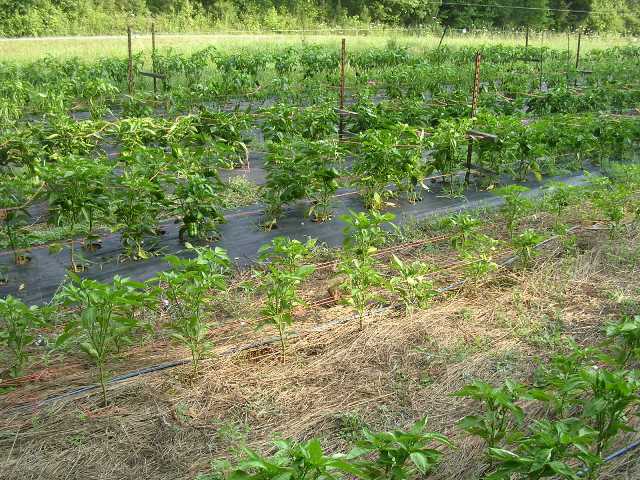
The effects of cool weather.  The same varieties next to each other but the plants on the warmer black fabric are much larger and have large peppers on them.

7/19/06 Vol. 3 #19

Everyday begins the same at this time of year.  I am usually out of the house around 6:00 to let the turkeys out before the increasing light makes them too fidgety.  We close the doors to their shelters each night at dark and most of them are self-loaded with the rest having flown up to the peak of the shelter to roost for the night.  In the morning the top sleepers fly back down and taunt the locked-up groups by strutting around just outside the chicken wire walls.  So, out they come for another day, pecking for bugs and discussing with each other what happened last night in the other shelter.  Then I walk down to the irrigation pump to turn on the water for the day.  When it is this hot we water everything for two hours a day, every day, and it is most effective if we do it early when it is cooler.  You can tell that fall is on its way because the spiders are getting serious about stringing their webs across the paths to catch every thing in sight.  I assume it is either to gather lots of food heading into the winter or trying to catch a ride for the new borns to another location so they can set up shop.  In the early part of the year you can walk all around the farm and never run into a spider web.   Now I have to find just the right stick, each morning, that I hold out in front of my face and chest to intercept them before I get a face full of spider!  This morning walk can be up to three quarters of a mile or more depending on side jaunts, which gives me a chance to think about what needs to be done this day and to contemplate other issues.  It is not quite a perambulation of the bounds but close.

Today I was thinking about the tragic passing of a friend, neighbor and fellow farmer, Chuck Glosson.  Chuck was accidentally hit and killed by a car on Saturday morning while we were at market, he was only 33.  The news spread quickly though the market community as we all returned home that afternoon.  Many of you may remember Chuck who sold at market from 1993 until 2000.  He and his family set up right behind our Saturday stall where Chapel Hill Creamery is now.  The next to take over the family farm, a farm that has been in the family at least 200 years.  Chuck finished High School and went right into farming with his father and it was a true partnership from the beginning.  A true traditional family farm, they raise cattle, pigs and chickens.  They also produce corn, wheat, soybeans, grass seed, hay, straw and many more crops, some to feed the animals and some to sell.  At market Chuck was an innovator.  He was the first to sell beef and pork.  They sold beautiful produce and cut flowers.  They immediately had a loyal customer following because of the huge diversity of product but mostly due to the fact that Chuck was the friendliest, kindest, and most sincere person they ever met.

We first met Chuck when he was about to graduate from High School.  He came by the farm one day because another market vendor suggested he go see what we were doing.  He was sure of staying on the farm and thinking about how he would fit into the family operation.  We walked all around our place and he asked good questions and soaked it all up.  In the years since we have bought straw from them, asked them about raising pigs and other crops.  After Hurricane Fran, when we had to move our transplant greenhouse after it was flooded, Chuck came over with one of their huge tractors and towed the structure up the hill and helped us set it on the new foundations.  He was always happy, willing to help and was a great listener.  The kind of farming that the Glossons do is completely different than what Betsy and I do but we had an understanding of each others daily lives.   Chuck has always been the picture, in my mind, of the future of traditional mid- size farmers.  Now I don’t know what image I will have in my head when someone talks about young conventional farmers but I will always know that I was friends with one of the finest humans to have ever walked this earth.

Picture of the Week
Bourbon Reds perambulating their bounds in the early morning.

7/26/06 Vol. 3 #20

This has been one of those weeks when people begin to ask “when do you have time to farm?” as I go from one meeting to another.  I have to admit that I have not spent as much time in the field this summer as I usually do.  Mostly due to the on going wrangling at the poultry plant and the Growers’ Choice Cooperative I have been running around central North Carolina a lot.  We knew heading into this season that this was going to be the case but felt that we could handle it this year because our staff is so good.  It has been!  We are extremely fortunate to have a group of people who have been with us for several years and begin to know the system as well as we do.  We joke that Joann understands my handwriting and speech patterns better than Betsy does!  When I scrawl the restaurant orders down, with my own abbreviations, Betsy will show it to Joann who knows exactly what it says.  Most mornings now, as they arrive at the farm, we sit under the little shed we use to store straw in and go over that days jobs.  I usually can say we need to do X,Y and Z and they head off to spend their mornings without me at their side.  Picking tomatoes, trellising flowers, weeding Lisianthus they now know how to do it as if it were their own farms.  Of course Joann has her own farm, Castlemaine, and Rett has just left us to move to his new farm in the mountains.  Will is starting a new farm down in Chatham county and Rachel is in her third year working on local farms after her boyfriend Lee worked for us before that.  We have always tried to create a working situation here where, as they learned the system, we let them operate it without excess supervision.  Just enough to make sure the quality and efficiency is there but not so much that they feel micro managed.  Generally we have managed to successfully hit that balance, sometimes we miss the mark but never with disastrous results.  It is difficult in our situation in that we can’t have permanent, year round help.  Because we are seasonal we have to make the job as enticing and rewarding as possible and become efficient and effective teachers so that they can get up to speed quickly without the frustrations that can come with learning something new.  We have been very lucky with staff for many years and this year they have made it possible for me to be distracted by off farm projects, I can’t thank them enough.

It is a little eerie when you go to deliver produce and there are life size posters of you by the door.  Tomorrow night (Thursday) Panzanella restaurant and Weaver Street Market are having another of their local Farm Dinners this one featuring us!  This one will benefit the Sustainable Farming Program at Central Carolina Community College in Pittsboro, five percent of the proceeds will be donated.  This is where I taught the Sustainable Vegetable Production class for six years and many of our excellent staff have taken classes there.  The format is they have a number of special dishes made from the featured farms produce along with their regular menu.  Yesterday we delivered a huge array of produce for Peter McKloskey to work with.  Five kinds of tomatoes, Poblano, Anaheim and Serrano peppers.  Red Torpedo Onions from Italy, Cucumbers, those great Galia Melons and of course flowers for the dining room.  I know that he is going to stuff some of the Poblanos and I wouldn’t be surprised to see the Melon for dessert.  Every summer we threaten to have an on farm open house and dinner during tomato season but never seem to be able to get around to it (I wonder why?), this is the next best thing and we don’t have to do the cooking!  Come on out and enjoy the produce of the season.  5:30 to 9:00, no reservations necessary.  Betsy and I will be there eating too (are you kidding, our food and we don’t have to prepare it!).

Otherwise it is business as usual on the farm.  Tomato picking twice a week, peppers once a week, with plenty of maintenance in between.  Tying up tomatoes and peppers, fighting back the encroaching weeds, mowing, mowing, mowing.  Betsy is of course cutting flowers everyday.  It is kind of like the steady buzz of the crickets at night, it just goes on and on.  The turkeys are all now in the Blueberries, divided by a section of fence.  This is the “get acquainted” period where they can talk to each other through the fence but the bigger birds can’t pick on the little (and strange to them) ones.  In another 10 days or so they will all run together and it will be like old home week, by then they will just think of each other as cousins they haven’t seen for a year but will feel comfortable hanging around with!

Picture of the Week
A foggy morning as the cousins stare each other down

8/30/06 Vol. 3 #24

We look skyward as we do the rain dance hoping that something will come to erase that crispy look and feel the farm has been developing over the last few weeks.  Now that Ernesto is on his way I hope we didn’t dance too gleefully as they are now calling for up to seven inches of rain before Friday afternoon!  Now we go into batten down the hatches mode.  Mostly that means we have to pick quite a bit of stuff for Saturday market this morning before the rains start.  Fortunately peppers are one of those vegetables that can be picked quite early and their quality holds up beautifully for days.  When you see how long it is possible to hold peppers one begins to wonder how old those peppers in the grocery store actually are, but I digress.  Anytime that it is dry, for this length of time, we also get lackadaisical about making sure everything is put away completely so it doesn’t get wet.  So we need to circle the farm and make sure there is nothing laying out in the weather.  We also need to pull the gravity feed intake out of the bone dry creek in case it floods as well as keep an eye on the river levels over the next few days as we might have to pull the irrigation pump if it actually rains that much.  Not much wind associated with this storm so at least we don’t have to make sure everything is tied down too.

Further signs of fall this past week as the days get noticeably shorter and the staff begins to move towards their fall and winter schedules.  Rachel started back at UNC this week so we only have her help on Friday afternoons and Saturday mornings.  Joann, who keeps a schedule that makes us weary to think about (she runs her own farm, mostly runs ours and also works a couple of days a week at Weaver Street Market!), is beginning to pick up more shifts at Weaver Street for the winter season.  Rett is already gone to his new farm in the mountains.  Will is still hanging in there for the next month or so until we have the place put to bed for the winter.  Several mornings a week it is just Will, Betsy and me to hold the place down.  Soon as my mother used to say it will be “just us chickens”.

We have just four Saturday markets left in our season so the end is in sight.  That means it is turkey reservation time!  We always wait until now to make sure we have a fairly accurate number before we start to take peoples names and deposits.  For those of you who got birds last year I will also send out a separate message just to make sure you don’t miss it in the regular newsletter mix.  We have 84 birds on the ground right now with many of those already spoken for, so don’t delay.  Attached is the turkey reservation information and form.  Eerily like last year we are not exactly sure where we will be getting the birds processed.  The local plant is in a state of transition and so we may have to go out of state or process them ourselves.  The law allows farmers to process, without inspection, their own birds (up to 250 turkeys a year) and sell them to the public.  Many people argue that in many ways this is a safer and cleaner option than large plants (like Perdue).  In either case they will be frozen just as last year at a state of the art freezing plant that results in excellent meat quality.  Because we are going to Italy before Thanksgiving we are going to process the birds early so we don’t  have to worry about them while we are gone.

Picture of the Week

The dry creek bed with the end of the gravity feed water line

9/13/06 Vol. 3 #26

Yesterday was one of the those interesting days, which occur from time to time, that are a condensed version of our life in one shot.  Up early when it is just barely light to go for a walk because there is a lot to do.  Back for just enough time to have a cup of coffee and check some emails.  This was turkey moving day so I headed out to do that but first started the irrigation in the little tunnels to keep all the Thanksgiving vegetables happy and to take soil samples in the field the birds are about to go into.  Put the fences up around the new area and open the fence that was keeping them in the current field as they watched me intently get the new field ready.  I think they really do know when it’s time to move.  Immediately they move into the lush green cover crop, heads down, making what we call the “happy turkey sound”.  Drag their shelters, feeders and waters into the new field and it is done.  Jump on the tractor to mow down the rest of the six foot tall sudangrass cover crop in the field they had been in so that I can be ready take soil samples there prior to preparing the soil for the winter.  While on the tractor I mow the grass field the turkeys will be in next so the tender regrowth will be just the right height when they move in there in a week or so.  It is 11:00, enough time to shower and change clothes and drive to Pittsboro several meetings.

Rural Advancement Foundation International (RAFI) is one of the hardworking non profits that we work with in multiple capacities, their headquarters is in Pittsboro.  First I met to discuss a new crop insurance program for diversified farmers to see if it would work for us.  We have never had crop insurance because one: it hasn’t been available and two: we are so diversified that if some crop fails some other crop or crops always makes up for it.  We decide we are not a good test case but come up with some other farmers who might be.  The bulk of the afternoon is spent meeting with a group of representatives of organizations who fund non profits like RAFI.  They are learning about sustainable agriculture and where they could fund projects, they are particularly interested in what is happening with our Growers’ Choice poultry cooperative.  I speak, our former plant manager talks about his experience and one of the Latino employees talks (with an interpreter) about the difference between working for us and the large chicken plants (he liked us better).  They are then all loaded on a bus and drive up for a quick tour of our farm, to see more examples of sustainable farming.  It is 4:00 by the time they leave, just enough time to feed and water the turkeys and head into town with Betsy.  We stop at the hardware store for a few supplies and then she goes to Italian class while I walk down the street to have dinner with a class of UNC students studying food.  We talk about farming (why are colored peppers so expensive), and politics (why we are going to Italy for the Slow Food conference), chefs, travel, local food, farming…. this same class will be coming to the farm in a few weeks.  I have to leave early (8:00) to meet Betsy and go to a Farmers’ Market Board meeting.  We are no longer on the board but try to go to as many meetings as we can to keep up and help answer questions that may come up.  10:30 we get home, what a day.

Picture of the Week
The guys strutting for the girls who are paying no attention, typical.