4/11/07 Vol. 4 #4

Wow, that was cold!  Five mornings in the twenties with the nadir Sunday morning at 20 degrees!  Everyone wants to know what the damage has been to the crops but it is really too early to really tell about most of them.  The tomatoes survived with some severe freeze damage on the outside rows but they all should grow out of it.  The cucumbers look unscathed, amazing.  The dutch iris actually look great, Betsy has begun to cut a few. and we haven’t had any open completely yet but so far they appear to have no injury.  The big question is the blueberries.  That will take a week or more for the damage to be really apparent.  This freeze is very similar to the April freeze in 2001, when it was 24 degrees on the 18th with high winds.   That season we lost all the blueberries.  Most of the rest of the crops look fine, the sugar snap peas are burned a bit along with other odds and ends of crops.  Time will tell.

Monday I gave my last big presentation of the speaking season in Spartanburg, SC.  While I have traveled around the country quite a bit giving talks on all kinds of farming subjects it is these full day workshops that I seem to becoming known for.  This one, for 60 farmers and other ag related folks, is at least the fifth or sixth where I hold forth for an entire day, attempting to cover the entire subject of organic/sustainable vegetable production.  Can’t be done really.  The best part, is that after an entire day of examples and pictures I think they go away with the most important lesson: this kind of farming is an interrelated system where each action the farmer takes affects other things up and down the line.  Sure they go away with a big notebook full of information, and lots of details on soil management, how to control weeds and more but it is the big picture that I hope has become clearer to them.  It is hard to get a grasp on this complex system when you only hear someone speak for and hour or so.  I am currently working with the Southern Sustainable Agricultural Working Group (SSAWG) on a CD-Rom on Organic Vegetable Production and Marketing that is modeled after my full day workshops.  Now all of this is really just the Readers Digest version of the Sustainable Vegetable Production course that I designed and taught for five or six years at the Sustainable Farming Program at Central Carolina Community College in Pittsboro.  There I carried on for three hours a night for sixteen weeks!  Full immersion for sure.  Now the real benefit for Betsy and me to all of this is that the more times I have to explain to people how we farm, the closer I scrutinize why we do things in certain ways and, hopefully, we refine the system even more.
Picture of the Week
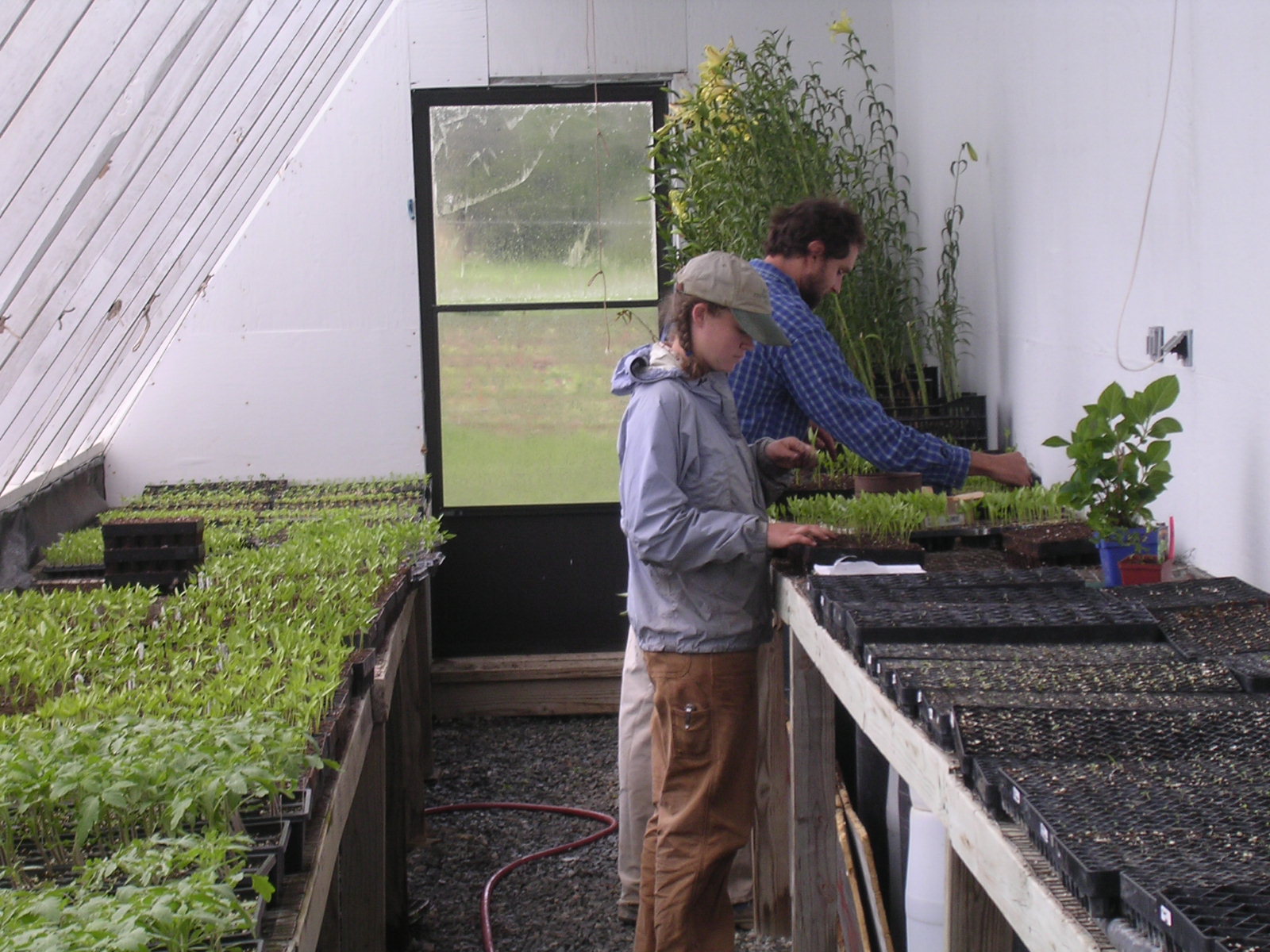
The perfect rainy day activity, moving up the 2500 plus pepper plants

4/19/07 Vol. 4 #5

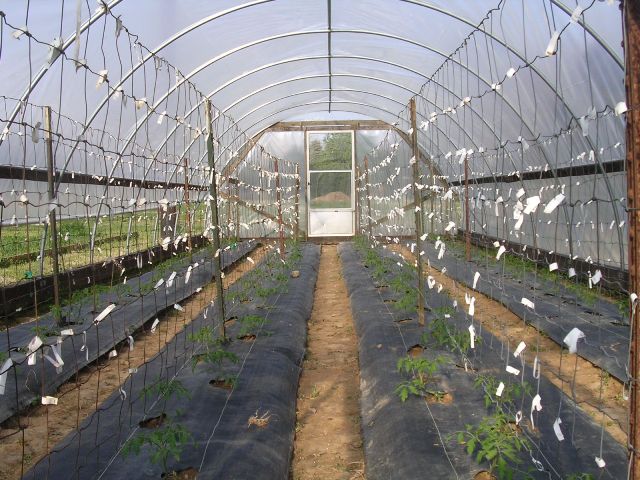
This is one of the pivotal weeks of the year, tomato week.  The whole focus is on getting ready to plant the big main crop of tomatoes and there are a lot of steps in the process.  Tomatoes are a major part of our business and we pay special attention to making sure they very happy.  Of course like everything on the farm we premeditatedly began this dance last summer when we took soil tests to make sure the tomatoes would have just the right amounts of mineral nutrients, especially lime and potassium which they need more of than any other crops.  Then in September we work those minerals into the soil and raise up the beds we will plant the tomatoes into and seed a cover crop of clover and oats.  This cover crop will hold the soil in place all winter, take up any extra nitrogen that may still be in the ground from previous crops and grow more organic matter to further enrich the soil for the coming tomatoes.  A month ago we tilled the tops of those beds, turning that cover crop in so it could begin to decompose and release its good nutrients for the soon to be planted small tomato plants.  Saturday I tilled those beds again, revealing a beautiful rich soil but we are far from ready to plant.  Yesterday after patiently waiting for the incessant winds of Monday and Tuesday to stop we started early (hence the reason for a late newsletter) in calm conditions and pulled the huge 30′ by 100′ sheets of plastic over the Big Tops, under which the tomatoes will grow.  New crew this year as the only people who have ever helped us do this job in the previous three years were Rett and Joann, it went flawlessly.  Under the shelter of the big plastic roofs, the beds can now be covered with the woven landscape fabric we use to keep the weeds down and warm the soil a bit.  A drip irrigation line runs under the fabric because from here on we have to give the tomatoes all the water they will need.  Finally 90 metal posts are driven into the ten beds of this planting and 1000′ of fencing that we use for trellis to support the plants will be hung from them.  By the end of today all will be ready to plant.  The hundreds of little seedlings are waiting in the cold frames, getting toughened up by the breezes and full sun.  Monday they will all be tucked into that beautiful soil, ready to grow up those trellises and give us lots of tasty fruit!

Saturday and Sunday is the Farm Tour, 1:00-5:00 each day.  Our annual opening of the doors to the general public to come see the farm.  Many of you have been on the Farm Tour before and it is a great opportunity to see many of the folks who sell and the Carrboro Market.  Now in it’s twelfth year, thousands of people go on the tour and it raises thousands of dollars for the work Carolina Farm Stewardship Association does.  Sponsored by Weaver Street Market, who does an incredible amount of work to promote the tour and local agriculture, it is easy to go on the tour.  Just pick up a map at the Carrboro Farmers’ Market or Weaver St. Market or many other local businesses and go to first farm that you want to see.  The best deal is to buy a button ($30) which will be your pass for as many people as you can stuff into one vehicle, for as many farms as you want.  34 farms this year so you will have to choose, it is hard to do more than 3 maybe 4 farms in a day.  In the mean time we will be mowing and picking up around the place, nothing like have hundreds of house guests all at once to make you buff up the joint!  Come on out and see what we have been up to, the weather looks to be perfect!

Picture of the Week
Putting the final touches on the tomato trellis under the roof on a gray day.

4/26/07 Vol. 4 #6

Farm tour weekend, wow, always enjoyable and always long days.  We had our usual modest sized crowds which makes it much easier for us to visit with everyone and answer their specific questions.  Some of the farms, especially those with animals, have told me that they had more than 1000 visitors!  There is no way we could deal with numbers like that and enjoy it as much as we do.  It was great to see everybody especially our customers from market, we also get quite a few people who are farming or are seriously looking into it and they ask really good questions about why we do things in certain ways.  One of the highlights was the three van loads of farmers and extension agents who drove all the way up form Louisiana for the tour!

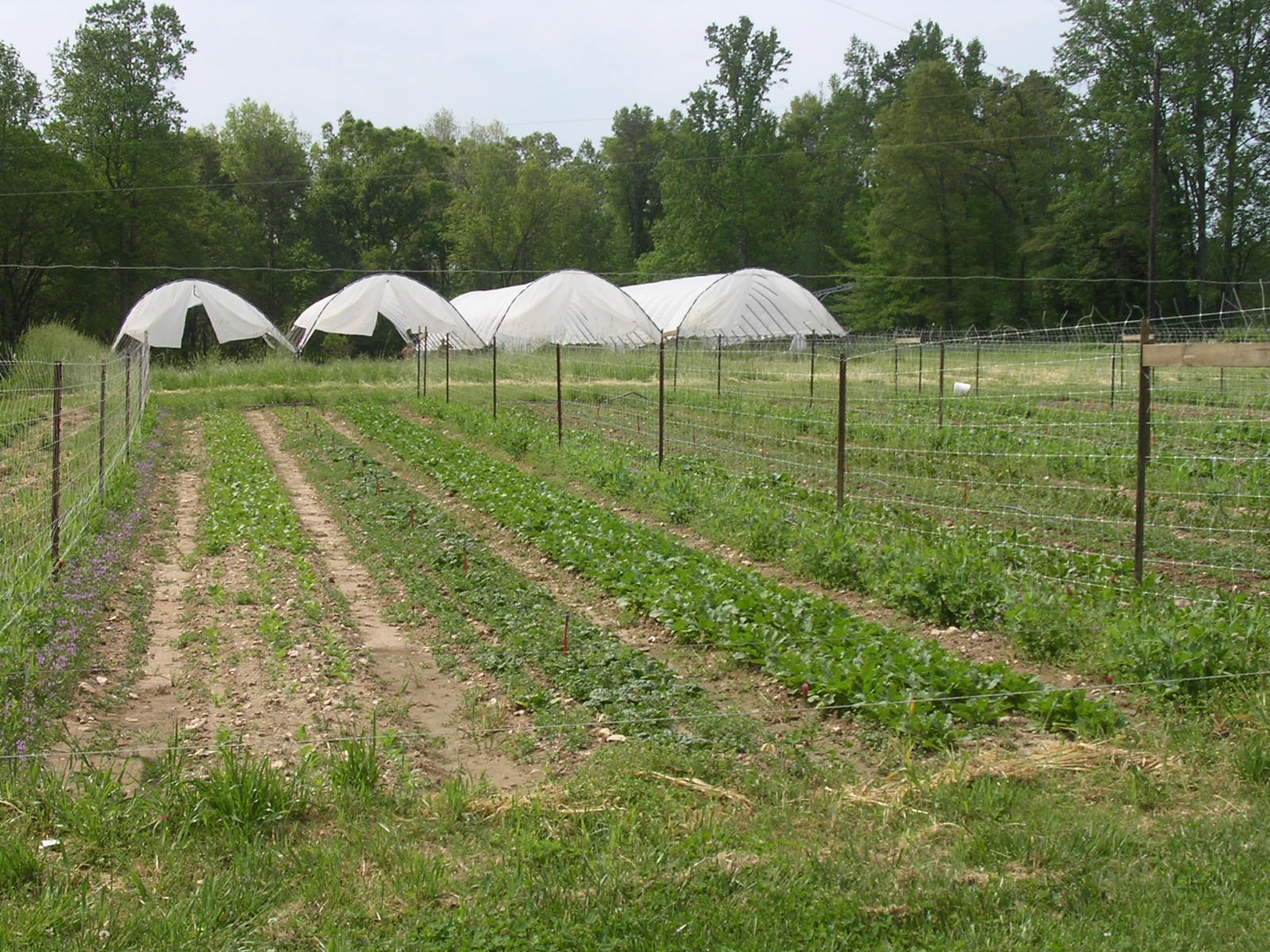
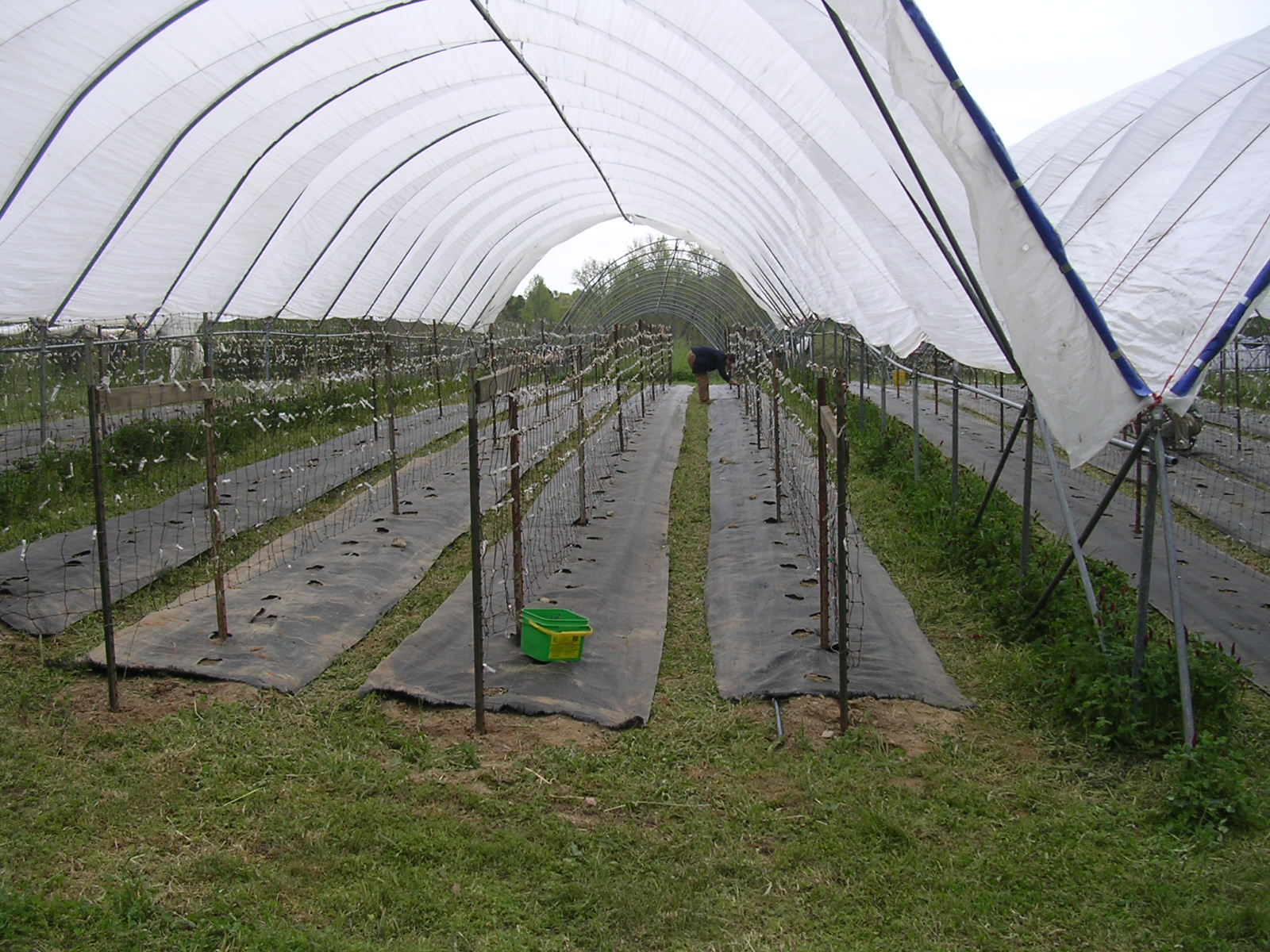
With the hubbub of the farm tour behind us we now turn to the next big projects on the list.  Yesterday we covered the four bays of the Big Tops, over the flowers, moving quickly before the winds came up.  We can now begin the last cultivation and weeding in those crops before we have to start trellising them in the next few weeks.  There are only a few big “hurdles” we must clear each year so we can move on with certain crops and this is one of them.  They punctuate the season which is dominated by little steps each day on the way to the end of the year.  Sliding the tunnels, preparing for planting tomatoes, covering the Big Tops, preparing for planting peppers; those are the ones that always loom large in my mind, three down, one to go.  The big planting of tomatoes went in Monday and they are very happy with this warm weather.  “Only” seventeen varieties in this planting including some new large sauce types from Italy and a cherry from Italy which is one of the Slow Food Presidia, special crops or foods that have been designated as such to help save them.  Here is a link to more information about Slow Food’s efforts to save endangered foods.  Pea trellis went up yesterday, the sugar snap peas have grown out of the freeze damage of a few weeks ago and are wanting to climb.  More flowers and vegetables have been planted and now we settle in on the chores of cultivating, trellising and keeping them watered.

Well many of you have been asking about the turkeys and if we will be raising them this year.  We normally would have the little poults here by now but have been waiting to receive word about the status of the new processing plant.  I finally talked with them on Tuesday and while they are making good progress on building it they could not assure me that it would be ready for Thanksgiving.  So the decision has been made for us.  No turkeys this year.  After two years of the stress of not knowing if there would be a place to have them processed we feel it is best to wait until we know for sure there will be a facility.  This is one of the big differences with turkeys as the heritage types, like the Bourbon Reds that we raise, take a full six months to grow so we need to be assured of the outcome far in advance.  With chickens they only take a little over two months to raise and are easier to get the chicks for, so those farmers producing them can still wait and have several flocks this year when the plant is ready to go.  Sadly no excellent turkey for Thanksgiving or stories of Mr. Tasty as the season unfolds.

Picture of the Week
Just covered Big Tops and newly trellised Sugar Snap Peas

5/2/07 Vol. 4 #7

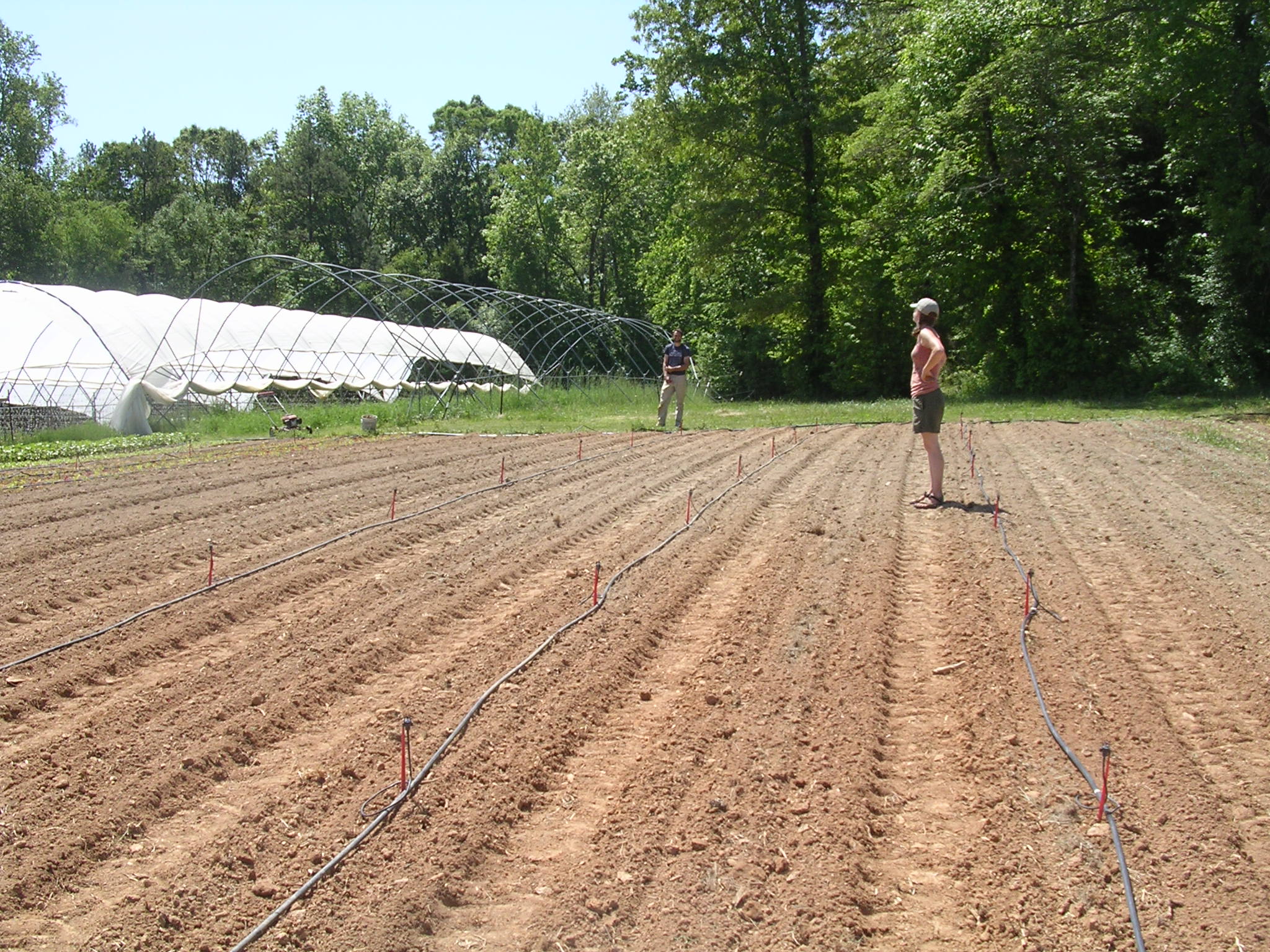
After two straight Wednesdays of early starts to cover the Big Tops I am finally back on schedule with the news from the farm.  It’s hot and getting dry, dry, dry and we are working to get enough water on everything but the newly transplanted small seedlings would really like a rain to get them established.  Our standard spring planting procedure is to plant on days just before a rain is due to arrive so everything gets a good drink of water.  The past few weeks the weather has not cooperated in that way so we move to our summer dry weather system of preparing the planting bed and then burying a drip irrigation line right down the middle of the bed.  We then plant the bed and drag a hose along to water the little plants in well and then let the buried irrigation take over.  This irrigation line is buried just a few inches deep so we can weed over it but it also makes it so the water, that slowly drips out of its openings, moves out through the soil soaking the bed and the plants roots.  That’s the theory and generally it works.  When the top few inches of the soil is as dry as it is now and a hot dry wind blows it is almost impossible to get the whole bed wet with the irrigation line.  We would have to run it for hours and hours to wet it completely and then the established plants in neighboring beds would be too wet.  So the next move, if the rains don’t come and the little plants are drying out, is to roll out the micro-sprinklers to artificially rain on them.  These little sprinklers run on low pressure like the drip irrigation lines do but can throw a fine spray up to ten feet but then we irrigate up the all the weeds too.  No easy solution other than a little rain, maybe tomorrow?

For the second year in a row we are working with NC State on an interesting research project with grafted tomatoes.  In other parts of the world with limited agricultural land and intensive plantings it can be very easy to begin to have problems with soil-borne diseases from planting the same kinds of crops in the same place year after year.  One solution is to use a disease resistant rootstock and graft the variety of vegetable you want on top of it.  Just like fruit trees where they use rootstocks to control the size of the tree and then put say a Golden Delicious on top.  In places like Korea and Japan and Israel a large percentage of their tomatoes, melons and other fruiting vegetable crops are now grafted.  Last year we/they tested two rows of tomatoes here on our farm, just out in the field, testing three different rootstocks just to see the growth and yield differences.  This year they wanted to have the research plot under the Big Tops just like the rest of our tomatoes and to use one of our usual varieties.  So we decided on testing our favorite tomato, Cherokee Purple.  We grow more Cherokee Purples than red tomatoes and so it is a very important crop for us.  Just in case they had trouble producing the grafted transplants in the lab at NC State we started a whole set ourselves so we wouldn’t be without our favorite kind, assuming we would just give those plants away if the graduate student ended up with enough plants.  Then we got nervous and decided to plant those plants anyway just in case there was other difficulties with the grafted plants, this is research after all, things can happen.  So now we have twice as many Cherokee Purples than ever before!  It could make for a very tasty July!

Picture of the Week
Setting up the micro-sprinklers to try and water up the new zinnias

6/6/07 Vol. 4 #12

Just when you think that you have seen it all in 25 years of farming some new wrinkle appears.  We are in a pitched battle with some kind of varmit who is eating all the ripening tomatoes in the little tunnels!  Don’t be messin’ with my tomatoes!  In the past we have found a few things (mostly melons) with tooth marks in them and only one or two a year, but this critter is having a grand old time working it’s way up and down the rows eating or biting into a dozen or so a night.  We put traps in the tunnels a few nights ago and caught a possum and thought OK problem solved but yesterday morning someone had been having a picnic again and the trap was tripped but no one inside!  So now they are getting crafty, maybe a raccoon?  We upped the ante baiting the trap with peanut butter (the universal food used to attract all wild things from mice to buffalo) and now slices of apple.  If this doesn’t get some results then we may have to surround the tunnels with the electric net fencing we use for the turkeys and that will keep them out but also make it harder for us to get in and work.  I am not yet ready to sleep out there with the gun but I mean we are talking about the first tomatoes of the season here!

What a great rain on Saturday night, we had an inch and a half that seemed to all soak in.  Now we can not only let the pond fill back up a bit but we can also get some things planted that just didn’t make sense to do unless there was some moisture in the soil.  Tuesday we finally planted the quarter acre of winter squash (acorns, butternut, spaghetti, sweet dumpling) which should come up nicely now that we had an additional bit of rain last night too.  A bit late to get the squash in the ground as our rule is it needs to be planted in May otherwise we lose the fruit to pickle worms in August.  But it was just too dry the last few weeks to get them germinated and it is one of the crops that I don’t plan on irrigating, especially when we are watering the rest of the farm and running low on water.  So we’ll see, maybe the first of June will be OK and we will slip past the flights of the pickle worm moths.  It is seasonal change here on the farm, cool season crops coming out and the beginning of the harvest of the warm season ones.  Peas and pea fences came down yesterday, the irrigation lines came out of the larkspur and bachelors buttons, soon all will be mowed and turned under ready for the summer soil improving cover crops.

Picture of the Week
Rat Tail Radish Pods

6/13/07 Vol. 4 #13

This is the time of year that we are always tieing something up.  Many of the summer crops need “assistance” standing up, so over the years we have developed multiple ways to trellis them.  Trellising takes extra time and labor so we only do it for certain crops that really need it.  Tomatoes, peppers, cucumbers and pole beans in the vegetables along with lisianthus, sunflowers, celosia, delphinium and a few others in the flowers.  Besides making it easier to harvest them because they are up off the ground it also gives us better quality.  Straight flower stems with clean blooms are Betsy’s goal, those S shaped sunflower stems may look cool but most folks won’t buy them.  In the vegetables it also give us nice clean fruit but also allows for good airflow around the plants so they dry out faster in the mornings after a rain or heavy dew.  Most of the diseases that affect these crops are a fungus or a bacteria, warm wet conditions are perfect for them to go wild.  If we can get those plants up into the breeze then we can slow down the inevitable spread of these diseases.  So we have come up with a set of trellis designs that can be put up fast, do the job and then come down just as fast.  I am the king of metal T-posts, electric fence wire, a few pieces of 2X4, baling twine and some kind of mesh either plastic or metal.  Sounds just like a farmer, a job is not worth doing if it doesn’t involve some electric fence wire, baling twine and maybe some duct tape.

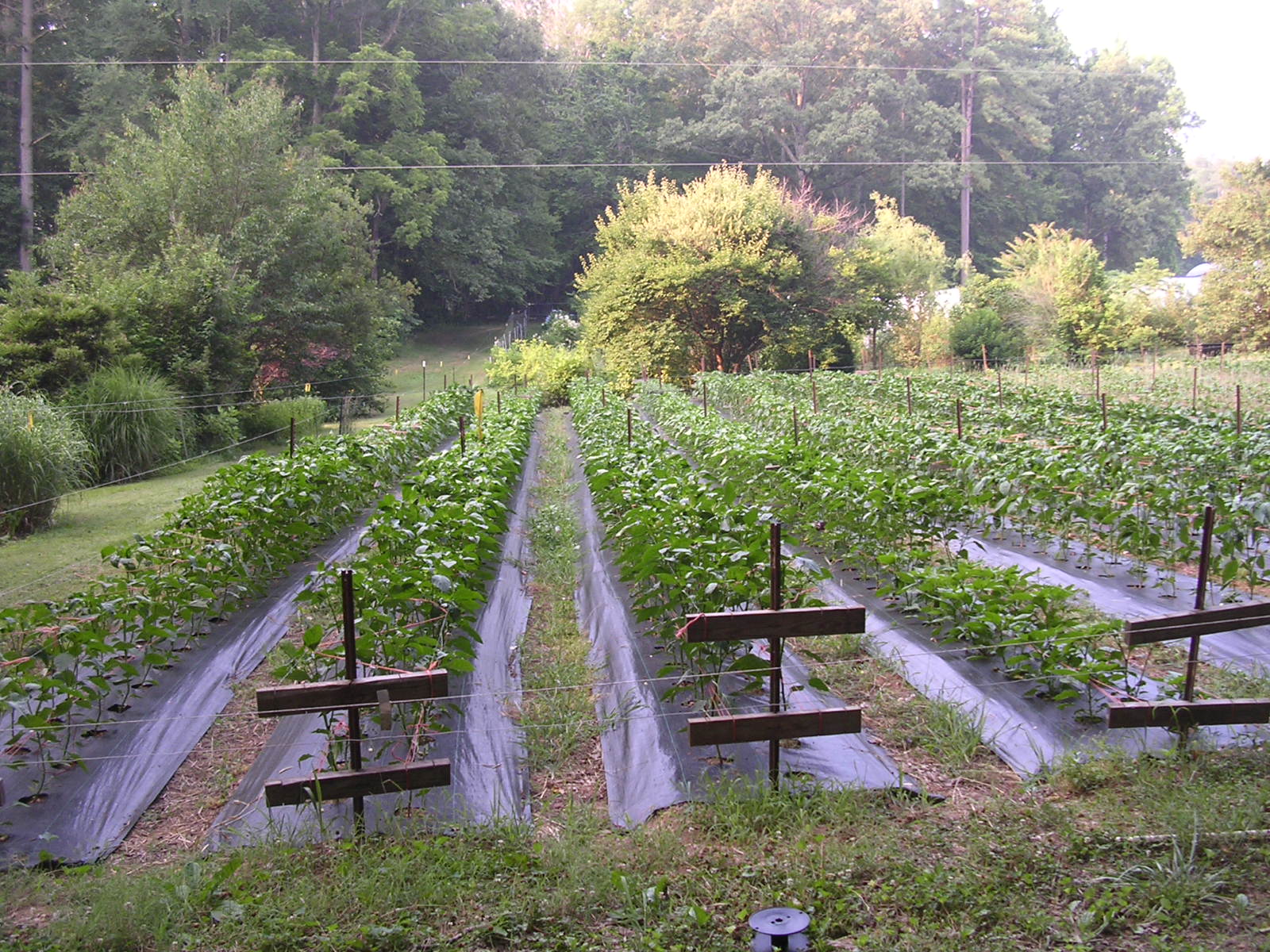
Early in the year the staff is gradually trained in how to build the various “styles”.  Heavy duty tomato trellis with metal fencing hanging off of six foot T-posts, strong enough to bear the weight of nearly 1000 pounds of fruit and vine per 100 foot long row.  Then the wispy pea fences of plastic mesh hanging off the same post set up, just enough structure for them to grab onto with their tendrils and light hollow stems.  Soon they move to the graduate courses in trellising, horizontal structures that float over the rows on cross arms attached to… metal T-posts.  First the plastic flower netting placed just above the growing and budding plants so the weight of just the heavy blooms are supported as they grow up through it.  Finally the two and three level condos of trellises, the pepper array.  A lower level of baling twine run on either side of the little ten inch tall plants to keep them upright in the summer storms.  Then another layer eighteen inches above that of wires and baling twine to catch the branches as they grow up through it to support the weight of the growing fruit, really tall peppers like poblanos get a third, pent house layer at almost four feet above ground.  Cov and Elizabeth are now certified trellis technicians, with almost 6000 feet of construction behind them.  This week the last 500 feet of tomato trellis and the first layer on the pepper trellis.  A friend once said my tombstone would read “He was an OK farmer but he sure could tie things up”.

Pictures of the Week
Tomatoes reaching for the sky and nice straight peppers

6/20/07 Vol 4 #14

It’s always the way, work hard to beat the rain and then the rain decides not to come.  It is summer cover crop planting time and we had been watching the forecast thinking it looked like a good bet that we would get rain to water up newly sown seed.  First it looked like the front would come through this evening and so we had Tuesday and Wednesday mornings to get it all done then, at the last minute, they pushed the time forward to this morning.  Yesterday was a sprint finish to slow race that’s been unfolding for a week or so.  As the spring vegetables come out we mow off what’s left and to help keep the weeds down, the same with the early spring flowers, finally we give it all one more mowing and cut it all in with the tractor.  I did that last Sunday since it was dry enough to work soil after the last rains.  I like to let it lay there a few days allowing all the just turned up weeds to perish in the intense summer sun, that was the slow part of the race.  Yesterday was the seeding day.  First spin out the cowpea seed (we always plant a legume to capture the nitrogen from the air for free) and then because it is a large seed and needs good soil cover to germinate we have to cover it lightly with the tractor, so around and around I go.  Then I walk back over the rough field and spin out the sudan grass seed (we always plant a grass with the legumes to grow huge amounts of organic matter to feed the soil), the grass seed is small and doesn’t need to be covered especially if a good rain is on it’s way.

Of course that was not the only item on the mornings agenda which included some last minute mowing and tilling for some other crops we wanted to get planted before the rain.  Cov and Elizabeth trellised some celosia and continued the red onion harvest, with other projects I would throw in from time to time as I came by.  Check in with the NC State research folks who were out to take measurements of their tomato plots.  I did manage to get most of it done by noon when the staff leaves and we disappear into the house for the heat of the day and it was a hot one!  I planned to go back out late and finish up.  By 3:00 there was the rumble of thunder and it looked like even earlier rain, damn!  So back out I go to finish the seeding and to roll out some Italian bean seed that we brought back to try, seed some more cucumbers and the rain starts to fall, just enough to chase me out of the field but not enough to get the ground wet.  Done, a three T-shirt, two sets of shorts day.  Now this morning it appears as if the rain has passed us by and there is no more forecast for a week or so, I may have to try and water these cover crops up, arghh!

On the tomato-stealing-critter front we had to resort to surrounding the tomato tunnels with the electric net fencing as I have not been able to catch the varmit in the big Have-a-Heart trap.  Thanks to all who sent suggestions for the best baits, looks like eggs and sardines are universally successful around the country.  I went with the sardines option (in Louisiana hot sauce) and the culprit managed to get the sardines out three times without getting caught in the trap!  I was beginning to think this was the Cajun Einstein of raccoons when it started to eat ripe melons out of the other tunnel and carrying them a hundred feet away.  Now I suspect our varmit is a fox.  The fencing has worked to keep it out of the tomatoes so the last job yesterday (on top of everything else) was to surround the melon tunnel too, it looks like a medium security detention center out there now.

Picture of the Week
Medium security electric net fencing around the tomato and melon tunnels.

7/4/07 Vol. 4 #16

A holiday today, well kind of.  Cov and Elizabeth are off today and we are taking the afternoon off but only after a morning of irrigating, flower cutting, mowing, tilling and a few other regular jobs.  Then later on we will head over to my sisters house for a little grilled food, adult beverages and cut throat croquet.  Our contribution to the meal is of course produce, especially the tomatoes.  This is the first full week of the big tomato harvest as we have picked at least a few of every single variety for this year, twenty in all.  So we will arrive with a large platter, the colors of the tomato rainbow- reds of Big Beef and Early Picks; yellows of Orange Blossom, Kellogg’s Breakfast, Nebraska Wedding, Azoychka and Sun Golds; the pink of German Johnson and the yellow and red stripes and swirls of Striped Germans; dark deep red of Cherokee Purple playing off the bright greens of Aunt Ruby’s, Green Giant and Green Zebras.  The juices of the sweet and fruity ones mixing with the higher acid kinds.

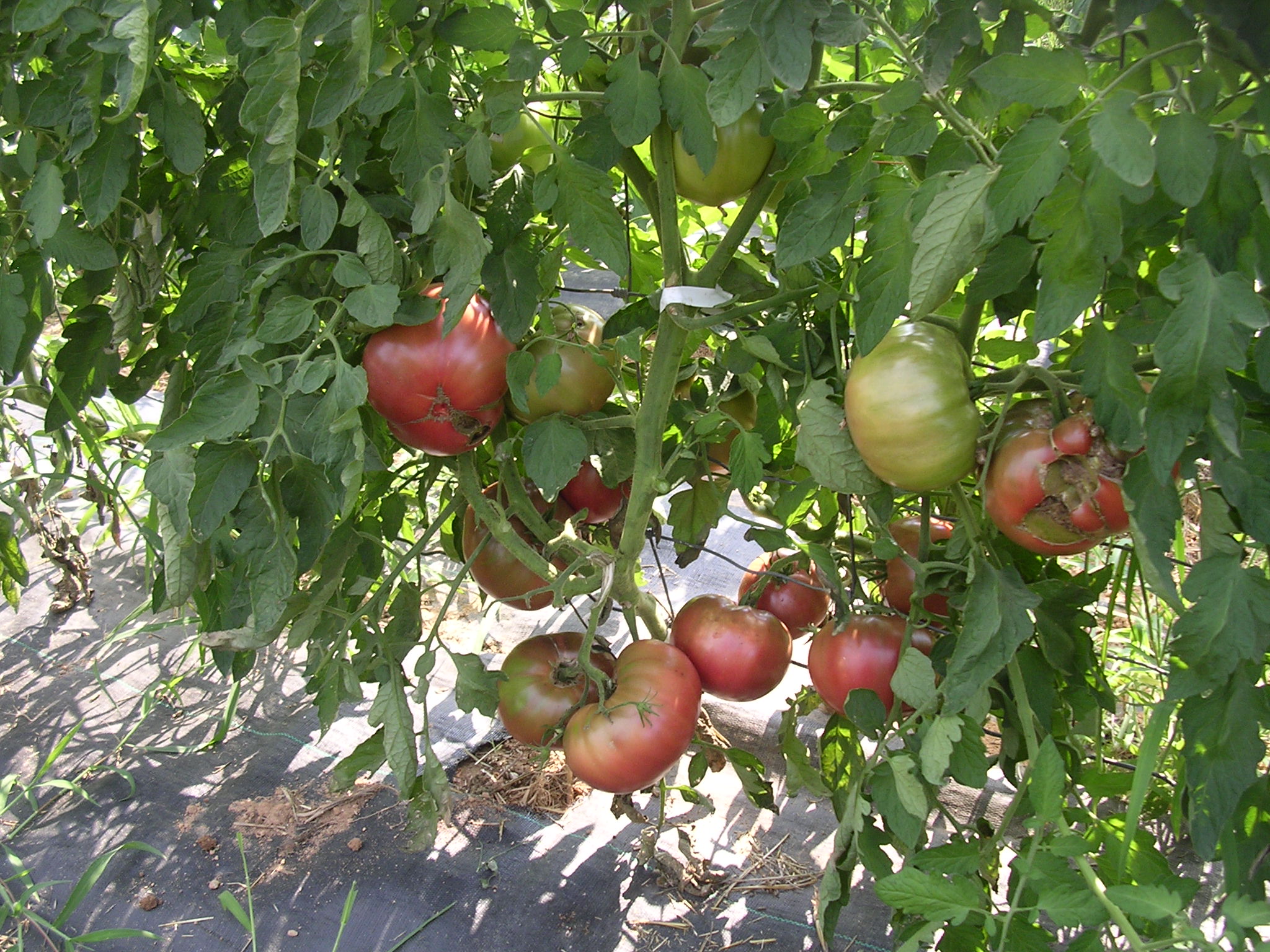
This is the great reward after months of careful tending.  It is always fun to introduce the new staff to the different varieties and their nuances of flavor and ripening habits.  Every Monday and Thursday we spend the mornings picking the 1600 feet of row.  Everyone becomes a specialist in certain varieties.  Cov is in charge of reds, learning to not pick them too green as they take forever to get fully ripe and can hang on the plants longer than all the others.  Only unblemished Italian sauce tomatoes are put in the box, no “freaks” with them.  The German Johnsons are much more tender so he has to change gears when he gets to them.  Elizabeth is the Cherokee Purple queen, fully 500 feet of row to pick and sort, they have the most difficult stems to remove with out damaging the fruit and sometimes one must resort to using needle nosed pliers to pull them off.  She is also responsible for the Orange Blossoms and if she gets done with the purples quickly helps me with the three other yellow kinds.  I start with the monster Striped Germans, so large that it takes two hands to pick them, carefully extracting them from between the vines and the trellis wires trying to not scar them.  I then move to the green-when-ripes, interpreting if it still green or if it has just enough golden cast to it to be picked.  The Sun Gold cherries are a shared job by who ever gets done first.

Bucket after bucket is brought to the back of the truck where each fruit is inspected and wiped with a cloth, sorted into three boxes by color and quality or set aside in the “have to eat today pile”.  The knife comes out as we get the first of the new varieties and slices are sampled between cleaning tomatoes.  Surprise at a high acid yellow tomato, amazement at the beauty of the interior of the bi-colored ones with red swirls through the fruity flavored yellow flesh, the reassuring solid full flavor of a Cherokee Purple, popping Sun Golds as one walks by the row that has them.  Finally finished we slowly drive the load down to the packing shed and the air conditioning to keep them from ripening too fast.  Stacks of boxes by variety and ripeness are built, long rows that run around the room.  Finally bags are filled with the “have to eat today” fruit and the staff heads home, stained a sticky green from rubbing up against the tomato foliage, talking about tomato sandwiches, salsa and gazpacho for lunch and dinner.  Life is good.

Picture of the Week
A great set of Cherokee Purples

8/1/07 Vol. 4 #20

We made it to August!  To me August always signals fall and the end of the season.  Yes it is still hot and sometimes it is a very wet month with thunderstorms but the lushness of early summer is gone and the farm begins to look tired after months of full production.  The tomatoes have given us their best and Betsy is into the third planting of zinnias as the first two look shabby as the diseases and insects gain the upper hand.  Even the weeds begin to mark the end of their run with big old seed heads and yellowing leaves, if we have let them get to that stage.  After 20 straight weeks at market, we are feeling shabby too so it is time for the summer break.  We will be at the markets this week and then will miss the markets on the 8th and 11th.  No newsletter either as we will be hiding somewhere cool with minimal human contact!  I know many of you will be taking a last bit of time off too before school and other fall things start the end of the month.

I have been thinking a lot this week about last Wednesdays radio show “The State of Things” on WUNC.  If you heard it you know they came to the market and recorded a piece on the Tomato Tasting event that the market held on the 21st of July.  It was a fairly interesting piece and they did a pretty good job of getting the feel of what the Tomato Tasting is like but there was one thing that got many of us market members hackles up and that was the comments about how food at Farmers’ Markets is expensive.  Excuse me, but IT’S NOT!  It used to be that prices at markets were ridiculously cheap and as I speak around the country to farmers I always say “Who ever started the concept that Farmers’ Markets are the place to buy cheap produce I want to grab them by the neck!”  Why would fresher, better tasting food, grown in better way, many varieties which you can’t find anywhere else be priced low?  Now the misunderstanding has swung the other way and I hear these “experts” say shopping at Farmers’ Market is expensive.  I want to grab them by the neck too.  Now I know there are exceptions to everything and some markets around the country are more expensive but by and large they are retail affairs with prices generally the same or cheaper than the grocery store.  I know for us at Peregrine Farm our vegetable prices are right in line with the local groceries because I check on a weekly basis.  The cheapest red tomato at Food Lion has not been below $2.29 this year and almost all of their tomatoes are $3.00 and up.  Food Lion!  Don’t even get me started on what they taste like.  Makes our delicious red tomatoes at $2.50 seem like a bargain not to mention all of our different heirlooms.  Same with lettuce and on and on.  With Betsy’s incredible flowers, that you can’t even get unless you work with a really good florist, it is even worse, our prices are wholesale- what the florist would pay before they charge the public at least twice as much.  Of course you all know that the Farmers’ Market is much more than just a place to buy and sell things, it is the town square where we all slow down and get to see and visit each other, let the kids run around and get some really beautiful food and flowers to enrich our lives even further.  That is worth a lot too and makes those incredibly flavorful sungold tomatoes seem really inexpensive!

Picture of the Week
Limelight Hydrangeas

3/28/08 Vol. 5 #2

Busy week, the last out of town conference trip of the season combined with typical spring chores.  Who would have thought that I would be in Kansas City twice in the span of two months?  In January I flew in to be the keynote speaker and a conference presenter at the Great Plains Vegetable Growers conference, a new group to me and I had a fine time.  In the back of my head was the knowledge that the Sustainable Agriculture Research and Education Program (SARE) was having their 20th anniversary meeting in late March, also in KC.  For us, once the market season starts, we just don’t go away, too much to do.  But the SARE program holds a special place in my heart and in the development of Peregrine Farm.  SARE is the federal government’s effort at promoting sustainable agriculture through an innovative grants program and then information dispersal.  Split into four regions of the country, I spent seven years in the 90’s as a farmer representative on the Administrative Council  of the Southern Region which reviews the grants and oversees the operation of the regional program.

Extremely unusual for a government program, it is very participatory and diverse.  The Administrative Councils have representatives from universities, industry, NGO’s, state and federal governmental organizations as well as farmers.  They discuss and debate the future of agriculture and how to direct that future towards more sustainable solutions via the carrot of grant monies.  Not only was I exposed to the newest cutting edge ideas in farming and the leading minds in sustainable ag but also how this kind of group operates.  The politics and relationships involved, how to manage large groups of diverse opinions to come to decisions, where the money goes.  In the end I was elected to the august position of council Chair (I think I left the room at the wrong time).  This took me to the National Operations meetings where I was able to work with my counterparts from the other regions.  In all it was a very formative time for us.  So late March be damned, Betsy particularly thought I should attend partly for the conference sessions but also to see old friends.  Off I flew early Tuesday and returned late last night tired but glad that I did attend infused with new ideas and renewed contacts.

Here on the farm the staff and Betsy have been making great headway.  The early tomatoes and cucumbers were planted on Tuesday, waiting until just after what we hope was the last night in the mid 20’s.  As it has become more common in recent years we are having to do variety trials to find a replacement for a longtime favorite vegetable.  This time it is the early red tomato we have relied on for great early production with great flavor.  Most tomatoes are not suited to planting this early and the ones that are, usually don’t have very good size or flavor.  Burpees Early Pick hybrid is the one we have grown for years and it has performed reliably but in today’s modern seed industry they have decided to discontinue it’s seed production, damn!  We had some seed left and are growing it alongside three new varieties in the hopes of finding good replacement.  In a few months you will get to taste the results.  Big cultivation and weeding week, looks like they got everything cultivated while I was gone.  Weed control is all about timing and the soil conditions were ideal this week.  If all goes well, that will be the last time we have to do any cultivation on the early spring crops.

Picture of the Week
Newly planted tomatoes