5/25/05 Vol. 2 #12

We started the annual clean up/rescue of the Blueberry rows yesterday.  Now that they have been in for fifteen or sixteen years they tend to mostly be forgotten and just a another part of the landscape until it is time to pick them.  We mow the grass between the rows a few times a year but the birds love to sit on the branches and “deposit” weed seeds under the bushes in places that make it hard to get at.  We do mulch the rows heavily every few years but this hardly stops the well fertilized weed seed.  It would be OK if they were just harmless annual weeds but as time goes on it is things like small trees, and the vines that like to cover the plants like trumpet creeper, morning glory and our favorite, poison ivy.  So every May, just prior to the berries ripening, we go out armed with gloves and pruners and cut out these woody invaders, mow as close as we can and maybe do a little selective weed eating.  In the end it is much cleaner and pleasant for the endless hours of picking to come.  Everybody has been asking when will the blueberries be at market.  I went back into the records and found that the average first picking has been May 25th (Friday) but as cold as this spring has been and from what I saw yesterday I don’t think we will make it.  The earliest ever was last year on the 22nd and the latest ever has been the 31st, with the exception of 1997 when we didn’t have any blueberries at all because of a very late freeze in April.  That was the same year that we had frost on Mothers Day, set the lowest high temperature record for June on the 6th at 59 degrees and the record June low of 48 degrees on the 10th!  I guess there can be stranger seasons than this one has been!

The last of the wholesale lettuce goes out tomorrow and in general it has been a good lettuce season, we will still have lettuce for market for weeks to come but the selection becomes narrower each week.  Behind the lettuce we immediately turn under the residue and have been planting more warm season flowers, the third planing of Zinnias awaits tomorrows lettuce harvest so that they can get in the ground, a week late!  The field tomatoes have finally decided to hell with the cool weather it is time to grow so we had to go through and prune and tie them up to the trellis for the first time this season.  Many more passes will be made over the next several months to keep them climbing up the fences.  The Turkeys are three weeks old now and will get to go outside, for the day, for the first time tomorrow, always very amusing to watch.  Betsy is now cutting flowers everyday and the walk in coolers are filling up and are a riot of color, it finally feels more like our normal routine.

Picture of the Week
Incredible Sweet William, what a great long lasting flower!

6/15/05 Vol. 2 #15

As hard as it is to believe, this season is our 20th at the Carrboro Farmers’ Market!  This week twenty Junes ago, June 7th 1986, we made our first feeble attempt at selling our vegetables, flowers, and berries at market.  We started the farm as a pick-your-own blackberry and raspberry farm planting the first crops in 1982.  Because they were perennials we didn’t open for business until 1984 and quickly realized that the pick-your-own business wasn’t going to pay the bills.  We began to look to additional markets for our berries.  In the winter of 1985 my brother Jon moved here to join us in the farming venture and we turned over the last piece of ground we had that wasn’t in berries.  Jon is a natural grower and he and Betsy had the little quarter acre patch overflowing with vegetables.  Our neighbor George Graves (some of you may remember him as a vendor at the market) kept saying “you really need to bring your berries down to the Carrboro Market”  every time we went to check the market out it was pitiful.  No customers and none of the vendors had anything to sell.  Turns out that 9:00 was too late to get there, it was all over but the cleanup by then.

Our first day it took two trucks to get everything to market, not that we had that much to sell, just that we were that disorganized!  One truck for the little bit of produce we had and one for all the display materials- saw horses to hold up the door we used as a table, five gallon buckets filled with concrete and poles to hold up a tarp, etc.  We had zucchinis the size of gun ships, summer squash, a few flowers and not much else.  We made $17.  It didn’t look like the market was going to pay the bills either but we were excited!  The customers were great, interested and encouraging.  The other vendors were helpful, we were so inept we certainly couldn’t be competition!  Jon left the next winter and the blackberries are long gone but we have now made the market the center of our business.  As exhausting as it can be we still are excited about going to market and seeing all of the customers who are still interested, encouraging and great!

The turkeys finally made it out to the field in a wild move.  Last Thursday as the berry picking finished up I decided to use all of those hands to help move them from the brooder to their first stop in the fields.  It had been raining and we waited until it stopped, we thought.  As we were chasing them around it started to rain again and by the time we had finished it was a down pour.  The poor birds were shell shocked both by being caught and handled but were soaking wet too.  We rushed their portable shelter over and got them all loaded with fresh food and water.  In an hour they were all dry and happy and so I let them out to run in the hydrangeas and viburnums.  They are now trained professionals, ranging the area for bugs and grasses by day and each evening as I go to put them up they are already loaded into the shelter, on the roosts, ready for a nights sleep.

Picture of the Week
Amazing Hydrangeas and brilliant? Turkeys

6/29/05 Vol. 2 #17

WooWee!  It’s raining!  I was starting to get a bit nervous and told Betsy that if we didn’t get rain early in the week that we would have to start pulling water from the upper pond, as the lower pumping pond was getting too low.  I hate to have to start using that water as it is a sign of serious drought.  The upper pond is two months worth of water and once we start using it there is no filling it back up until next winter.  The lower pond, while not very deep, is easily replenishable both by it’s slow running spring and the gravity feed line that we have into the creek (which is also slow running right now).  Last week I said that we were pumping about 10,000 gallons a day but the creek and spring are only giving us back about 5 – 6,000 gallons a day.  After two weeks of solid irrigation you can see the problem.  With this rain headed into it’s third day this will buy us the time we need for the water to fill back up.

Of course with the rain I am now kicking myself for not having gotten more ground ready for seeding of the summer cover crops (he is never happy).  The forecast has been for such dry weather, including headed into this bit of rain, that we didn’t want to put seed out there that would just sit there and maybe not come up at all.  We have only had a bit over a half an inch so it’s not so wet that I won’t be able to get out there and till the soil soon afterwards but it sure would have been nice to get them in with this gentle rain.  I did get the sliding tunnel ends seeded yesterday just as the rain started but still have another half acre waiting.

The second round of Turkeys did not arrive last week and we are hoping that they will make it this week.  We are working with our processor, who also raises his own birds, to buy the 35 broad breasted birds that we need to round out the flock.  It looks as if the bronze variety that we want to get may, once again, not be available and so we may have to get whites again.  Like I say, it is always something new with this turkey venture!  Otherwise things are settling back down to more normal pace now that the blueberry season is over.  We are back to our normal 70 hours a week of hired help down from a high of almost 200 hours two weeks ago!  Soon we will be in our mid summer routine of picking tomatoes twice a week, peppers once a week and general chores the rest of the time.  When it gets really hot we like to maintain a steady and not too frantic pace, better for the mind and the body!

Picture of the Week
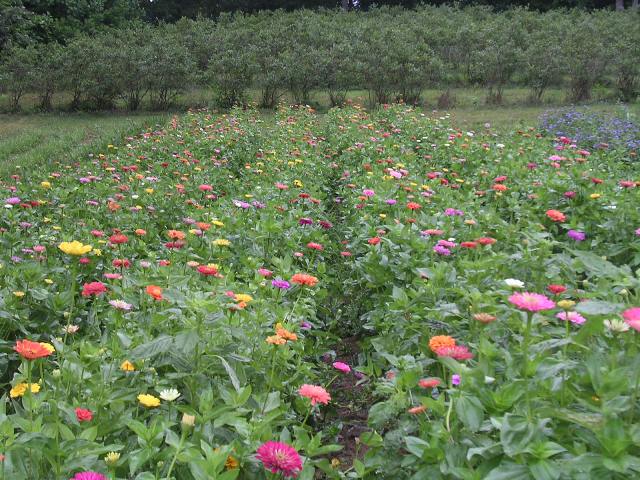
Even on a dreary day the Zinnias are bright

8/17/05 Vol. 2 #23

Betsy says never mention the word vacation to her in August again.  I actually downplay it and call it the August “break” because we never really can just walk away from the place at this time of year.  We still have to do enough work to “keep the lights on” so that there will be something to harvest and sell when we come back.  We still harvest a little (if you don’t cut those flowers they go into decline early) and of course have to water the greenhouse and irrigate and deal with the turkeys and, and, and…  The break concept is important though because we are so worn down after five straight months it helps for the mind and body to heal a bit before heading into the last stretch.  The complication this year was that I strained a muscle so badly in my back that I was out of commission for most of the week and so Betsy had to take care of my “vacation” chores and well as hers.  She says this one is going to cost me jewelry!  But we’re back! and the staff is back, well rested and ready to go.

This is another one of those transitional weeks during the year that signal seasonal change.  We begin pulling out the very first plantings of tomatoes today as they are essentially dead.  No more Early Picks or Orange Blossoms.  Tomorrow we will begin and maybe finish the winter squash harvest.  One normally thinks of these hard squash as being ready more up into the fall months but we have to plant them early so we can avoid their number one enemy, pickle worm, which bore into the fruit and destroy it if we plant them too late.  So they are ready to pick now and we will have them through September.  The “mechanical frost” as Betsy likes to call it rolls in too.  We really begin to mow down many crops that are spent especially flowers that Betsy has stopped cutting because there are newer better looking plantings coming on in another field.  Now our thoughts turn to late fall and cool nights and travel to foreign places.

Picture of the week
New beautiful Zinnias

11/19/05 Vol. 2 #29

Wow! has it really been two whole months since the last newsletter?  We have been running hard and fast as well as having lots of fun!  The trip to Holland and Italy was very informative and beautiful.  The week we spent in Holland was mostly focused on cut flowers but we did manage to go to several markets looking for new and unusual things.  We were able to visit with many farmers and plant breeders and I think that Betsy has found a few new things to try.  The horticultural trade show was over the top!  Dutch agriculture is so fastidious and high tech that I can’t even begin to approach that level of obsession!  Italy was much more relaxed and we didn’t get on as many farms as we would have liked to but still saw many new things.  Our Italian family, that we stayed with last year when we went to the Terra Madre Slow Food event, was great and Betsy’s hard work at learning Italian paid off in much better understanding of each other.  We rented a car this time and spent many days driving through the countryside and going to markets.  We found a few new ideas that we will try and incorporate here this year.  One of our missions was to go to the Slow Food headquarters in Bra, Italy, and visit with the people who are organizing the next Terra Madre conference for next fall (2006).  It appears as if we will be able to go back again, Betsy has even volunteered to help with whatever they need including some basic interpretation!
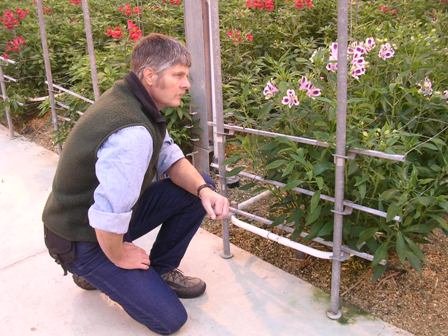
Alex amazed at the technology!

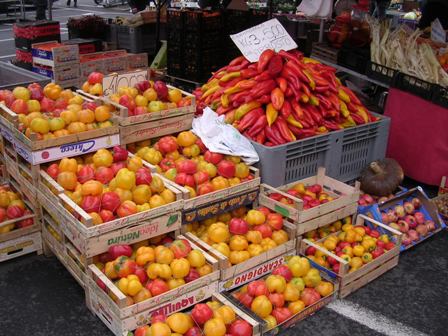
Peppers in Italy

Here are the farm we got all of the soil preparations for the winter finished with near perfect results, never has all of it worked up so beautifully with the exception of this on going dry spell.  The cover crop seeds that I planted a month ago have just barely sprouted.  We are running that fine line now of getting them established before the really cold weather sets in, which can kill them before they have enough roots underneath them.  The turkeys went in for processing before we left for Europe and came out looking good.  The Heritage birds were slightly smaller than last year and the Broad breasted Bronzes were also smaller which is great for those of us who don’t normally eat 26 pound birds!  The flash freezing process went smoothly and they came home yesterday in fine condition.  The processing plant project goes on and on.  In general it is working about the way we had hoped for but every day there is something that breaks down or needs to be worked on.

3/16/06 Vol. 3 #1

Well here we go again!  That statement can be applied to a lot of aspects of this late winter?, early spring season.  Market in two days?  It just seems brutally early but  with the weather we have been having it almost seems too late.  Saint Patrick’s day tomorrow and the first day of Spring on Monday.  Last year on this date it actually snowed on us.  Not this year, I just came in from running the irrigation on the lettuce field.  We are beginning to get really worried about the potential of the drought for this coming season.  You may remember the picture of one of our ponds near the end of last year, pumped down to almost empty, well after an entire winter it essentially hasn’t comeback up an inch.  We have only had it not refill one other time in 25 years!  We are now in the process of refilling it from the other pond and the creek to try and have some water on hand for what is shaping up to be a worse drought than 2002, which is the worst of all time since we have been farming.

The big theme that goes with “here we go again” is that this is a big year for us!  You will probably hear references to this all year but this is what we are calling our 25-25-50 year.  This year we will have been married for 25 years, farming for 25 seasons and we both will turn 50 this year!  The numerologists will go wild with this I am sure!!  Twenty five springs of wondering what it will be like, new beginnings, new crops, new ideas to try.  It is still exciting and scary after all these years.

Despite how wildly busy and un-winter like this past few months have been the farm is actually right on schedule as for as planting goes.  Betsy has taken time out of studying all things Italian to make sure that I focused enough so that we got things done in a timely manner.  The poultry plant saga rolls on and has used up more time than we could have ever imagined possible.  I would like to say it is all running smoothly but can’t.  I do feel as if we have turned some major corners and things look better in recent days.  So good in fact that I have ordered turkeys for this season, six more months of good bird stories!  The first 6000 heads of lettuce are in the ground, the peas are up as is the spinach, turnips, radishes and more.  Lots of flowers in the field too, we just now need to get some water to them to make them grow.

The winter speaking season ended last week with two presentations in Asheville at the Organic Growers’ School.  I also traveled to speak at conferences in Virginia, Kentucky and Georgia.  Good folks at all these meetings and we feel that the small farm-local food message is really growing by leaps and bounds.  One more big meeting this weekend (the Southern Sustainable Agriculture Working Group board meeting) and I can finally stay home and farm!  Betsy is still taking Italian class two nights a week and I am taking a pastured pork production class one night a week, think prosciutto and pancetta!

Picture of the Week
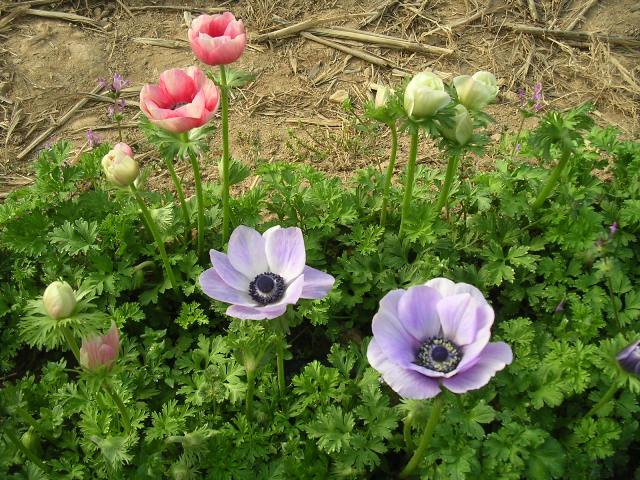
Fantastic Anemones

5/17/06 Vol. 3 #10

The endless lettuce season rolls on.  At least it feels endless these days as I go out to cut four mornings a week.  The staff arrives each morning and I brief them on the days jobs and end with “of course I will be cutting lettuce if you need me”.  Mondays and Thursdays I cut for delivery to Weaver Street Market, Wednesdays and Fridays I cut for the markets and the restaurants.  Usually two, sometimes three, hours each morning.  We are now into the fourth week with one big week left to go.  Lettuce is one crop that I do all the harvesting of.  It is such and ephemeral plant that it takes sometime to develop an eye for which head is large enough and tender enough to cut.  In a few days the heads that I pass over will be big enough to then take, in a few more days they will be too far gone, getting tough and bitter.  The hotter it gets the faster this progression occurs.  The weather of the past few weeks has been about as ideal as we get in North Carolina as far as lettuce is concerned so the pressure has been off a bit.  It is easy for me to train the staff on what is the right size of turnip to pick and how big a bunch is but the lettuce thing is more like “is this flower at the right stage to harvest?”, it is subjective (hence the reason why Betsy cuts almost every flower stem on the farm).  Twenty four heads to a case, six cases and hour if I have to search around, ten cases and hour if the planting is really uniform, that is one head every fifteen seconds!  I am counting the seconds until the season is done.

Big event at the Market this Saturday.  The Market is having a fundraiser for our sister market in New Orleans and all of the farmers and fishers who where devastated by hurricane Katrina last fall.  Like the Carrboro Market which was open two days after hurricane Fran crippled this area in 1996, the Crescent City Market was up and running only weeks after the water receded in New Orleans.  Markets are an important social component for towns and cities as well as sources of food.  Muffulettas and Gumbo prepared by a dozen Triangle chefs will be available to go for $10/serving, for more details go to the Carrboro Market websiteAll proceeds will go to the Crescent City Markets and their efforts to bring their vendors back into production.  Come on out for the good food!

It has been the normal orchestrated chaos this week with more planting of summer crops, more zinnias, sunflowers, celosia, cucumbers and another planting of Cherokee Purple tomatoes.  Weeding, trellising of flowers and vegetables, mowing, harvesting and on and on.  The turkeys got so wild last week that we had to trim the wing feathers on all of them.  After chasing the little miscreants all over the farm, including one that spent the night out because we couldn’t catch him at all, we decided we had to make sure none of them could fly until they learned better behavior, maybe this is where the term “grounded” came from that our parents threatened us with as kids.  Well this was no idle threat for these birds!  They go out to the field permanently tomorrow.

Picture of the Week
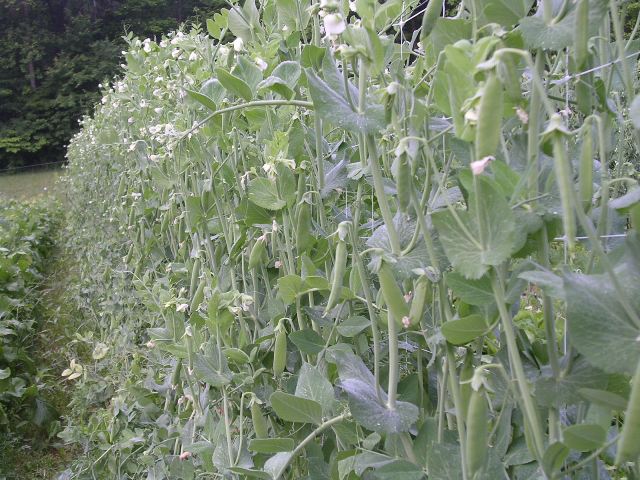
Sugar Snap Peas already loaded up with many more blooms on the top of the plants

5/31/06 Vol. 3 #12

The heat has arrived and with it the big flush of blueberries.  We started out with plenty of picking help last Thursday and then spiraled out of control at the beginning of this week.  I always try and line up enough extra help so we can pick and get other chores done on the farm.  We need to have six to eight people every day for the next two weeks to keep the berries picked on time.  With fewer than this we fall behind on all the other things on the farm.  Tying the tomatoes up to the trellis, cultivating and weeding, building trellis in the peppers and flowers and more.  Every year it is the same, so I don’t know why I am surprised and it always works out.  I try to get out and help pick too but end up spending most of my mornings taking care of the other duties, irrigating, picking the other vegetables for market the rest of the show must go on too.  Blueberry picking is really the most enjoyable job on the farm and the staff has fun doing it as there gets to be quite a banter out in the field.  At least the wholesale lettuce season is over, I cut the last of Weaver Street’s lettuce on Monday so now I can have my mornings free to chase the other items around.

One of yesterdays tasks was to clean out the turkey brooder to get ready for the next batch of birds, which come tomorrow.  The shavings and droppings are shoveled out and spread on the beds of one of the sliding tunnels, great stuff for that soil that we use so intensively.  A thorough cleaning including spraying down the walls and floor with chlorine to disinfect a bit.  After it dries out well we put in a new batch of shavings about three inches deep.  Over that goes a layer of newspaper that they will be on for the first three days while they learn to eat (and read I’m sure) the right food instead of the wood chips.  Finally a draft ring goes in and the newly disinfected feeders and waterers.  Now we are ready for that early morning call from the post office.  Forty broad breasted Bronzes to eventually join the Bourbon Reds out in the field.  We get this group later because they grow so fast, they would be forty pounds if we got them at the same time as the others.  This way everyone runs together and finishes up at the same time.

We had an interesting group of visitors last week from the EPA.  These are some of the folks who are responsible for registering pesticides for farmers to use.  Now we don’t use many pesticides (remember that a pesticide is anything that kills a pest, even organically approved materials) seeing as how we are committed to sustainability and organic practices, so we wondered why they would want to come see us.  Turns out that while they have pretty good data and an idea of how soybeans and corn grow they don’t have a clue as to how an intensive horticultural operation works, how the crops actually grow and how one could grow them without pesticides.  There were entomologists, biologists, pathologists and the much maligned agricultural economist.  We described how we maintain soil fertility, rotate crops and what strategies we use to deal with pest problems.  They seemed genuinely interested and as a sign of how things are changing in the world of big Ag and regulation they actually are trying to measure the costs and risks of using a pesticide over using other techniques such as we us.

Picture of the Week
Dark and threatening rain this morning, but the Campanula brightens up the day

6/21/06 Vol. 3 #15

The first day of summer and now the days begin to get shorter.  While we have been fortunate to have cool weather last far into June the days getting shorter are still a sign that it is all down hill to fall now.  I know we still have lots of summer season to go but in our minds we are always anticipating the next season, seeding crops for it, making plans around it. etc.   This long term view of the world is important for a farmer to have, partly to be prepared for what is to come so we are ready to take advantage of it (“have to make hay while the sun shines”) and partly to see past what might not be going well this season (“there’s always next year”).  I find that having an understanding of the long cycle of the seasons allows us to better plan our crops and how they best fit into the agro-ecosystem.  What summer cover crop works best before a fall planted flower crop that if planted at the right time and temperature will not have horrible weed problems next spring to fight.  Those flowers need to come out in time for another summer cover crop (different this time) that will be mature enough in time to run the turkeys through and will build organic matter and nutrients for the following springs lettuce crop which needs lots of nutrients but never uses them all.  When the lettuce is done we can plant late summer zinnias and sunflowers that can soak up all that excess nitrogen but will be done in time to plant a winter cover crop that will feed the next years early summer flowers and on and on.  A farmer friend of ours says “I only have about twenty more times to try and get this right”.  In some jobs you can try and get it right instantly, or the next day or the next week.  In farming we only get one chance a year and we better see it coming!

It is summer cover crop time and as the spring crops come out we are preparing to turn the residue under and seed those soil improving crops.  I wish I could have gotten it done before the big rains of last week but will all work out.  We were lucky again to get good rains but not as heavy or as much as some our friends.  Two inches on Sunday last and a steady 1.6″ from Alberto.  Some of our fellow market farmers had as much as fourteen inches from the various storms last week!  Blueberries are finished and because it was such a light crop we are not in too bad a shape coming out of the season on the rest of the farm.  This weeks big job is the red onion harvest.  We have to wait until the tops start to fall over which is the signal that they are finished growing.  It is best to harvest when it is dry and warm so that he necks of the onions dry out well.  If it is too wet then the chances are high of some kind of disease infecting the freshly cut off neck and causing the onion to rot.  Perfect weather this week, but the staff always feel like I have staked them out on and ant hill when I say its time to harvest onions.  We carefully pull each one of the 5000 plus plants, cut off the top leaving a inch of neck, cut off the roots, wipe off any excess dirt and place them in ventilated trays.  The trays are then put into our passive solar greenhouse to cure and dry.  Then over the next few months we will clean a few boxes each week and bring them to market.  It is a lot of work but the quality and health benefits of these red onions are worth it.

Picture of the Week
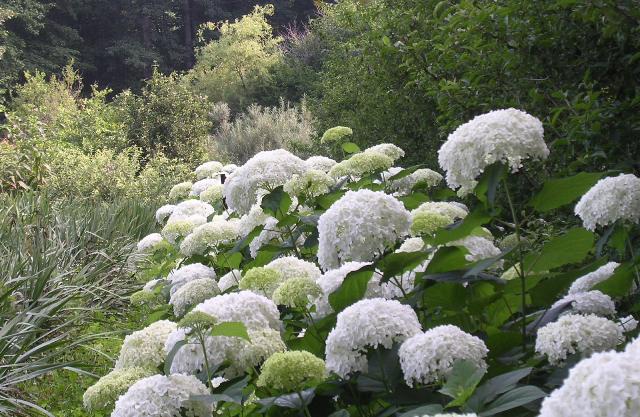
Fabulous Annabelle Hydrageas at their peak

7/5/06 Vol. 3 #17

The day after July 4th, we gave the staff the day off as it was going to blistering hot anyway.  Normally we would have worked a little and then taken the rest of the day easy.  We did the little bit of work but then had to go truck shopping.  I would rather walk across hot coals than go to a car dealership but Betsy’s little truck had finally gotten so unreliable (it is only twenty years old I don’t understand why these trucks can’t last longer) that we had to do something.  The big white truck is what most people see at market and when we do wholesale deliveries but the little truck is Betsy’s work vehicle.  It goes around and around the farm with buckets of water for the flowers and moves plants and supplies and more.  About twenty Saturdays a year it goes to market too.  Usually carrying 20-30 buckets of flowers it is this duty that makes it critical to the farm business. So while we only drive it less than 1000 miles a year we couldn’t carry on without it.  If you need a wheelbarrow and don’t have one there is just not substitute.  We have debated for years what to do, maybe a different kind of vehicle, or an on farm “stuff mover” and it always comes back to the same formula, one big truck, one little truck.  Last Saturday we had to borrow Rachel’s truck to get everything to market because the old girl just wouldn’t go.  This just won’t do so off we went on mission to knock it out quickly.  Believe it or not two stops later after very direct no nonsense haggling on our part we drove home with a new work truck for Betsy, I still wonder about the color name though “Impulse Red Pearl”.

Today is finally cover crop seeding day.  It dried out enough this week to get the acre of spring crops (or the remnants of) mowed down and turned under.  The rains are coming back tonight so I really need to get the soybeans and millet sown to take advantage of this next wet window.  This is always a race but made even more difficult with trying to get it all done before we have to go to market this afternoon.  These cover crops are the life blood of our soil fertility program.  In eight weeks we can grow up to eight tons per acre of organic matter, in place!  It is one of the miracles of raising crops.  That you can spin out about 150 pounds of seed and then two months later mow down 16,000 pounds of material and captured over 100 pounds of free nitrogen out of the atmosphere is mind boggling.  Include the fact that we don’t have to spend hours running up and down the road hauling manure or compost and then spreading it on the fields, my back and the environment are applauding.  When we turn these cover crops, also known as “green manure”, under they are broken down by the millions of soil inhabitants and all those nutrients are released for the next crop to use.  The earthworms, fungi and bacteria are all applauding too.  What a system nature developed over the billions of years!  Maybe I will take the Impulse Red Pearl over to our farm supply to get the seeds.

Picture of the Week
A sea of Lisianthus