7/7/04 Vol. 1 #17

Whew!  The heat’s on now, it’s usually either feast or famine, we could live in a climate like California where the weather is constant and predictable but where would the challenge be?  I am sometimes surprised by the folks who comment to me about how we seem to have one problem after another or as my sister described the newsletter “the first part is about how hard they work and the second is about the market”.  The newsletter is a stream of consciousness (or unconscious as I do it way too early in the morning) about our life here on the farm.  Our intent is for you to get a snapshot of how a small farm works and why we choose to do this as a living.  With less than one percent of the population being farmers these days it makes it harder for those of you who are not on the land to get a feel for what it takes to produce crops week in and week out.  We don’t want you to think that what we do is all work and no joy, there is nothing else we would rather do for a living (besides the fact that we are unemployable in the outside world at this point!).  In fact there are many times when we look at each other as it simultaneously occurs to us that this is what we actually do for a living!

It is different for farmers because we live where we work and our work is part of everything we see and do.  We could be cabinet makers and have a shop at home but at night you would close the doors and go to the house.  We can’t close the doors because our shop is all around us.  The challenge is what makes it interesting for us, my obsession is in managing the whole system in an elegant way so that, with the least effort possible, we mimic the ecosystem around us, as much as we can, while producing great stuff.  Betsy’s is in the beauty of the plants themselves, she is a plant junky, she wants to see how they grow and what they will produce.  Our real goal is the highest quality of life possible.  Sure at this time of year the work is brutally constant but there are still many rewards like the sunrise this morning, or the sight of the turkeys jogging over to see us or the fun we have with the people who work for us.  Six months off isn’t too bad either!

The second batch of turkeys is looking good and growing fast, and the “big boys” are now nine weeks old.  We did find one this week that had hurt its leg somehow and is in the “hospital ward” eating all of the melon and cull peaches it wants, this is our version of “peel me a grape”.  We may put him back in with the rest today.  The summer cover crops went in this week as well.  When the spring crops come out we follow them with summer soil improving crops like soybeans and millet.  Just like the winter “green manure” crops that we grow we prefer to grow our organic matter and fertilizer in place than spend all of that time and energy hauling it in.  We are planting the last flowers for this year and actually seeding, in the greenhouse, flowers for next spring!
Picture of the Week
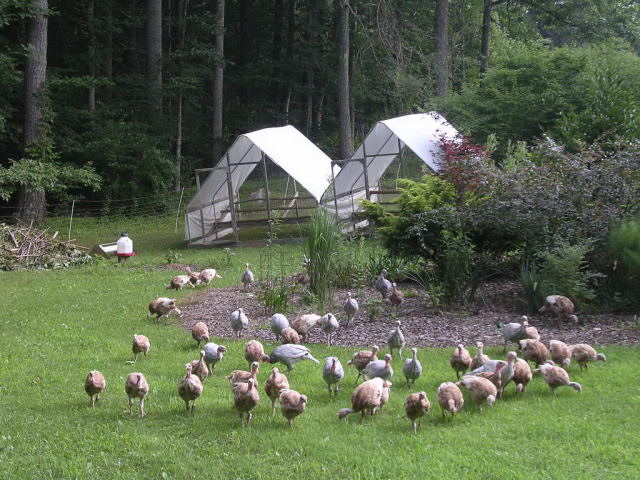
The turkeys grazing in Betsy’s recreational gardens

7/21/04 Vol. 1 #19

Pretty quiet out here on the farm this week, even with the slight break in the really hot weather we have been just chugging along with the usual chores.  The mid summer meeting season seems to have arrived and so we have been trying to attend some that we think might be good for us to participate in.  Most of the farmer meetings are in the winter when we all have lots of time to think about new ideas but it is all on paper or in slides.  There is a period during the growing season when short events happen, usually afternoon or evening, that allow us to actually see things growing, in person!

This week we attended a seed saving workshop.  With over 200 varieties of crops that we grow, it is just not possible to think about saving our own seed.  To do a good job of saving seed one really needs good isolation from other like plants so that you can be assured of no cross pollination, that would be really hard for us to achieve.  We have been interested in this for several years now, particularly in the heirloom tomatoes.  From time to time we have ordered tomato seed and when they began to produce it was clear that it was not what we had ordered, imagine how excited I might get if the Cherokee Purples turned out to be something else!  So we are looking at beginning to make selections for fruit quality and plant strength in some of these heirloom tomatoes so that we can have some more control over one of our most important crops.  In the back of my head I also have an interest in trying to develop our own Poblano pepper that would produce consistently under our conditions here in North Carolina.  We have trialed at least a dozen Poblano varieties and have found only one that does reasonably well and are afraid that we may not be able to get that one for too much longer.  The seed business these days has been in great flux as it becomes more and more consolidated.  We have lost several varieties over the past few years as the new companies decide to discontinue varieties for one reason or another (the main reason being dollar$).  I’m not sure it’s not just the heat that makes my head swim with such ideas!

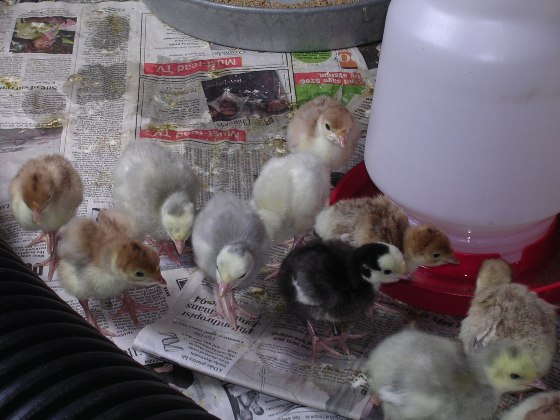
The Broadbrested turkeys, known here on the farm as the “little guys”, are three weeks old now and will graduate to going outside from the Poultry Villa during the day to get them used to eating grass and sunshine and their new mother ship.  After two weeks of day time privileges they get to go out to the fields for good.  First along side, but separated by a fence, the “big boys” and finally total integration.

Picture of the Week
The Broadbreasted White Turkeys thinking about making a run for the outdoors!

8/23/04 Vol. 1 #23

Sort of a normal week for us, just what we needed to recover from vacation!  We are beginning the process of putting the farm to bed for the winter that goes on from now until November (I know it is still August but the job has to be started at some point).  The first major act is pulling out the first planting of tomatoes and preparing that ground for a winter cover crop.  Slowly we will be taking out the summer crops and seeding them down until the whole place is a carpet of brilliant green cover crops.  Leeks for Thanksgiving went in the ground along with kale and more radishes.

Speaking of Thanksgiving it is Turkey ordering/reservation time.  As I have told folks all season we like to wait until the birds get old enough so that we have a good idea of how many we will actually have in November before we start putting names on paper.  Even then things can happen and we can lose birds like we did last year, with four weeks to go, when something got in and killed three birds.  There are some changes from last year that you should be aware of.  We had a meeting with our processor last week and due to their higher production numbers we are going to have to have our turkeys processed two weeks before Thanksgiving.  This means we will have to freeze the birds to hold them until you pick them up on Tuesday November 23rd. There is just no way we can hold them safely as fresh/unfrozen birds that long.  We understand if you want a fresh bird and decide to buy one elsewhere.  We can tell you that the frozen turkey that we have been eating all year has been fabulous without any loss of quality.  It may also be more convenient for some who need to travel with their bird such as one person who plans to take one to France!

The second change this year is in the price per pound of the Heritage turkeys.  After crunching the numbers from last years birds we realized that due to the longer growing time, higher initial bird cost and the lower average weights that we needed to raise the price to $4.00 per pound.  The Broadbreasted Whites will continue to be $2.50 per pound.  That still means that a turkey will cost between $30 and $60 depending on the size.  The Heritage birds will run from 7-15 lbs. averaging 10 lbs. and the Broadbreasted birds will run from 15-25 lbs. with an average of about 20 lbs.

This is how to reserve your Thanksgiving bird.  We take reservations on a first-come-first-serve basis, those who had a turkey last year will have the first choice.  We are announcing this first to those of you receiving the newsletter and then we will put a sign up at market in a few weeks if by chance there are any birds left.

Picture of the Week

Our niece and nephew with a Blue Slate

9/8/04 Vol. 1 #25

Let’s see how does that go?  Forty days and forty nights…?  Another 3.2 inches of rain in the last couple of days making it hard to get anything done.  I was on the tractor on Monday beginning to get soil prepared for winter cover crops and was chased off by the rain, now it will be another week before it is dry enough.  The gravel that was on the driveways is well on its way down to Jordan Lake, we have at least a half a mile of roads on the farm that will take a few days to pull them back up the hill, some of them look like the Grand Canyon!  It is times like these that we look brilliant for deciding to stop selling the end of September, these are precisely the kind of conditions that make it really hard to produce consistently good fall crops.  Heavy rains that make it hard to get crops started followed by huge disease, weed and insect pressure.  I take my hat off to those at the market who continue on in the fall!  I hope that you all will continue to support them at market knowing they are waging a considerable battle to bring that produce to market.

We did manage to get the winter squash out of the field, washed and in storage, look for them this week.  Not a great yield this year, got them in a little late and then too much powdery mildew disease.  The last of the tomatoes came down this week as well, now the turkeys will move into that field and finish the clean up.  Mowing, mowing, mowing trying to keep up with the grass and taking down the remnants of the summers crops so we can someday get them turned under.

News on the turkey front.  After talking to a large pastured turkey producer in California it looks as if we can keep the turkeys unfrozen/fresh for Thanksgiving.  This whole situation is very frustrating in that you can not get a straight answer from either the NC Department of Agriculture or the USDA as to how long you can keep a turkey at what temperature.  There simply are no official written guidelines or regulations, amazing.  Fortunately we have connections that put us in contact with this producer who also is a processor and knows exactly how to do it properly.  Nothing like hands on experience to clear up a problem!  The last hurdle is to check with our refrigeration guy to make sure that our walk in coolers can be operated at the temperature that we need to keep the birds at.  I will let you know next week if we will have the birds fresh and not frozen.  For those of you who want a frozen bird we can still make that happen too.  About half the birds are reserved now, I will make sure that I bring reservation forms to market for folks to fill out there if they would prefer.

Picture of the Week
The sleepy creek just below our house (which is 100 feet to the left)

11/20/04 Vol. 1 #29

Busy, busy, busy!  Both here at the farm and on the road.  Betsy was gone for a week to Florida for the Association of Specialty Cut Flower Growers convention.  She always comes back with a million new ideas and I have to try and sort through them with her.  She was also awarded the Distinguished Service Award, even though she tried not to accept it, no one has worked harder for the Association.  The last week and half has been a blur.  The turkeys went in for processing which is both a lot of work and somber at the same time.  It all went fairly smoothly and they are now in our walk-in cooler awaiting Tuesday’s market. Betsy had to turn around and drive up to Virginia to pick up 12,000 tulip bulbs that she jointly ordered with some fellow growers.  These are now planted in crates so that we can force them early for next spring, look for them in March!

The two of us passed each other as I drove up to Asheville for the Carolina Farm Stewardship Assoc. conference where I presented in three different workshops.  At the banquet the Carrboro Farmers’ Market was awarded the Sustainable Business/Entity Award for the work its done and the leadership the market has given both to local farmers and to other markets across the state.  It is markets like Carrboro and customers like you that give hope to small farmers and the ideas of viable local food systems.  Monday I jumped on a plane to Alabama to give two workshops.  One for the Alabama Sustainable Ag. Network and the other to a group from Auburn Univ. who are setting up an organic research station.  I was really glad to get home after giving five talks in five days!  I’d say the meeting season has started hard and fast.

The end of this week has been back to farm work.  The cold snap last week finally killed the foliage on the tuberoses and the dahlias so that we could dig them for the winter.  We have to dig these tubers because they cannot take the cold temperatures we experience over the winter, then we will replant them next spring.  They have been kind of in the way of getting the rest of the fields put to bed for the winter.  Now that they are out the last of the soil preparation is done and the cover crops are sown!  Yesterday we planted the first 4000 Dutch Iris and the backs of our legs are telling us about it!

Picture of the Month
Look close and see the Brussels Sprouts (left of center) and the Celery on the right

5/5/05 Vol. 2 #9

A day late with the newsletter for good reason.  The heritage turkeys came yesterday morning and we were scrambling around getting the brooder house (a.k.a. Poultry Villa) ready for them.  Every year it is something new with this turkey thing.  This year there are problems between the US Postal Service and certain airlines, who carry the mail, about shipping live birds.  So we were not sure that we were going to be able to get these turkey poults from Texas until they confirmed that they had actually made it on to the plane.  That was Tuesday afternoon and we originally thought we had until Thursday to get ready!  So we scampered around until dark on Tuesday getting the brooder all cleaned out and disinfected and going to town to get feed and  bedding.  Yesterday morning I was putting the finishing touches on the Poultry Villa as Betsy drove up to the Post Office after they called at 7:00 to let us know that the the little cheeping box had arrived.  So here we go again!  70 two day old balls of fluff zipping around.  So far they are all singing and dancing amongst the feeders and waterers.  We plan on getting another 35 Broad Breasted Bronzes from a local source in about 6 weeks to round out the flock.

Cinco de Mayo today and to celebrate we got all of the hot peppers in the ground the last couple of days, now we have to get all of the sweet bells planted if it will ever warm up!  It is now official, this cool spring season is the worst we have had in over ten years.  So cool that even the cool season crops are holding back including the flowers!  For the first time ever we will not have the overflowing flower display at market for the Mothers Day crowds.  It is also holding us back a little on getting the rest of these peppers in the ground as we plant the sweet bells, no-till, into a cover crop that we kill by rolling it down.  The problem is the cover crop won’t kill/die if it is not blooming and because of the cool weather it too is delayed.  Additionally if we plant the sweet bells into the colder-than-usual soil under that cover crop they will just sulk.  We plant the hots into black landscape fabric, just as we do with the early tomatoes, so that the soil is warmer but the sweet peppers don’t need as much heat , usually.  So we are going to wait a week to see if warmer temperatures will finally settle in.  How am I going to bring out the pepper roaster on schedule if peppers are delayed?

The cool weather has some good points.  Because there is not a lot for the staff to harvest yet we are getting really caught up on all the other jobs around the place.  Everything is weeded (well almost) , irrigated and trellised.  We may have to break out the paint brushes and put a coat on the packing shed or something!  The Rhubarb plants finally came this week and we planted them quickly.  This is the third time we have tried Rhubarb so if it doesn’t work this time then destiny is not on our side.  I think we finally have learned from our mistakes and have it in the right spot.   Next year we will see if we were right.  The video crew from NC State came out on Tuesday to shoot for a piece on the farm for the on-line Agroecology course.  If it is available for the public to view I will give you the link when it happens.

Picture of the Week
Bourbon Reds, Blue Slates and one of the black sheep Slates drinking and reading the N&O

5/11/05 Vol. 2 #10

The first warmish morning when you can see the air outside.  We are torn.  On one hand we would really like to see some warmer weather so that the newly planted warm season crops would not sit there and stare at us with those how-about-another-blanket eyes.  These crops like tomatoes and peppers and zinnias get established best and in the long run produce better if they go into warming soil and grow fast.  They end up producing earlier and have less stress so they can fight off insects and diseases better.  You set their roots down into cool soil and they just sulk.  It is kind of like putting your toe into really cold water and recoiling, you could go for a swim but won’t enjoy if much and might die of hypothermia later!  On the other hand we don’t want to see it run up to the nineties either.  All of these beautiful cool season crops that we have been coaxing along because of the extremely cool conditions the last month or so will look at us with those someone-turn-on-the-air eyes.  One of the reasons that California is the salad bowl of the nation is because they grow in the cooler coastal valleys where the conditions are ideal (except for this year with the rains, good for us in the east coast lettuce business) it rarely gets above ninety and the nights are cool.  Remember Mark Twain’s quote that goes something like “the coldest summer I ever spent was a week in San Francisco”.  We have those kinds of conditions here for about 15 minutes in late April or early May the rest of the time we are just hoping for the best.

Wholesale lettuce deliveries kicked in this week.  If you came out on the Farm Tour you saw the 10,000 heads of lettuce just about ready to begin harvest.  We have done all of the spring lettuce for Weaver Street Market for fourteen years now.  In a perfect season it comes down to five weeks worth of supply for them from late April through the end of May.  Any earlier it is too cold to put plants out and any later it is too hot and they get bitter.  We seed different varieties of lettuce in the greenhouse every week for twelve weeks beginning in December and then transplant those plants to the field every week for about ten weeks beginning in early February.  Different varieties mature at different rates, Boston is faster to grow than Romaine.  In the end if we have staggered them correctly they come off in an orderly fashion.  I tell folks that growing lettuce for the stores is like running towards a cliff as fast as you can, if you stop short the heads are not big enough, if you go too far you go over the cliff edge and the heads are past their prime maybe bitter and beginning to go to seed.  This window for prime lettuce is only usually four or five days.  So we are cutting fast these days.  Monday and Thursday mornings we cut for delivery to the stores those afternoons and Wednesday and Friday mornings we cut for the markets and the restaurants.  In total we will cut 50-60 twenty four head cases a week.  When it is all over I am ready to stand upright and pick blueberries and tomatoes!

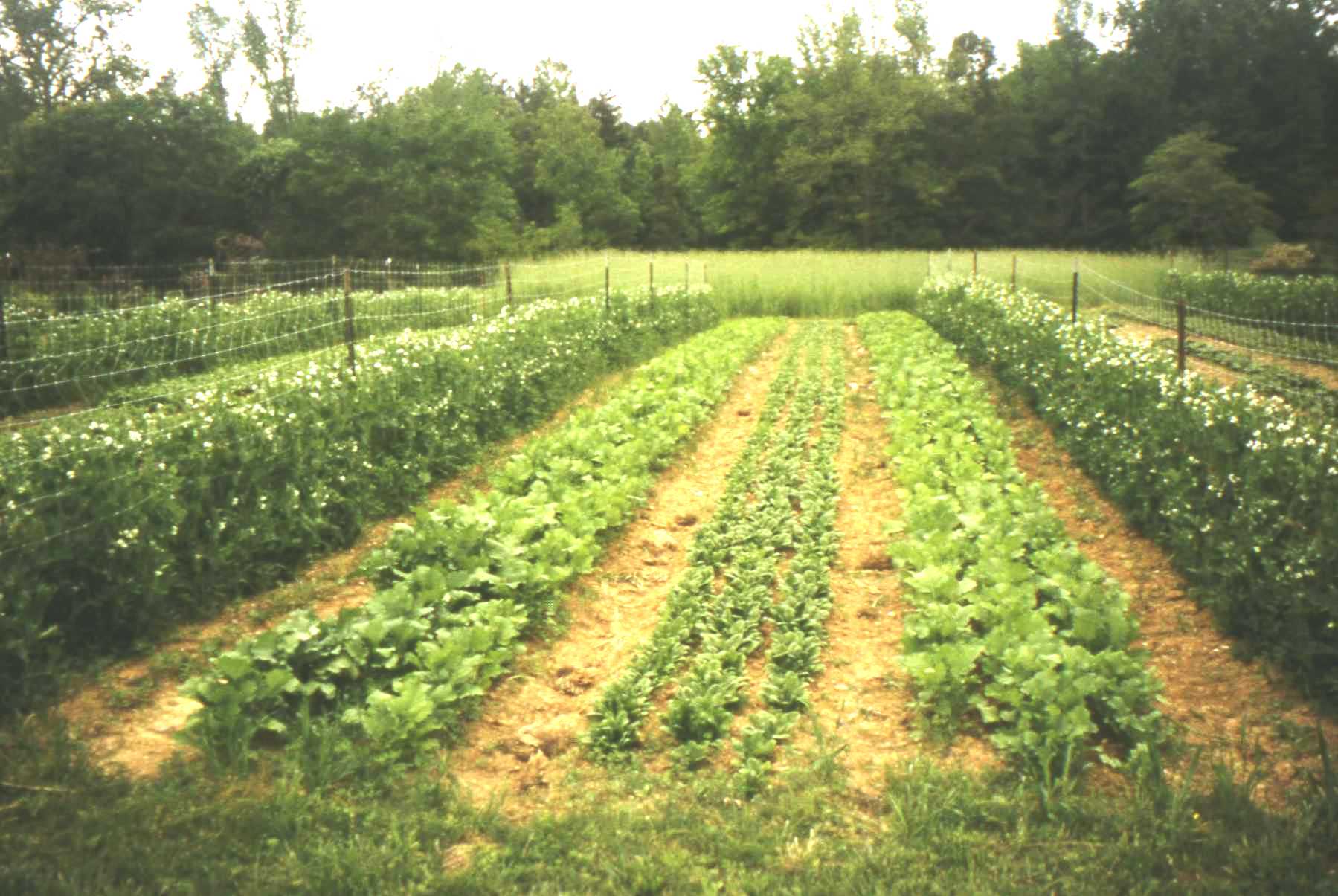
As usual more planting, weeding, trellising, irrigating, and finally more picking.  Need to get that lettuce out of the way because Betsy needs to get more flowers planted there.  The peas are blooming up a storm and the flowers are responding to the warmer temperatures.  The Turkeys seem to have finally settled in.  The first few days can be a little rocky until they all get the hang of eating and drinking.  We lost seven Bourbon Reds the first five days but have had no losses since Sunday.  This is one of the difficult realities of raising animals, sometimes they get sick and die no matter what you do.  At $7.00 a bird it can add up quickly.  Now that we are over that hump they usually are extremely hardy, last year we only lost two out of sixty heritage turkeys and none after the first three weeks.  Cross your fingers!

Picture of the Week
Look at those peas!  Can’t wait until we can eat all we want.

6/1/05 Vol. 2 #13

June first the beginning of hurricane season, let’s not start there.  The beginning of blueberry season, that’s better.  We picked the first blues yesterday and they are really loaded up!  This first pass doesn’t yield much and is very tedious to do, the temptation is to pick anything that shows color but we try and only pick the fully blue fruit.  It is sort of a mental training exercise so that later in the season you automatically get the best ones.  We want to make sure that these first berries are fully ripe and sweet, in a few days they will begin to ripen so fast that we won’t have to be so careful and also will not be able to keep up.  Many folks who come to the farm ask why the blueberry rows are so far apart.  We originally planned on having twice as many bushes and left room for a row in between the existing rows so we could plant some different varieties to act as pollinators for the variety we have.  Most blueberries (and fruit trees too) need a different but similar season variety to cross pollinate with to be able to set fruit.  This southern highbush variety that we grow turns out to be self fruiting (a trait that the researchers where not completely sure about when we planted them)  so we never got around to planting the additional rows.  It turns out that blueberries are so time consuming to harvest that the idea of having twice as many just scares us to death!  It takes five or six people harvesting every morning, five days a week to keep up with the ripening berries, and it is only 200 plants!

In the meantime we fall far behind on all the other farm chores.  This year with the delayed first harvest we have been trying to get certain jobs done before time runs out, with some success.  We have gotten a lot of weeding and cultivating done as well as flower trellising and planting but as usual there are still far too many things that will need to be done during the hectic peak weeks of blueberry season.  We add on additional help during this period and keep them on for a few days after the season so they can help us catch up, let’s hope we can!

Let’s hope it rains this week as it is getting very dry out there and we are already pumping lots of water.  The pond is already getting low and the creek we back it up with is beginning to slow down too.  Fortunately as cool as it has been we are only watering every other day but with the forecast for hot weather coming in this weekend  we may have to go to daily irrigation.  The turkeys made there outdoors debut this last week.  They are always very tentative the first time they are exposed to anything new, now they are acting like old hands including a few bad actors flying over the fence!  One more week in the brooder at nights and then they graduate to the fields full time.

Picture of the Week
Sunflowers wating for the sun

6/15/05 Vol. 2 #15

As hard as it is to believe, this season is our 20th at the Carrboro Farmers’ Market!  This week twenty Junes ago, June 7th 1986, we made our first feeble attempt at selling our vegetables, flowers, and berries at market.  We started the farm as a pick-your-own blackberry and raspberry farm planting the first crops in 1982.  Because they were perennials we didn’t open for business until 1984 and quickly realized that the pick-your-own business wasn’t going to pay the bills.  We began to look to additional markets for our berries.  In the winter of 1985 my brother Jon moved here to join us in the farming venture and we turned over the last piece of ground we had that wasn’t in berries.  Jon is a natural grower and he and Betsy had the little quarter acre patch overflowing with vegetables.  Our neighbor George Graves (some of you may remember him as a vendor at the market) kept saying “you really need to bring your berries down to the Carrboro Market”  every time we went to check the market out it was pitiful.  No customers and none of the vendors had anything to sell.  Turns out that 9:00 was too late to get there, it was all over but the cleanup by then.

Our first day it took two trucks to get everything to market, not that we had that much to sell, just that we were that disorganized!  One truck for the little bit of produce we had and one for all the display materials- saw horses to hold up the door we used as a table, five gallon buckets filled with concrete and poles to hold up a tarp, etc.  We had zucchinis the size of gun ships, summer squash, a few flowers and not much else.  We made $17.  It didn’t look like the market was going to pay the bills either but we were excited!  The customers were great, interested and encouraging.  The other vendors were helpful, we were so inept we certainly couldn’t be competition!  Jon left the next winter and the blackberries are long gone but we have now made the market the center of our business.  As exhausting as it can be we still are excited about going to market and seeing all of the customers who are still interested, encouraging and great!

The turkeys finally made it out to the field in a wild move.  Last Thursday as the berry picking finished up I decided to use all of those hands to help move them from the brooder to their first stop in the fields.  It had been raining and we waited until it stopped, we thought.  As we were chasing them around it started to rain again and by the time we had finished it was a down pour.  The poor birds were shell shocked both by being caught and handled but were soaking wet too.  We rushed their portable shelter over and got them all loaded with fresh food and water.  In an hour they were all dry and happy and so I let them out to run in the hydrangeas and viburnums.  They are now trained professionals, ranging the area for bugs and grasses by day and each evening as I go to put them up they are already loaded into the shelter, on the roosts, ready for a nights sleep.

Picture of the Week
Amazing Hydrangeas and brilliant? Turkeys

6/29/05 Vol. 2 #17

WooWee!  It’s raining!  I was starting to get a bit nervous and told Betsy that if we didn’t get rain early in the week that we would have to start pulling water from the upper pond, as the lower pumping pond was getting too low.  I hate to have to start using that water as it is a sign of serious drought.  The upper pond is two months worth of water and once we start using it there is no filling it back up until next winter.  The lower pond, while not very deep, is easily replenishable both by it’s slow running spring and the gravity feed line that we have into the creek (which is also slow running right now).  Last week I said that we were pumping about 10,000 gallons a day but the creek and spring are only giving us back about 5 – 6,000 gallons a day.  After two weeks of solid irrigation you can see the problem.  With this rain headed into it’s third day this will buy us the time we need for the water to fill back up.

Of course with the rain I am now kicking myself for not having gotten more ground ready for seeding of the summer cover crops (he is never happy).  The forecast has been for such dry weather, including headed into this bit of rain, that we didn’t want to put seed out there that would just sit there and maybe not come up at all.  We have only had a bit over a half an inch so it’s not so wet that I won’t be able to get out there and till the soil soon afterwards but it sure would have been nice to get them in with this gentle rain.  I did get the sliding tunnel ends seeded yesterday just as the rain started but still have another half acre waiting.

The second round of Turkeys did not arrive last week and we are hoping that they will make it this week.  We are working with our processor, who also raises his own birds, to buy the 35 broad breasted birds that we need to round out the flock.  It looks as if the bronze variety that we want to get may, once again, not be available and so we may have to get whites again.  Like I say, it is always something new with this turkey venture!  Otherwise things are settling back down to more normal pace now that the blueberry season is over.  We are back to our normal 70 hours a week of hired help down from a high of almost 200 hours two weeks ago!  Soon we will be in our mid summer routine of picking tomatoes twice a week, peppers once a week and general chores the rest of the time.  When it gets really hot we like to maintain a steady and not too frantic pace, better for the mind and the body!

Picture of the Week
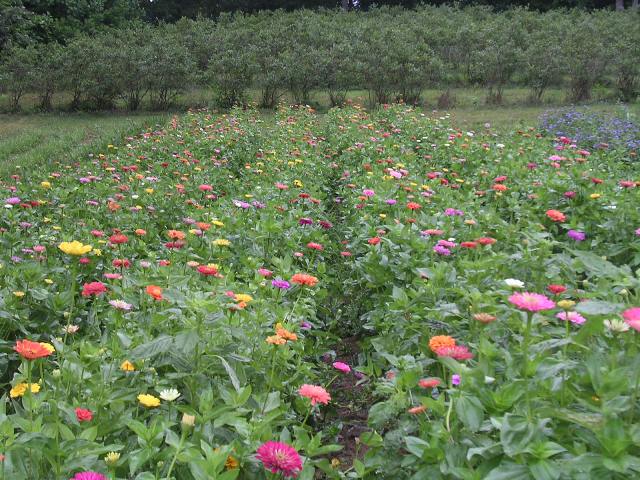
Even on a dreary day the Zinnias are bright