7/6/05 Vol. 2 #18

What a glorious week to live in central North Carolina!  Not!!!  A little bit of rain every day to keep the humidity up high and the temperatures in the mid to high nineties, the kind of weather that makes me think about moving back out west.  The only thing worse was when we lived in Houston and it rained every day and then the steam would rise off of all the concrete just like a steam bath.

We have been plugging along despite the conditions and getting quite a bit done.  We harvested all of the red onions and while we did not get as many this year the size is much larger which is nice.  We have both the Stockton Sweet Reds and the Long Reds of Tropea which we grow for Ben Barker at Magnolia Grill (he says when cooked they make a great sauce).  Years ago I was in Arkansas for a conference and was impressed by an onion breeder who spoke about the healthy attributes of Red Onions, very high in anti-oxidants, and he was trying to breed varieties high in these compounds.  Red onions are harder to grow than white ones and you cannot store them very long either.   The sweeter the onion the shorter its storage capabilities.  We are limited here also by day length.  Onions are classed as long, intermediate and short day length varieties.  Most of the onions are grown either far south (Texas with short day lengths) or north (New York with long days).  We are smack in the middle of the intermediate zone so are limited by the varieties we can choose.  Fortunately the Stockton Sweet Red is a really good variety.  Enjoy them for the next month or so.

The next batch of turkeys arrived on Thursday and we were able to get the Broad Breasted Bronzes that we wanted and have been trying to get the last several years and couldn’t.  As these are large turkeys they grow much faster than the heritage birds so we want to get them later (closer to Thanksgiving) so they don’t get huge.  The problem is that there is only really one breeder for these Bronzes and the later into the summer you go there are fewer available because the their fertility goes down and so the hatch rate is low.  We have wanted to raise this type because although they are a broad breasted type which means they are prone to the sorts of inbreeding problems associated with large birds we think that they may be hardier than the white kinds and also be more adapted to our outdoor, pasture management system.  We’ll see.  They look great so far!
Picture of the Week
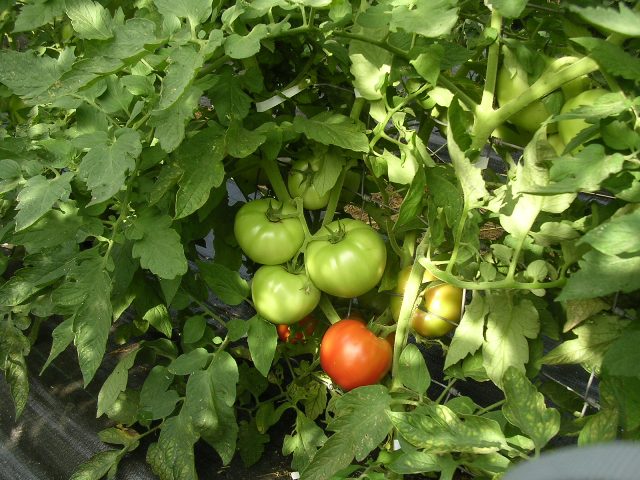
A peek at good things to come, Big Beefs

7/27/05 Vol. 2 #21

What can I say, 102 degrees behind the greenhouse in the shade, 99 degrees on the porch, deep in the woods.  We are pumping lots of water to try and keep everything happy.  So far it seems to be working.  We are having some trouble with the tomatoes, especially the large ones like the Striped Germans and Kellogg’s Breakfast.  When ever it is this hot it seems they can’t get enough water and will have hollow areas inside them just beneath the outer layer.  It actually has an official name “Puffy Wall”.  Supposedly caused by a combination of high or low temperatures way back at pollination and a nitrogen:potassium ratio that is out of whack.  All I know is we see it when its extremely hot, it is almost like the tomatoes start to dehydrate from the inside.  They still taste fine but sometimes are not the perfect slicing tomato for the plate.

This has been a week or so of turkey high jinks.  This morning topped it off.  Last night they did not go into their shelters at dark like they always do, so when I went out to close them up they were all down in one corner of the field sleeping in the grass.  I figured it was the heat and just let them stay out for the night.  This morning when Betsy went out at 5:30 for her walk she came back in immediately and rousted me out because forty odd birds were outside the fence and wandering all over the farm!  With not too much herding we got them all back inside the fence, eating and drinking like it was all normal.  This was after a long week or two of “turkey issues”, that started with the big guys picking on one of their own so badly that we had to put the injured bird in the Turkey Hospital.  After a week the bird, now know as Buckwheat, was all healed up and eager to get back with his pals so I carried it down and put it in with the others.  Immediately they started after him again so I took him back to the hospital.  The next night I slipped him in the shelter with the others thinking that they would wake up the next morning not notice another bird amongst the crowd (turkeys seem to have no short term memory).  All went well and when I let them out the next morning they started back in on him.  Puzzled I took him out again and set him up in his own outdoor area, under the figs, as he couldn’t continue to stay in the 4′ X 4′ hospital room.  Maybe when I moved the rest of the group in a day or two they would be so distracted by new turf that I could put him in then and no one would notice.

He was so lonely that he would just sit there and call to his buddies.  At one point he even flew out and ran down to the others pacing up and down the fence wanting to get in, but the bullies were trying to get at him through the fence!  So we put him back under the figs and grabbed one of the others and put it in with him so he would have company.  That bird just sat and called to his friends and eventually flew out and went back to the others.  Nothing was working.  As the “little boys” were now three weeks old and ready to start going outside we decided to put Buckwheat in with them until they graduated out to the field in a few weeks.  When everyone gets integrated after awhile all will be back to normal.  Kind of a Trojan horse trick.  So off we went with Buckwheat under armand put him in with the little guys.  Love at first sight!  He was walking around like the big man on campus and they were all huddled around his legs.  Now almost a week later it is Buckwheat and his posse!

Picture of the Week
Buckwheat and the little boys

8/24/05 Vol. 2 #24

Hallelujah the weather has broken!  We needed some kind of positive sign to reassure us that we were not descending into some kind of special hell.  After all the fun we had on “vacation” it continued into this week.  Including both trucks breaking down and going into the shop.  It is kind of hard to run a farm out of a small passenger car!  We should have the big market truck back by tomorrow but it will mean no market today (Wednesday).  Fortunately things on the farm itself appear to be growing well and most projects are occurring in a timely manner.  The dismantling of the farm for the winter rolls on.  First any trellising that was in place is taken down, rolled up and stored for next years use, then the “mechanical frost” arrives with the mower.  The way the grass and weeds are growing, with all the rain, this is a huge psychological boost on its own.  All of the buried irrigation lines are then pulled up, coiled, and sorted into save for next season, or not.  Soil samples are taken to be sent to the State lab for testing so we will know what minerals we may need to add for the next years crops.  Then it is back on the tractor to turn under all of the crop residue so that we can prepare the beds for the spring crops.  Finally a winter cover crop is seeded to hold the soil over the winter, capture nutrients left over from this seasons crops, and grow some more organic matter/food for the soil microbes.  Every week another section or two are taken out until by mid October it’s all finished and a green haze of newly sprouted cover crops covers the whole place.

There is still planting going on for this year as well.  The celery, kale and more leeks went in for Thanksgiving.  Lettuce and parsley was seeded to be planted out in few weeks, also for Thanksgiving.  Soon we will begin to plant the over wintered flower crops that will sit there until next spring for the first blooms of the year.  The older, heritage turkeys moved to the blueberry field, next door to the younger, broad breasted birds and their leader Buckwheat.  Much eyeing of the neighbors and posturing going on until they all run together in a week or so.  They too are glad the heat has broken, now they are happier to run about the place, chasing bugs and each other.

Picture of the Week
The Maginot Line, the older birds trying to impress the new kids.

8/31/05 Vol. 2 #25

The August of our discontent, at least the month is about over if not the discontent part.  This is a lengthy newsletter with lots of details so please hang on.  First as a person who makes his living outdoors and constantly dances with the weather, I have always had a fascination with “severe” weather events.  Having lived through a number of those events I get a certain uneasy feeling in my gut when they happen elsewhere, as if I know what others are experiencing.  The news and pictures from the aftermath of hurricane Katrina are such that it overwhelms my capacity to comprehend.  We have friends (farmers and non) and family who are now cleaning up from the storm and we can only will them the strength to get the job done.

Our travails pale by comparison and it is just a matter of time until we work our way through them (the big market truck is still in the shop, the walk-in cooler is broken down etc.) but there is one farm problem that we are wrestling with that we may not be able to solve.  Many of you have been asking when we will begin taking orders/deposits for turkeys.  Last year we began last week.  The reason for the delay this year is we are still not certain we will be able to get the birds processed.  I have been waiting several weeks to let you all know what is happening as we try to come up with a solution.  The situation is this: the place we have had the turkeys processed, in the past, is the only small scale inspected poultry plant available to independent producers in North Carolina and within at least 300 miles.  The operator of this plant is selling and trying to leave the state as soon as possible.  This leaves us and many other small producers, without the proverbial pot to….   Several of us have been trying to work out a deal to lease the plant, with the option to buy, so we can keep it open in the short term and maybe eventually have it operated by a small scale producers cooperative of sorts.  Very exciting possibilities in the long term but huge and very complicated problems in the short term.  In short we are not having much luck along this route and I would have to say our chances are 50% at best right now.

This leaves us with really only two options.  The first is to process them ourselves, a prospect neither of us are in favor of.  The law allows farmers to process, without inspection, their own birds (up to 1000 a year) and sell them to the public.  Many people argue that in many ways this is a safer and cleaner option than large plants (like Perdue).  It is a lot of work and we have never done it before but have friends who have.  The second is to sell the birds off live and escape without further expense to us.  This of course does not help with your Thanksgiving plans of having one of our turkeys on the table.  Our current plan is to go ahead and take reservations/orders as we are running out of markets we will be there to physically take them.   If it turns out we cannot get them processed, we will then refund the deposits in plenty of time for you all to arrange for other turkeys.  Attached is the order form and instructions.

This access to poultry processing plants is a very big problem for small scale poultry producers and limits the potential for consumers to be able to buy and eat much higher quality poultry.  The health benefits, flavor and eating quality of birds that run around on grass is so much higher than everything else available in the grocery store as to not even be comparable.  It also severely limits small farmers from diversifying into poultry and potentially making their farms more sustainable.  Not everyone wants to or is able to process their own birds.  For all other animals it is fairly easy to find a processing plant near them but not for poultry.  This is why we are trying so hard to save the one plant we have because the cost and difficulty in building a new facility is so large that is may not be feasible for a group of small producers to achieve.  Wish us well.

Picture of the Week
Red Bells ready for the picking

9/7/05 Vol. 2 #26

What a glorious morning; clear, coolish, dry air.  As the weather has improved this past week so have our fortunes, we are rising like the Phoenix!  All vehicles are back on the road, the refrigeration is all repaired and the poultry plant problem is looking brighter.  I have spent quite a bit of time this week fact finding about the plant and all of it’s very complicated relationships with other businesses and producers.  While we have not yet signed any papers I would now say that we are 85% sure that we can take over the processing plant.   We have a small group that is helping to steer this ship but quickly will need to expand it.  Joe Moize of the Shady Grove Farm (they also sell at market) has really been the main force behind all of this and is doing a great job in working with all of the financial details.  Weaver Street Market has signed on both financially and with expertise in Cooperative development.  It is in their interests to see this happen both in meeting their mission to support local agriculture but to also have good local poultry in the stores.  In the wings (no pun intended) also offering expertise, are other allied organizations, Rural Advancement Foundation International, American Livestock Breeds Conservancy, Carolina Farm Stewardship Assoc., NC Cooperative Extension Service and others.  All of these groups see this small independent plant as vital to the local farm economy and the local food system.  In the next week we will be putting a call out to producers and others to raise money for, and to belong to, the eventual cooperative organization that will own and operate the plant.  I have heard from several of you who have expressed interest in investing and we will let you know as we have more details.  We immediately need to find someone to actually manage the plant day to day.  Someone who has knowledge of processing and the regulatory details.  That list does not include either me or Betsy!

At home the farm rolls on.  All of the early tomatoes have now been taken out, quite an ugly job pulling the vines off the trellis and taking it all down.  Mowing goes on and on in preparation for fall and winter crops.  The chiggers we have stirred up are voracious!  It is amazingly dry and we are back to pumping water everyday.   The turkeys have finally graduated and are now one large group, a little confused at first as to who all these new bodies are but now they are wandering around together as if its been that way all along.  The staff is on reduced hours now as we head for the end of the season in a few weeks.  I think they are just as relieved to see the end as we are, they have really helped us keep it all together this year, especially this past few wild weeks.

Picture of the Week
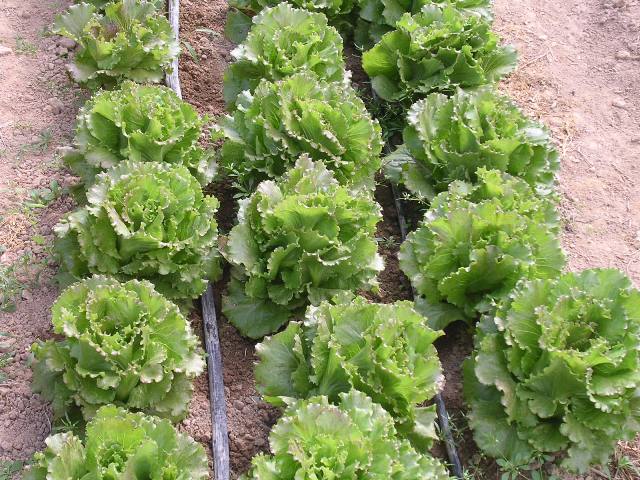
Summer Crisp Lettuce, fall is here again!

9/15/05 Vol. 2 #27

Newsletter a day late as I spent the whole day down at the processing plant watching how it all works, talking to the USDA inspectors and the folks who actually do the work.  We have agreed to taking over the operation the first of the month, with a lease until the first of the year.  This gives us time to get a feel for how it will go and what the true numbers look like.  It will also get all of us, both turkey producers and chicken producers, through Thanksgiving before things slow down a little during the winter months.  Quite honestly I am way out of my comfort zone both in knowledge, time and money but fortunately have people working with us and at the plant who know what they are about.  I keep saying to Betsy “I wonder what the next thing will be that will steer my interests?”  I guess maybe we know now, at least for awhile!  This doesn’t mean we plan on producing more poultry, in fact if Betsy has her way we may never have another bird on the farm; it is just that we see this one tiny plant as one friend of ours says “as the eye of the needle we are trying to pass the camel through”.  If we lose this one operation then many many poultry and rabbit producers will have to get out of the business.  The future looks very bright, we just have to get over these first hurdles.

On the farm it is very dry and Ophelia doesn’t appear to want to give us anything but a few drops.  I have been pulling water out of the upper pond as both the creek and the lower pond have dried up.  Good thing we don’t have much longer to go.  The last of the tomatoes get pulled out today.  All of the big tops are now uncovered for the season, it was time to pull the plastic off the last tomatoes anyway but we did it Monday just to be safe in case the hurricane decided to come a little closer to us.  Soon we’ll be down to just the peppers and a few rows of flowers to finish up the season with.

Picture of the Week

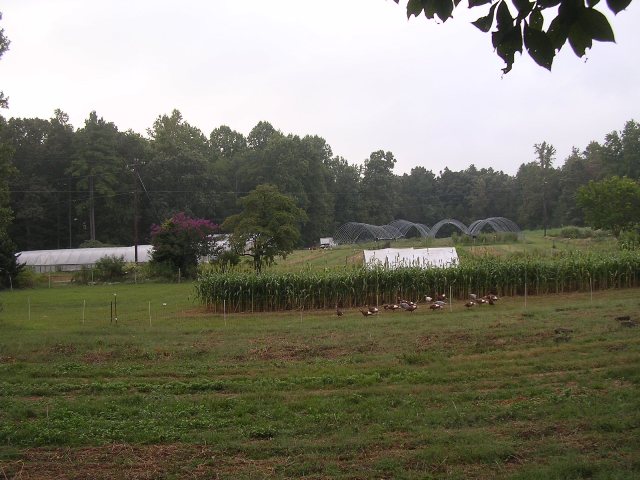
Not much left, big tops uncovered, turkeys running around, crops mowed down.

9/21/05 Vol. 2 #28

Congratulations to Sheila Neal, the Carrboro Farmers’ Market manager, for the birth of a big ol’ boy this Tuesday!  She and Matt and baby are all reportedly doing great.

Well this is the last weekly newsletter for the season.  Saturday is our last regular market (don’t forget the special Tuesday before Thanksgiving market!) and we are very ready to wrap it up for the year.  With all the extra curricular things going on around here as well as the heat and drought, that are lasting way too far into September for my comfort, we are glad that we can concentrate on putting the farm to bed for the winter.  After all tomorrow is the first day of fall and it’s going to be in the 90’s!  We are only a few days shy of the record for days over 90 in a year, I am sure we will not break it but it’s been painful all the same.

We are slowly catching up on things here at the farm.  I need to spend some quality time on the tractor over the next few days getting soil ready to seed the winter cover crops.  It is hard to work the soil the way I like to see it when it is this dry, partly because it doesn’t cut as well but also the remaining crop debris don’t decompose and incorporate well either.  Besides it is dusty work and we would prefer for our farm to stay on this side of the road!  We are also getting close to beginning the next season.  We plant almost a half and acre of flower crops between now and mid November.  These over wintered flowers need a cold period and time to develop a good root system so that in the spring they take off and make vigorous growth and fantastic blooms.  The staff knows that the end is near too and are already transitioning to their winter occupations.  A few more weeks and Betsy and I will be “empty nesters”!  Just us and the turkeys.

It appears that we have lost a few turkeys, either to dogs or coyotes or humans.  Last Friday we came out to find a bunch of birds out in the road and the fence suspiciously bent over.  We got them all back in and then found one of the Broad Breasted Bronzes a bit beaten up and moved it to the hospital pen.  Later I found another seriously injured and we had to kill it.  When they get all stirred up for some reason they just get crazy.  After all they are teenagers right now with lots of hormones raging around.   Finally they all calmed down and I was able to get a count.  36 Bronzes and 39 Bourbon Reds, just as it should be but only 16 Blue Slates, missing three.  No signs of a scuffle so we are suspicious of turkey napping.  So now there are 91 left.  I finally had time last night to bring the turkey order list up to date and half are reserved at this time.  While there is time left, those of you who have not yet sent in your reservation should do so to make sure you get the size and breed you prefer.

One change this year from last.  After all of the hassle of trying to keep the birds fresh/unfrozen and the fact that we are going away again for two weeks prior to Thanksgiving (and have to get Joann to manage the birds while we are away) we are planning on having them processed a few weeks early and freezing them.  Our understanding of the new regulations are that if they are not sold with in three days of processing then they are supposed to be frozen anyway.  Our plan is to pick them up from the freezing plant a few days before the Tuesday pick up day and put them in our cooler in the low 30’s and they will slowly begin the thawing process so that when you get them they will be well on the way to defrosted for cooking on Thursday.  For those of you who want to keep them frozen either for Christmas or later we can keep them frozen for you.

Look for newsletters from us prior to Thanksgiving and then monthly over the winter to let you know what is happening here on the farm.  If we don’t get a chance to say it to you either this Saturday or before Thanksgiving, we do greatly appreciate your support of what we do here at the farm!

Picture of the Week
The quickly disappearing upper pond

11/19/05 Vol. 2 #29

Wow! has it really been two whole months since the last newsletter?  We have been running hard and fast as well as having lots of fun!  The trip to Holland and Italy was very informative and beautiful.  The week we spent in Holland was mostly focused on cut flowers but we did manage to go to several markets looking for new and unusual things.  We were able to visit with many farmers and plant breeders and I think that Betsy has found a few new things to try.  The horticultural trade show was over the top!  Dutch agriculture is so fastidious and high tech that I can’t even begin to approach that level of obsession!  Italy was much more relaxed and we didn’t get on as many farms as we would have liked to but still saw many new things.  Our Italian family, that we stayed with last year when we went to the Terra Madre Slow Food event, was great and Betsy’s hard work at learning Italian paid off in much better understanding of each other.  We rented a car this time and spent many days driving through the countryside and going to markets.  We found a few new ideas that we will try and incorporate here this year.  One of our missions was to go to the Slow Food headquarters in Bra, Italy, and visit with the people who are organizing the next Terra Madre conference for next fall (2006).  It appears as if we will be able to go back again, Betsy has even volunteered to help with whatever they need including some basic interpretation!
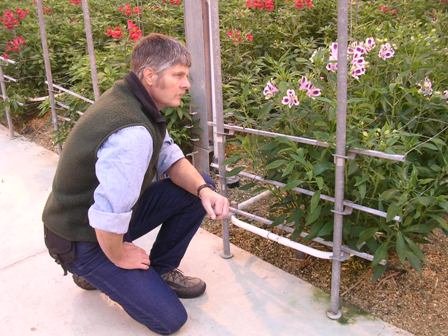
Alex amazed at the technology!

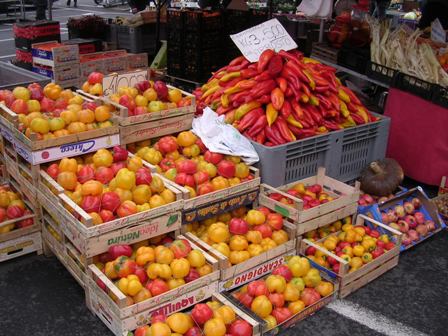
Peppers in Italy

Here are the farm we got all of the soil preparations for the winter finished with near perfect results, never has all of it worked up so beautifully with the exception of this on going dry spell.  The cover crop seeds that I planted a month ago have just barely sprouted.  We are running that fine line now of getting them established before the really cold weather sets in, which can kill them before they have enough roots underneath them.  The turkeys went in for processing before we left for Europe and came out looking good.  The Heritage birds were slightly smaller than last year and the Broad breasted Bronzes were also smaller which is great for those of us who don’t normally eat 26 pound birds!  The flash freezing process went smoothly and they came home yesterday in fine condition.  The processing plant project goes on and on.  In general it is working about the way we had hoped for but every day there is something that breaks down or needs to be worked on.

4/6/06 Vol. 3 #4

The one good thing about a drought, the weeds don’t grow very fast!  This week has been busy with a combination of cultivating for weeds and then setting up the rest of the irrigation in the newly “weeded” beds.  Cultivation can mean a lot of things when describing the process of growing crops but for us it means using “stirrup” hoes.  Like a stirrup on a horses saddle, the blade slices just under the soil surface no more than a inch deep.  The perfect timing is just before the weeds come up or have just germinated, otherwise it is a lot more work and less effective for those weeds that now have large root systems.  We joke around here that I am the straight line police because all of the plants run in exact parallel rows, usually three to a bed.  The main reason for the straight rows is that it makes the cultivation much easier than if everything was a crazy zigzag.  Our secret weapon is a Swiss made “wheel hoe”, this is the Ferrari of wheel hoes.  Made with multi adjustable handles on a small pneumatic tire it handles like a dream.  Attached to this can be may different implements but the best is an eight inch wide stirrup.  A person can walk up and down the rows and cultivate with ease.  If the rows are straight and the timing correct a person can cover a quarter acre in hour or so.  Rett is the king of the wheel hoe around here, no bending over!

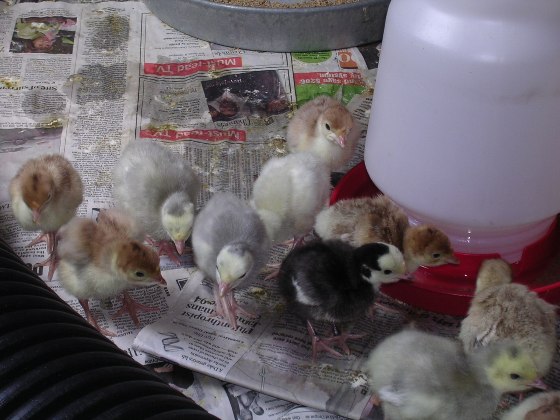
As Betsy now says in Italian “I bambini tacchini sono aravati ieri mattina!”  The turkeys arrived yesterday morning!  This first batch are all the slower growing heritage birds.  This year we decided to do all Bourbon Reds as we like their ease of handling.  The handful of Blue Slates that we have had the last two years have been “a handful”.  While they generally get to be a few pounds larger they have always been the bad actors, flying out of the fence, showing the others how to misbehave, you know smoking cigarettes and hanging out on street corners.  It is still always hard to believe that they were hatched two days ago, put into a box and sent in the mail.  They have enough reserves inside them from the egg yolk to not need food or water for several days but they can’t go too long.  We notify the post office which day they will arrive and we have them call us as soon as they come in.  Usually the call comes about 7:00 a.m. and one of us rushes up to retrieve them.  As soon as we get them back to the farm we put them into the prepared and warm brooder house.  Each bird gets its beak dipped into the water and then plopped down into the feed pan so they begin to learn where their feed and water is.  Everyone asks are they really dumb birds.  My reply is if you were taken away from your mother at birth, without anyone to show you how to do things, you might look dumb too!  Once they have done something once then they get the hang of it, I’m not saying they are rocket scientists but…

Picture of the Week
Eating, Drinking, all singing, all dancing

5/10/06 Vol. 3 #9

So busy yesterday that I couldn’t get this done until this morning (after chasing yet more roaming turkeys), see you at market!

The big pepper plant is today and I hope we are ready for it.  It is a challenge this year as we are planting into maybe the most difficult field we have, as far as soil is concerned.  This is the field that we call “the Top” as it is the highest point on the farm and the farthest away from everything.  When we started going to Farmers’ Market in 1986 this was the only piece of ground that wasn’t planted to blackberries and raspberries so we turned it over and began the experiment with vegetables and cut flowers.  My brother Jon was here at that time and vegetables were his area of expertise.  He and Betsy borrowed a neighbors plow and turned over this far corner of the farm and found a mixed bag.  The field is long and irregular in shape (you know those of use who are members of the straight line police hate that) and the soil changes from one end to the other.  Marvelous sandy loam on the bottom end but the top end is the most difficult red clay we own, very slow to dry out and almost impossible to work into a good seed bed.  Joann is still scarred from having to plant tomatoes into that red clay and having to stack what amounted to pieces of brick around the root balls.  This spring, however, the beds worked up as nicely as they ever have so we don’t have to fight that problem, at least on half of the 1600 feet of pepper beds.  The other half we always plant without tilling the soil, right into thick cover crop of grain rye and hairy vetch that we have killed and flattened down by rolling it.  It is like growing our fertilizer and mulch right in place.  After we roll it down we cut slits into the mulch and the soil, with the the tractor, to set the plants into.  If it is too dry the cutting wheels can’t cut through.  If it is too wet, especially in red clay, it can make a mess that is hard to plant into.  With all of the rain in the last two weeks I am a bit worried that it could be a bit too wet.  We’ll find out later today if that is the case!  None-the-less Rachel and Will (the newest staff member) will be charged with carefully interpreting my diagram of which pepper varieties go where.  Just like the tomatoes there is a strategy as to which ones like or will do better in the different soil types.  The hot peppers definitely need to be in the warmer sandy loam soil while the more disease resistant sweet bells can stand up better to the red clay.  No matter what it will be one at time until the over 2000 plants are tucked into the ground whether it be sandy or clayey.

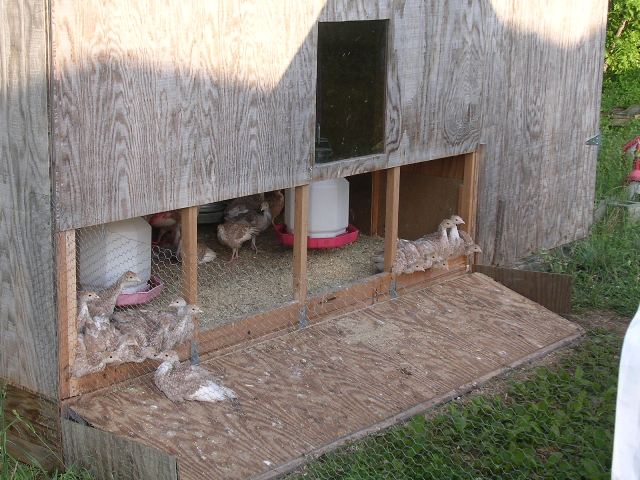
Late graduation day for the turkeys this week.  Usually we start letting them out to get used to the idea at three weeks of age.  This year because we got them earlier and it has been cold we just let them out yesterday for the first time.  Now five weeks old and full of extra energy from being cooped up they have been acting up already!  We pull one of the shelters up in front of the brooder building, about five feet away and then put up some chicken wire between the two.  There is a ramp/door on the front of the brooder so they can come in and out.  Usually they are very tentative and take a day or so to get used to going out, into the new shelter, and eating grass.  These guys came out and started flying over the chicken wire almost immediately.  I had to chase some down into the woods to catch them.  We clipped the wing feathers on these bad actors after they flew out a second time.  I hope we can get them calmed down or it will be a long summer of rounding up escapees.

Picture of the Week
Tentative about the outdoors just before going wild in flight