6/7/06 Vol. 3 #13

One more shot of beautiful cool weather with occasional rain.  I always feel like we are cheating or escaping from something when the weather is like this in June.  I know full well that the relentless heat of summer is hiding just around the corner and then we have to settle into a more measured pace just to make it through until September.  Having been born and raised mostly in the South you would think that I would be used to the heat and humidity but that gene never got passed to me.  When we moved here twenty six years ago from Utah, we lived in a tiny duplex in the middle of a field in Bynum while we crafted the plan for Peregrine Farm.  That first summer, in that non-air conditioned box, was hot as hell and we thought we were going to die!  We would lie awake at night with the tiny window high on the wall above, a box fan feebly trying to move hot air around us.  Thoughts of cool nights in the mountain west would somehow coax us to sleep.  I always assumed that I would acclimate and get used to the heat and while it did happen, somewhat, I still cower when the forecast reads in the 90’s.

The blueberries roll on.  After last years record crop it is hard to judge just how this years will end up.  My best estimate is that we have about a third of last years harvest, maybe half a normal year.  It is hard to say exactly why.  My best theory is that it was so warm this late winter it caused the bushes to bloom very early.  They started in late February and consequently many blooms and fruit were lost to frosts that came afterward.  It makes the fruit that is left a bit larger and maybe more flavorful because they get all the good stuff they don’t have to share when there are too many berries on the plant.  I was told yesterday that our berries were served last week to the former White House pastry chef, of twenty five years, and he said they were some of the best he had ever had!  With not so many berries to pick we are actually able to get other things done on the farm like critical weeding and tying up the tomatoes.  We are also beginning the process of taking out the spring crops to be replaced by summer cover crops or more summer flowers.  Out come the irrigation lines, mow down the weeds and what is left of the spring crop, turn under the residue.  If we are planting another crop then a little feather meal is spread for nitrogen, the bed is tilled again, then a drip irrigation line is buried right down the middle of the bed.  Planting follows quickly behind.  Last week more sunflowers and seven more beds of zinnias (the third planting of the year).  Soon those fields that don’t go on to summer crops will be turned under and sown to big summer soil improving crops.  The next batch of turkeys arrived on cue last Thursday morning.  Forty broad breasted bronzes, all happy and running around in the brooder.

Picture of the Week
Purple Bouquet Dianthus flanked by Campanula and Safflower

6/14/06 Vol. 3 #14

Well I’ve been up since 4:00 a.m. trying to reserve plane tickets to Italy.  As these things go on the Internet sometimes, I have yet to successfully complete the transaction (it is now 6:30).  We have finally heard, quasi-officially, from the Slow Food people that we have been accepted to attend the second Terra Madre conference in Turin Italy!  Some of you may remember that we were very fortunate to have been nominated to attend the first ever world gathering of food producers two years ago.  That experience of convening with 5000 other farmers, ranchers, herders, gatherers, etc. and the on farm housing has colored many of the new things we do here on the farm.  The exposure to cultures steeped in artisanal foods and old breeds has made us explore new (to us) varieties and food production ideas.  The on going attempt to form a successful poultry and meat processing cooperative has partly sprung out of the knowledge that with out it, local farmers will not be able to move towards further sustainability of their operations.  So we are off again to Turin the end of October.  This time not only with 5000 food producers but also with 1000 chefs and over 150 academics from around the world.  Slow Food is correctly expanding their aim to include the professional people who cook with local foods and can most quickly affect peoples palates and minds.  Our local chapter (convivium in Slow Food parlance) put forth an ambitious slate of people to attend and it appears as if almost all were accepted to go.  This includes our good friends, chefs and customers Ben and Karen Barker of Magnolia Grill and Andrea Ruesing of Lantern Restaurant.  Our delegation will also consist of at least eight animal producers and eight representatives of the seven local producer-only farmers’ markets.  We see this as a great opportunity to help move our local food system to a new level of understanding and cooperation.

The Slow Food organization and it’s mission resounds closely with what Betsy and I have been trying to do for the past twenty five years.  In the words of it’s founder, Carlo Petrini, producing food that is “good, clean and fair”.  We have always tried to grow products with great flavor and eye appeal (good), in a way that is sustainable (clean) and treats us, our employees and our customers well (fair).  With over 80,000 members world wide there appears to be lots of folks who think similarly.

Otherwise it is a rain day as the remnants of Alberto pour down.  We now appear to be in the monsoon season.  In preparation for todays storms we did cover the last of the Big Tops under which the late tomatoes are to be planted.  The trellis is up and probably tomorrow the plants will be slipped into the ground.  We also got the first layer of trellis on the hot peppers.  Unfortunately the huge storms on Sunday had laid over many of the tall Poblano and Anaheim plants.  So we stood them back up and secured them with the trellis strings before any more damage occurs today.  In general the peppers look really good but need a little more heat to really get going.  The eggplant and tomatillos are now in as well.  The turkeys are wearing trench coats and rubber boots, it was hard to find some small enough for Shrimpy.

Picture of the Week
On a sunny day the birds are eyeing Betsy’s lush Zinnias

6/21/06 Vol. 3 #15

The first day of summer and now the days begin to get shorter.  While we have been fortunate to have cool weather last far into June the days getting shorter are still a sign that it is all down hill to fall now.  I know we still have lots of summer season to go but in our minds we are always anticipating the next season, seeding crops for it, making plans around it. etc.   This long term view of the world is important for a farmer to have, partly to be prepared for what is to come so we are ready to take advantage of it (“have to make hay while the sun shines”) and partly to see past what might not be going well this season (“there’s always next year”).  I find that having an understanding of the long cycle of the seasons allows us to better plan our crops and how they best fit into the agro-ecosystem.  What summer cover crop works best before a fall planted flower crop that if planted at the right time and temperature will not have horrible weed problems next spring to fight.  Those flowers need to come out in time for another summer cover crop (different this time) that will be mature enough in time to run the turkeys through and will build organic matter and nutrients for the following springs lettuce crop which needs lots of nutrients but never uses them all.  When the lettuce is done we can plant late summer zinnias and sunflowers that can soak up all that excess nitrogen but will be done in time to plant a winter cover crop that will feed the next years early summer flowers and on and on.  A farmer friend of ours says “I only have about twenty more times to try and get this right”.  In some jobs you can try and get it right instantly, or the next day or the next week.  In farming we only get one chance a year and we better see it coming!

It is summer cover crop time and as the spring crops come out we are preparing to turn the residue under and seed those soil improving crops.  I wish I could have gotten it done before the big rains of last week but will all work out.  We were lucky again to get good rains but not as heavy or as much as some our friends.  Two inches on Sunday last and a steady 1.6″ from Alberto.  Some of our fellow market farmers had as much as fourteen inches from the various storms last week!  Blueberries are finished and because it was such a light crop we are not in too bad a shape coming out of the season on the rest of the farm.  This weeks big job is the red onion harvest.  We have to wait until the tops start to fall over which is the signal that they are finished growing.  It is best to harvest when it is dry and warm so that he necks of the onions dry out well.  If it is too wet then the chances are high of some kind of disease infecting the freshly cut off neck and causing the onion to rot.  Perfect weather this week, but the staff always feel like I have staked them out on and ant hill when I say its time to harvest onions.  We carefully pull each one of the 5000 plus plants, cut off the top leaving a inch of neck, cut off the roots, wipe off any excess dirt and place them in ventilated trays.  The trays are then put into our passive solar greenhouse to cure and dry.  Then over the next few months we will clean a few boxes each week and bring them to market.  It is a lot of work but the quality and health benefits of these red onions are worth it.

Picture of the Week
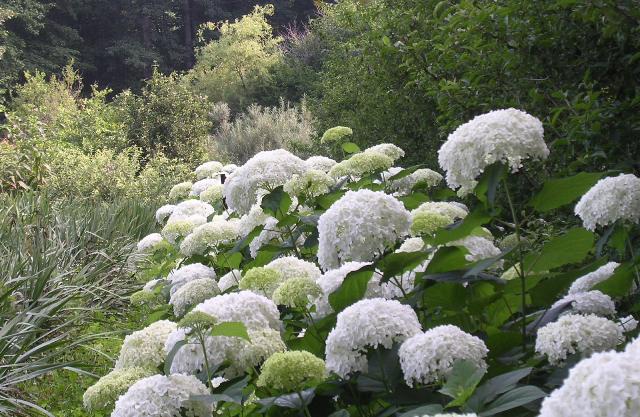
Fabulous Annabelle Hydrageas at their peak

6/28/06 Vol. 3 #16

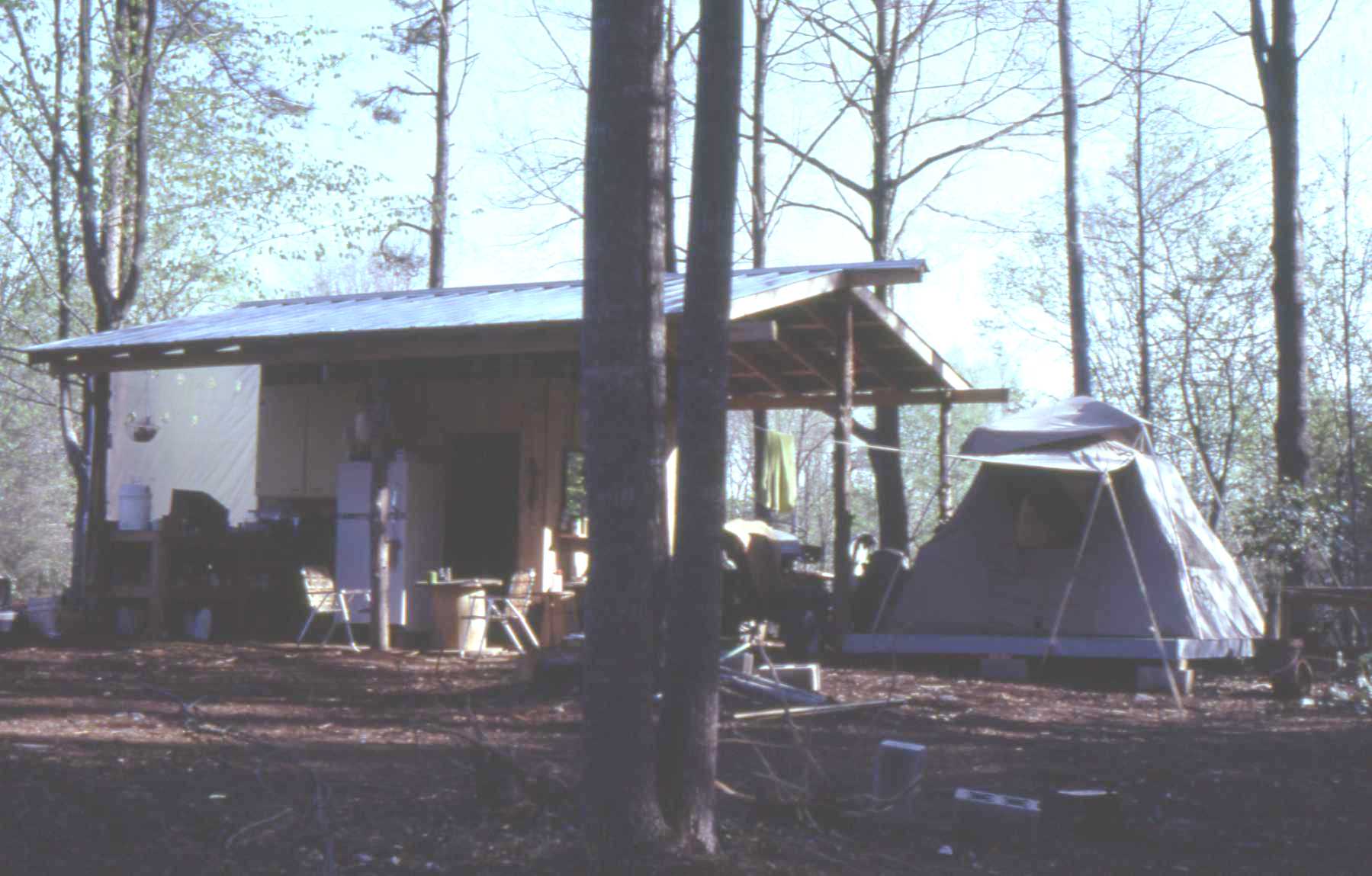
Rain, that is what has been going on.  7.3 inches this month.  Not as much as many other folks have had but wet just the same.  When we first moved to the farm in 1982 we lived in a tent for eight months while we began to develop the farm and build the first part of the house.  We had planted 5,000 berry plants in March and struggled through a very dry April to keep them alive.  We would fill five gallon buckets, by hand, out of the pond put them on a trailer behind the tractor and slowly drive up the hill to the field and hope that all the water wouldn’t splash out on the way.  We would then carry those buckets up and down the 20,000 feet of row and pour a little bit of life giving water onto each one.  Finally in late April the irrigation company we had contracted with to install our system arrived and we spent three very long days running thousands of feet of two inch PVC pipe up to the field to carry the water to the drip lines that we buried down each row next to the plants.  I always joke with folks that we lived in a tent while we put in $6000 worth of irrigation and I am still married to the same wonderful woman!  Now we could water all those new berry plants and our future.  In May it began to rain.  Every day we would stand under our little twenty by twenty tin roofed tractor shed/kitchen/world headquarters and watch as the rain dumped down on us.  The dirt track that ran past the tent and shed would run like a river and the lightening would shake everything around us.  The month ended with seventeen inches of rain!

Out in the field the plants were now happy but so were the weeds that we had unleashed by turning over soil that had held the weed seeds for years just waiting for someone to come along and bring them to the sun.  The May rains gave them extra vigor and we saw our berry plants disappearing into the jungle.  I carefully worked my way up and down the four miles of rows and hand weeded a cylinder around each plant after I found them first.  It was a race as the weeds: lambsquarter, pig weed and ox-eye daisy grew to head high.  I finally got on the tractor and stood on the seat so I could look down and find the cylinders I had created around each plant as I carefully mowed the aisles between the rows.  The battle with the weeds carried on through out that first summer (and still continues today) but we had saved the crop.

Fortunately we are going to have a dry spell coming the next five days or so and we will be able to get in and start to fight the weeds back.  We now have more equipment and tools and more help to do it with.  After years of cultivating, hand weeding and rotating crops our weed seed bank is not what it used to be but just letting a few big ones make seed will set a portion of a field back five years, so we are ever vigilant.  There is a section in the new Zinnias where it looks like we spread grass seed with a butter knife, or spray painted the ground green.  Last year we had Dahlias there and couldn’t till or mow the grass in them and couldn’t keep up by hand so some grass went to seed anyway.  We may end up mowing those Zinnias down early so that grass can’t make more seed, better that than making the problem even worse.  When organic farmers are surveyed about what is their number one problem it always comes back weeds.  It has been that way since man first started farming.

Picture of the Week
From the archives.  The early camp with tent as bedroom wing, ah the good old days!

7/5/06 Vol. 3 #17

The day after July 4th, we gave the staff the day off as it was going to blistering hot anyway.  Normally we would have worked a little and then taken the rest of the day easy.  We did the little bit of work but then had to go truck shopping.  I would rather walk across hot coals than go to a car dealership but Betsy’s little truck had finally gotten so unreliable (it is only twenty years old I don’t understand why these trucks can’t last longer) that we had to do something.  The big white truck is what most people see at market and when we do wholesale deliveries but the little truck is Betsy’s work vehicle.  It goes around and around the farm with buckets of water for the flowers and moves plants and supplies and more.  About twenty Saturdays a year it goes to market too.  Usually carrying 20-30 buckets of flowers it is this duty that makes it critical to the farm business. So while we only drive it less than 1000 miles a year we couldn’t carry on without it.  If you need a wheelbarrow and don’t have one there is just not substitute.  We have debated for years what to do, maybe a different kind of vehicle, or an on farm “stuff mover” and it always comes back to the same formula, one big truck, one little truck.  Last Saturday we had to borrow Rachel’s truck to get everything to market because the old girl just wouldn’t go.  This just won’t do so off we went on mission to knock it out quickly.  Believe it or not two stops later after very direct no nonsense haggling on our part we drove home with a new work truck for Betsy, I still wonder about the color name though “Impulse Red Pearl”.

Today is finally cover crop seeding day.  It dried out enough this week to get the acre of spring crops (or the remnants of) mowed down and turned under.  The rains are coming back tonight so I really need to get the soybeans and millet sown to take advantage of this next wet window.  This is always a race but made even more difficult with trying to get it all done before we have to go to market this afternoon.  These cover crops are the life blood of our soil fertility program.  In eight weeks we can grow up to eight tons per acre of organic matter, in place!  It is one of the miracles of raising crops.  That you can spin out about 150 pounds of seed and then two months later mow down 16,000 pounds of material and captured over 100 pounds of free nitrogen out of the atmosphere is mind boggling.  Include the fact that we don’t have to spend hours running up and down the road hauling manure or compost and then spreading it on the fields, my back and the environment are applauding.  When we turn these cover crops, also known as “green manure”, under they are broken down by the millions of soil inhabitants and all those nutrients are released for the next crop to use.  The earthworms, fungi and bacteria are all applauding too.  What a system nature developed over the billions of years!  Maybe I will take the Impulse Red Pearl over to our farm supply to get the seeds.

Picture of the Week
A sea of Lisianthus

7/12/06 Vol. 3 #18

Now the weather is returning to more normal summers conditions this week but in general we are all looking at each other and saying “I don’t ever remember a summer like this”.  This, this… not so hot.  No complaining here mind you but it does sort of throw one off balance.  Just as you have your brain programmed to expect one thing and act in a certain way it doesn’t happen.  The only comparison is back in 1991, which we always refer to as the Mt. Pinatubo summer.  That summer that volcano in the Philippines erupted and sent huge amounts of ash into the stratosphere which circulated the globe for months.  The result was a very cool summer in North Carolina,  we barely got into the 90’s.  Back then we were in the midst of the long and expensive “Raspberry Experiment”.  The most noticeable result from that cool summer was that the raspberry canes grew almost twice a tall as normal and the following year we had the best harvest we had ever had.  It turns out that it is too hot here for raspberries to grow vigorously, but that summer it was more like the conditions further north where they produce them in abundance.  Soon there after the raspberries came out of the ground never to be planted here again (under threat of certain penalties from Betsy!).  So while we are not experiencing as dramatic conditions as that year it is still affecting crops here on there farm.  Most noticeably the tomatoes are still not producing at the level we are accustomed to.  Every Monday and Thursday we go out and pick and while we are getting some of all the varieties we are not bringing back the number of boxes that we should be.  Normally this would be the peak week of tomato harvest but it will be at least next week if not later.  Yesterday we were up working in the peppers and the rows that are on black landscape fabric are moving along well but the rows planted no-till are way behind.  The soil is cooler under all that mulch which in hot weather a good thing but this season it is holding those plants back.  Just when your brain is programmed one way…

We did manage to get the cover crops all seeded before the big rains last week and they are up already and looking great, little soybean plants raising there fat heads out of the soil and the millet with one blade pointed straight up towards the sky.  The turkeys have all been rotated around the farm.  The little guys as we call the Broad Breasted Bronzes right now (they will eventually weigh twice a much as the Bourbon Reds) graduated out to the blueberries from the brooder and are extremely happy lazing the days away in the shade of the blueberry bushes and taking group walks around their new grassy enclosure.  The Bourbon Reds have moved into Betsy’s first and now abandoned Zinnia patch (we plant Zinnias five times and she is now cutting off the second batch).  This is the same field that had the leeks, radicchio and the last lettuce among other crops so they are now eating the crab grass and other weeds while hiding out in the four foot tall Zinnia rows like outlaws only to come creeping out when someone walks by the fence.  The last Zinnias get planted this week and the Brussels Sprouts for Thanksgiving went into the ground this week too.  Despite the different weather we still march on with the calendar assuming that normalcy will return.

Picture of the Week
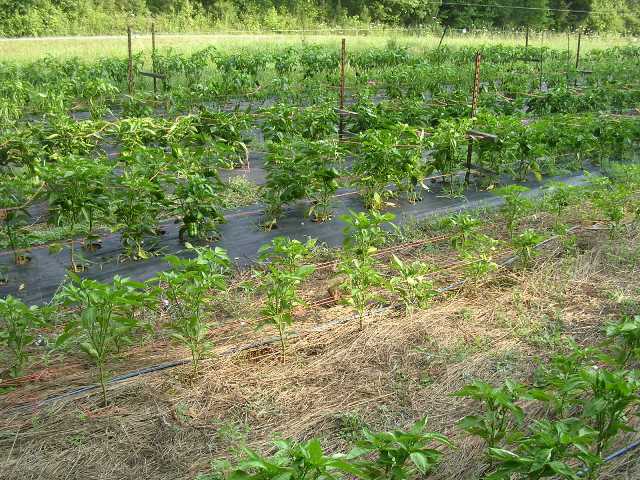
The effects of cool weather.  The same varieties next to each other but the plants on the warmer black fabric are much larger and have large peppers on them.

7/19/06 Vol. 3 #19

Everyday begins the same at this time of year.  I am usually out of the house around 6:00 to let the turkeys out before the increasing light makes them too fidgety.  We close the doors to their shelters each night at dark and most of them are self-loaded with the rest having flown up to the peak of the shelter to roost for the night.  In the morning the top sleepers fly back down and taunt the locked-up groups by strutting around just outside the chicken wire walls.  So, out they come for another day, pecking for bugs and discussing with each other what happened last night in the other shelter.  Then I walk down to the irrigation pump to turn on the water for the day.  When it is this hot we water everything for two hours a day, every day, and it is most effective if we do it early when it is cooler.  You can tell that fall is on its way because the spiders are getting serious about stringing their webs across the paths to catch every thing in sight.  I assume it is either to gather lots of food heading into the winter or trying to catch a ride for the new borns to another location so they can set up shop.  In the early part of the year you can walk all around the farm and never run into a spider web.   Now I have to find just the right stick, each morning, that I hold out in front of my face and chest to intercept them before I get a face full of spider!  This morning walk can be up to three quarters of a mile or more depending on side jaunts, which gives me a chance to think about what needs to be done this day and to contemplate other issues.  It is not quite a perambulation of the bounds but close.

Today I was thinking about the tragic passing of a friend, neighbor and fellow farmer, Chuck Glosson.  Chuck was accidentally hit and killed by a car on Saturday morning while we were at market, he was only 33.  The news spread quickly though the market community as we all returned home that afternoon.  Many of you may remember Chuck who sold at market from 1993 until 2000.  He and his family set up right behind our Saturday stall where Chapel Hill Creamery is now.  The next to take over the family farm, a farm that has been in the family at least 200 years.  Chuck finished High School and went right into farming with his father and it was a true partnership from the beginning.  A true traditional family farm, they raise cattle, pigs and chickens.  They also produce corn, wheat, soybeans, grass seed, hay, straw and many more crops, some to feed the animals and some to sell.  At market Chuck was an innovator.  He was the first to sell beef and pork.  They sold beautiful produce and cut flowers.  They immediately had a loyal customer following because of the huge diversity of product but mostly due to the fact that Chuck was the friendliest, kindest, and most sincere person they ever met.

We first met Chuck when he was about to graduate from High School.  He came by the farm one day because another market vendor suggested he go see what we were doing.  He was sure of staying on the farm and thinking about how he would fit into the family operation.  We walked all around our place and he asked good questions and soaked it all up.  In the years since we have bought straw from them, asked them about raising pigs and other crops.  After Hurricane Fran, when we had to move our transplant greenhouse after it was flooded, Chuck came over with one of their huge tractors and towed the structure up the hill and helped us set it on the new foundations.  He was always happy, willing to help and was a great listener.  The kind of farming that the Glossons do is completely different than what Betsy and I do but we had an understanding of each others daily lives.   Chuck has always been the picture, in my mind, of the future of traditional mid- size farmers.  Now I don’t know what image I will have in my head when someone talks about young conventional farmers but I will always know that I was friends with one of the finest humans to have ever walked this earth.

Picture of the Week
Bourbon Reds perambulating their bounds in the early morning.

7/26/06 Vol. 3 #20

This has been one of those weeks when people begin to ask “when do you have time to farm?” as I go from one meeting to another.  I have to admit that I have not spent as much time in the field this summer as I usually do.  Mostly due to the on going wrangling at the poultry plant and the Growers’ Choice Cooperative I have been running around central North Carolina a lot.  We knew heading into this season that this was going to be the case but felt that we could handle it this year because our staff is so good.  It has been!  We are extremely fortunate to have a group of people who have been with us for several years and begin to know the system as well as we do.  We joke that Joann understands my handwriting and speech patterns better than Betsy does!  When I scrawl the restaurant orders down, with my own abbreviations, Betsy will show it to Joann who knows exactly what it says.  Most mornings now, as they arrive at the farm, we sit under the little shed we use to store straw in and go over that days jobs.  I usually can say we need to do X,Y and Z and they head off to spend their mornings without me at their side.  Picking tomatoes, trellising flowers, weeding Lisianthus they now know how to do it as if it were their own farms.  Of course Joann has her own farm, Castlemaine, and Rett has just left us to move to his new farm in the mountains.  Will is starting a new farm down in Chatham county and Rachel is in her third year working on local farms after her boyfriend Lee worked for us before that.  We have always tried to create a working situation here where, as they learned the system, we let them operate it without excess supervision.  Just enough to make sure the quality and efficiency is there but not so much that they feel micro managed.  Generally we have managed to successfully hit that balance, sometimes we miss the mark but never with disastrous results.  It is difficult in our situation in that we can’t have permanent, year round help.  Because we are seasonal we have to make the job as enticing and rewarding as possible and become efficient and effective teachers so that they can get up to speed quickly without the frustrations that can come with learning something new.  We have been very lucky with staff for many years and this year they have made it possible for me to be distracted by off farm projects, I can’t thank them enough.

It is a little eerie when you go to deliver produce and there are life size posters of you by the door.  Tomorrow night (Thursday) Panzanella restaurant and Weaver Street Market are having another of their local Farm Dinners this one featuring us!  This one will benefit the Sustainable Farming Program at Central Carolina Community College in Pittsboro, five percent of the proceeds will be donated.  This is where I taught the Sustainable Vegetable Production class for six years and many of our excellent staff have taken classes there.  The format is they have a number of special dishes made from the featured farms produce along with their regular menu.  Yesterday we delivered a huge array of produce for Peter McKloskey to work with.  Five kinds of tomatoes, Poblano, Anaheim and Serrano peppers.  Red Torpedo Onions from Italy, Cucumbers, those great Galia Melons and of course flowers for the dining room.  I know that he is going to stuff some of the Poblanos and I wouldn’t be surprised to see the Melon for dessert.  Every summer we threaten to have an on farm open house and dinner during tomato season but never seem to be able to get around to it (I wonder why?), this is the next best thing and we don’t have to do the cooking!  Come on out and enjoy the produce of the season.  5:30 to 9:00, no reservations necessary.  Betsy and I will be there eating too (are you kidding, our food and we don’t have to prepare it!).

Otherwise it is business as usual on the farm.  Tomato picking twice a week, peppers once a week, with plenty of maintenance in between.  Tying up tomatoes and peppers, fighting back the encroaching weeds, mowing, mowing, mowing.  Betsy is of course cutting flowers everyday.  It is kind of like the steady buzz of the crickets at night, it just goes on and on.  The turkeys are all now in the Blueberries, divided by a section of fence.  This is the “get acquainted” period where they can talk to each other through the fence but the bigger birds can’t pick on the little (and strange to them) ones.  In another 10 days or so they will all run together and it will be like old home week, by then they will just think of each other as cousins they haven’t seen for a year but will feel comfortable hanging around with!

Picture of the Week
A foggy morning as the cousins stare each other down

8/2/06 Vol. 3 #21

Just when you are at your weakest they always pour it on!  Last weeks weather was bad but this week is just grinding it in.  Good thing we are going on break next week to recover.  After 21 straight weeks at market we are crawling into the mid summer break, and this heat just reinforces why we take it.  We have taken the second week in August off for years now, as a way to get some recharge for the end of the harvest and marketing season.  It is planned for when the first tomatoes crash and before the colored bell peppers really get going.  Now I always refer to it as a “break” and not a vacation because Betsy and I don’t really get to check out.  We give the staff the week off with pay and they usually leave town.  That leaves us here to water, and irrigate, keep and eye on the turkeys, pick a little bit of stuff that has to be harvested, etc.  The break is in not going to markets and doing regular deliveries.  We usually do a few hours of chores in the cool of the morning and then find some kind of diversion in the afternoons, eat a lot, take naps, read and other general sloth.  To that end there will be no newsletter next week and we will not be at market Wednesday 8/9 and Saturday 8/12.

In preparation for all of this we have been mowing old crops down and generally tidying up the place.  Earlier in the year, when I wasn’t thinking clearly, we agreed to have an open house for the company who manufactures the Big Tops (Haygrove).  Well it is today!  Hottest day of the year!  We have tried to gussie up the joint as much as we can but what they really want to see is how well crops do growing under the covers.  Well on top of it being time for the tomatoes to expire we also have those unusual diseases in them as well so it is not exactly a beauty pageant in the tomatoes.  We are so tired and it is so hot that it is hard to muster enthusiasm for having a group of folks here this afternoon, maybe the 100 degree forecast will limit the crowd, only the truly insane will come out to look at the tunnels and with the sweat running down into their eyes maybe they will think it all looks great!  Now the stuff that they don’t want to look at does look good.  The late flowers are doing really well in this heat and the peppers look respectable along with the limelight hydrangeas.  It is so hot that the turnips, radishes and other crops that we need to plant this week will have to wait until early next week to go in so that they don’t just vaporize in the hot soil.

Picture of the Week
Celosias and Asclepias and the proper distance for viewing the quality of the crops in the Big Tops

8/14/06 Vol. 3 #22

Back from the summer “break” and already we are running around like crazy so this will be a quick newsletter.  The time off was too short and we worked far too much, we did have some nice dinners out and slower afternoons but we are going to have to rethink how to actually make it even slower.  Now we are back at it trying to get caught up and into the swing.  The staff is back too and are ready to go, after a good long week off.  Today was tomato picking and turkey moving.  The rest of the week there are more fall crops to plant, peppers to pick and plenty of regular maintenance chores to take care of.  The dry spell is really getting noticeable as the cover crops are not growing as they should and some near the tree lines are really stunted.  The creek stopped running last week and we will have to start pulling water out of the upper pond soon.  Perfect weather for peppers as long as we keep them irrigated.

What’s up with the early newsletter?  Betsy and I have to leave for the airport at 4:30 in the morning to fly to Wisconsin.  Not exactly the week we would have planned to be gone again but we are receiving the Patrick Madden Award for Sustainable Agriculture and thought we might ought to be there to accept it.  We are very surprised and honored to have been even nominated for such an award and nearly speechless (well almost, you know Alex).  The award is presented by the Sustainable Agriculture Research and Education program, the USDA’s effort at helping to make agriculture more sustainable.  “This award recognizes producers who have explored ways to make farming more profitable, environmentally sound and good for communities, and have served as effective educators”.  We are always amazed when anyone recognizes us for what we consider everyday farm work and the outreach we do to anyone who has questions.  On top of it there will be an embarrassing amount of publicity about it including an interview on NPR’s All Things Considered with Melissa Block on Wednesday afternoon.  We won’t be back until Thursday late so Rachel and Will will be taking care of Wednesday market and the farm along with Joann.

Picture of the Week

It is colored bell and pepper roaster time!