6/20/07 Vol 4 #14

It’s always the way, work hard to beat the rain and then the rain decides not to come.  It is summer cover crop planting time and we had been watching the forecast thinking it looked like a good bet that we would get rain to water up newly sown seed.  First it looked like the front would come through this evening and so we had Tuesday and Wednesday mornings to get it all done then, at the last minute, they pushed the time forward to this morning.  Yesterday was a sprint finish to slow race that’s been unfolding for a week or so.  As the spring vegetables come out we mow off what’s left and to help keep the weeds down, the same with the early spring flowers, finally we give it all one more mowing and cut it all in with the tractor.  I did that last Sunday since it was dry enough to work soil after the last rains.  I like to let it lay there a few days allowing all the just turned up weeds to perish in the intense summer sun, that was the slow part of the race.  Yesterday was the seeding day.  First spin out the cowpea seed (we always plant a legume to capture the nitrogen from the air for free) and then because it is a large seed and needs good soil cover to germinate we have to cover it lightly with the tractor, so around and around I go.  Then I walk back over the rough field and spin out the sudan grass seed (we always plant a grass with the legumes to grow huge amounts of organic matter to feed the soil), the grass seed is small and doesn’t need to be covered especially if a good rain is on it’s way.

Of course that was not the only item on the mornings agenda which included some last minute mowing and tilling for some other crops we wanted to get planted before the rain.  Cov and Elizabeth trellised some celosia and continued the red onion harvest, with other projects I would throw in from time to time as I came by.  Check in with the NC State research folks who were out to take measurements of their tomato plots.  I did manage to get most of it done by noon when the staff leaves and we disappear into the house for the heat of the day and it was a hot one!  I planned to go back out late and finish up.  By 3:00 there was the rumble of thunder and it looked like even earlier rain, damn!  So back out I go to finish the seeding and to roll out some Italian bean seed that we brought back to try, seed some more cucumbers and the rain starts to fall, just enough to chase me out of the field but not enough to get the ground wet.  Done, a three T-shirt, two sets of shorts day.  Now this morning it appears as if the rain has passed us by and there is no more forecast for a week or so, I may have to try and water these cover crops up, arghh!

On the tomato-stealing-critter front we had to resort to surrounding the tomato tunnels with the electric net fencing as I have not been able to catch the varmit in the big Have-a-Heart trap.  Thanks to all who sent suggestions for the best baits, looks like eggs and sardines are universally successful around the country.  I went with the sardines option (in Louisiana hot sauce) and the culprit managed to get the sardines out three times without getting caught in the trap!  I was beginning to think this was the Cajun Einstein of raccoons when it started to eat ripe melons out of the other tunnel and carrying them a hundred feet away.  Now I suspect our varmit is a fox.  The fencing has worked to keep it out of the tomatoes so the last job yesterday (on top of everything else) was to surround the melon tunnel too, it looks like a medium security detention center out there now.

Picture of the Week
Medium security electric net fencing around the tomato and melon tunnels.

6/27/07 Vol. 4 #15

This is one of those growing seasons that feels like death by a thousand cuts.  Now every year we have crops that don’t do well or fail completely and others that are magnificent and make up for the short falls, that is what being diversified is all about.  You hear farmers say something like “this year I lost money but we had a couple of good years in a row there, we have another bad one and we might lose the farm”.  For twenty three straight years we had always made more money than the year before, in the early years that was easy to do as we were so pitiful at the beginning the only way we could go was up.  The later years we were still figuring things out, building the business, settling on markets and crops to grow with lots of room for improvement.  Now that trick gets harder as we have pretty much settled in to a  routine, so when one crop fails, there is not a new one in the wings to surprise us.  For the last few years we have done well but not better than the previous best year, the thousand cuts are more of a psychological issue than a serious financial one.  They just begin to weigh on you, especially as it gets hotter and as I tell the staff “I begin to lose my sense of humor”.

The list of nicks is already long this year, the freeze took the blueberries and affected other crops in strange ways.  The unusually cold spring affected germination of many of the early direct seeded vegetables and flowers, we had to replant the first Zinnia planting when it didn’t come up, an eighth of an acre!  The drought in May made it hard to get crops established and others slow to grow.  No turkeys or asparagus this year either.  Then lately the varmit eating tomatoes and melon issue.  The most recent discoveries are that half the red onions are not what we had ordered (they will still eat well, just not what we wanted) and the 400 poblano plants that were looking so good appear to not be poblanos, but some kind of bell pepper instead!!!!  This too will change and the other summer crops look great.  The lisianthus may be even more fantastic than last years incredible crop.  We picked the first good batch of tomatoes out of the big planting Monday and they look good too.  The rest of the peppers are right on schedule and even the onions are bigger than last year (even if some of them are the wrong variety).  This adversity is what drives some people out of farming, they can’t take the unknowns and set backs, no matter how great the rest of the rewards are.  For us this is the challenge that keeps us getting up in the morning, trying to figure out how to solve a problem or learn yet more about how nature works.  Some days I just wish the box of band aids wasn’t out on the counter.

Picture of the Week
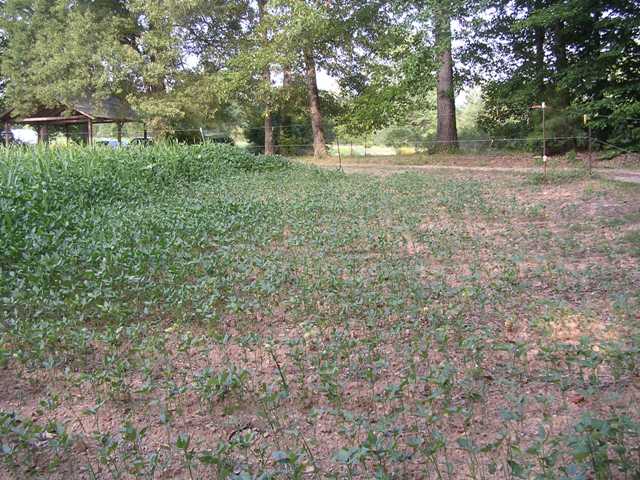
It did rain enough to get the summer cover crop up!  Cowpeas with the daisies.

7/4/07 Vol. 4 #16

A holiday today, well kind of.  Cov and Elizabeth are off today and we are taking the afternoon off but only after a morning of irrigating, flower cutting, mowing, tilling and a few other regular jobs.  Then later on we will head over to my sisters house for a little grilled food, adult beverages and cut throat croquet.  Our contribution to the meal is of course produce, especially the tomatoes.  This is the first full week of the big tomato harvest as we have picked at least a few of every single variety for this year, twenty in all.  So we will arrive with a large platter, the colors of the tomato rainbow- reds of Big Beef and Early Picks; yellows of Orange Blossom, Kellogg’s Breakfast, Nebraska Wedding, Azoychka and Sun Golds; the pink of German Johnson and the yellow and red stripes and swirls of Striped Germans; dark deep red of Cherokee Purple playing off the bright greens of Aunt Ruby’s, Green Giant and Green Zebras.  The juices of the sweet and fruity ones mixing with the higher acid kinds.

This is the great reward after months of careful tending.  It is always fun to introduce the new staff to the different varieties and their nuances of flavor and ripening habits.  Every Monday and Thursday we spend the mornings picking the 1600 feet of row.  Everyone becomes a specialist in certain varieties.  Cov is in charge of reds, learning to not pick them too green as they take forever to get fully ripe and can hang on the plants longer than all the others.  Only unblemished Italian sauce tomatoes are put in the box, no “freaks” with them.  The German Johnsons are much more tender so he has to change gears when he gets to them.  Elizabeth is the Cherokee Purple queen, fully 500 feet of row to pick and sort, they have the most difficult stems to remove with out damaging the fruit and sometimes one must resort to using needle nosed pliers to pull them off.  She is also responsible for the Orange Blossoms and if she gets done with the purples quickly helps me with the three other yellow kinds.  I start with the monster Striped Germans, so large that it takes two hands to pick them, carefully extracting them from between the vines and the trellis wires trying to not scar them.  I then move to the green-when-ripes, interpreting if it still green or if it has just enough golden cast to it to be picked.  The Sun Gold cherries are a shared job by who ever gets done first.

Bucket after bucket is brought to the back of the truck where each fruit is inspected and wiped with a cloth, sorted into three boxes by color and quality or set aside in the “have to eat today pile”.  The knife comes out as we get the first of the new varieties and slices are sampled between cleaning tomatoes.  Surprise at a high acid yellow tomato, amazement at the beauty of the interior of the bi-colored ones with red swirls through the fruity flavored yellow flesh, the reassuring solid full flavor of a Cherokee Purple, popping Sun Golds as one walks by the row that has them.  Finally finished we slowly drive the load down to the packing shed and the air conditioning to keep them from ripening too fast.  Stacks of boxes by variety and ripeness are built, long rows that run around the room.  Finally bags are filled with the “have to eat today” fruit and the staff heads home, stained a sticky green from rubbing up against the tomato foliage, talking about tomato sandwiches, salsa and gazpacho for lunch and dinner.  Life is good.

Picture of the Week
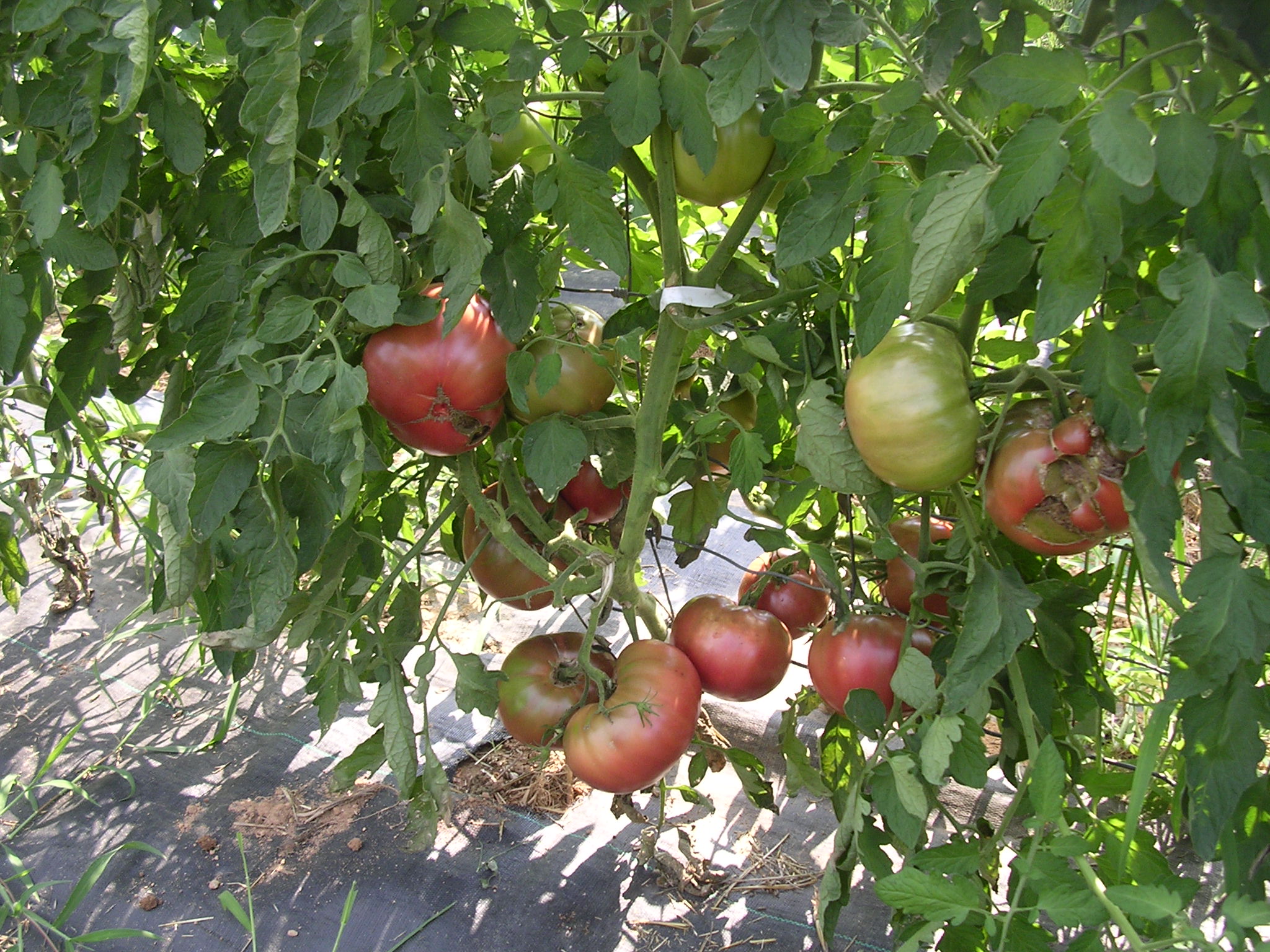
A great set of Cherokee Purples

7/11/07 Vol. 4 #17

While not what some would call a million dollar rain, last nights rain was worth a lot to us.  1.3 inches of much needed water on those crops that are not irrigated (cover crops, winter squash, corn, hydrangeas and the like) and a mental boost for the irrigator.  The creek had dropped to a trickle and the line from the creek to the pumping pond was likewise down to a trickle.  Yesterday after nearly two straight weeks of daily irrigation the pumping pond was getting seriously low, I was even beginning to eye the water stored in the upper pond.  Once we start taking water out of the upper pond there is no recourse, no resupply for that reservoir other than winter rains.  So at least for this morning the wolf has backed away from the door.  A rain like last nights will last us for four or five days and then we will have to fire up the pump again and if we are lucky the creek will show a little more life and help fill the pumping pond back up before we have to start major irrigating again.  Of course everything under the Big Tops and the little tunnels still needs water but that is less than a third of the normal daily irrigation needs.  Every little bit helps!

Major dog days of summer now.  Highs in the 90’s everyday and the air (especially after last nights rain) if getting thick.  We are in that lets- not-get-too-physical mode, a steady even out put of energy to get us through the mornings and then go and hide in the shade for the rest of the day.  Harvest first thing in the morning while it is sort of cool, a little weeding, a little trellising, change the irrigation, watch the sun get higher and the temperature spike just before noon (or it seems to).  It is summer after all.

Something to look forward to next week though.  Tuesday evening at Panzanella restaurant (in Carr Mill next to Weaver Street Market) is our “Farm Dinner”.  This is the third year we have worked with them on a dinner centered around what is at the peak of the season.  So obviously this one will be tomato heavy but also with cucumber and sweet corn undertones.  Come on out and enjoy their air conditioning.  The restaurant is open as usual and their regular menu is also available.  They will have specials (usually several appetizers and entrees) using our produce.  Tomorrow I will be going in to visit with Chris (the head chef) to get an idea what dishes he is thinking about and how much produce and what kinds he has in mind.  It is always fun, and we will look for you there!

Picture of the Week
Three foot tall Lisianthus brightening a grey day

7/18/07 Vol. 4 #18

An extremely pleasant meal last evening at Panzanella.  What a huge turn out, I don’t think I have ever seen the place so full.  The dishes Chris made from our produce were simple yet full of great flavors, the risotto with the sweet corn was my favorite but the pasta was also outstanding with just the right amount of Italian parsley coming through the tomato sauce.  It was good to see all of you who came out.  We drove home through a good rain so I won’t have to irrigate this morning either, what a bonus!

I was thinking about the sweet corn experiment and continue to be amazed at those farmers who consistently grow sweet corn.  We have not grown it in the past for several reasons.  First corn takes a lot of room and we just didn’t have any spare ground to put it in.  The second major reason is that you just don’t make the money per foot of row that we feel you need to make on a farm as intensive as ours, even at 50 cents an ear much less the old days when it was two dollars a dozen.  We use a rough rule of thumb that we need to gross $200 a bed (that is a planting strip 4′ X 100′) or the crop probably isn’t carrying it’s weight here on the farm.  In theory you have a corn plant every eight inches in the row, with two rows per bed, that is 300 plants per bed and, usually, you get one ear per plant so at 50 cents an ear that is $150 a bed.  That is in theory though, before the ones that don’t pollinate well, the corn ear worms, the Japanese beetles, and finally the raccoons that seem to be able to levitate over the electric fence and help themselves to all of the perfect ears that are just now full and ripe.  With this last planting we pulled about 80 ears a bed, $40 hmmm…  But corn at least is fairly easy to grow in some aspects as it is a large vigorous plant once you get it germinated and past the crows who love to pull up the tiny seedlings.  One good cultivation and as long it rains, it takes care of itself until picking time, no transplanting, no pruning, or trellising.  The good corn growers of course do it on a large scale, with tractors, so their labor is minimal until picking time.  Then to have a consistent supply requires planting every ten days or so.  So my hat’s off to those corn growers at market who have corn for weeks at a time.  We will continue to mess around with the corn experiment, for a while anyway, it is so good when it does behave, and it gives me something else to tinker with.

Picture of the Week
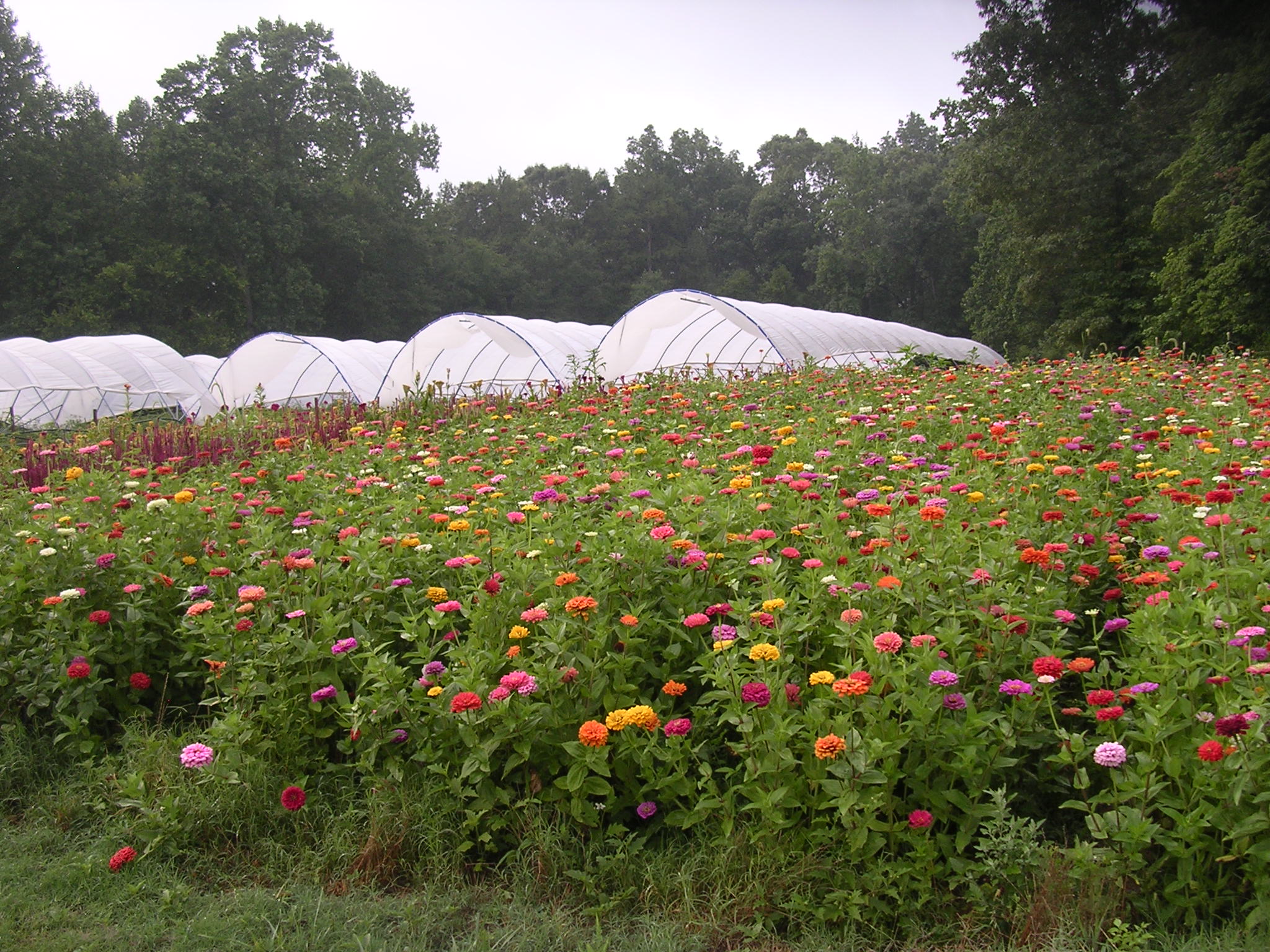
Brilliant Zinnias in front of the Big Tops

7/25/07 Vol. 4 #19

Glorious weather this last week and a little eerie, similar to when hurricanes are around and they suck all the moisture up into their circulation, creating strangely clear skies with clouds moving in directions completely different than normal.  None the less we have been enjoying almost sweat free work and getting things done in the afternoons that we would normally just put off because it would be just too beastly to be out “there”.   At some point you know the other shoe must drop and so it did this week.  That shoe being the continuing and deepening drought.  Sunday I was going down to turn the irrigation on and and found the gravity feed line, that we use to run water out of the creek to help keep the pumping pond full, was not running.  This happens from time to time, especially when the creek flow is very low.  I walked back up to the head of the field to check the creek and the line to find the creek not running at all.  This is not the first time we have seen the creek dry up but it is very unusual (it has happened maybe 5 times in 26 years) and is a sure sign of seriously dry conditions.

This drought is one of those insidious ones where it is not really apparent unless you are trying to keep plants alive and producing.  We think of most droughts as hot monsters that clamp down and it doesn’t rain at all for weeks.  This one is tricky, a little cool weather here to lull you into a false sense of comfort, a bit of rain there to make you say to yourself “well it rained just the other day”.  With the creek dry we are now down to using the last above ground water we have.  The “upper pond” as we refer to it is about two months worth of water when full, but after months of evaporation it was down about two feet already.  That was before I ran its water down hill to the pumping pond yesterday as it was less than half full.  We can refill the pumping pond about 4 times from the other until it is dry too.  Maybe six weeks of irrigation.  So it goes, daily watering to keep it all happy, cutting off crops as soon as we decide they are done, checking for leaks, deciding which crops are marginal and maybe won’t get any water at all or we won’t plant for fall as there just isn’t enough water to go around.  There are good things about droughts too, especially for us organic growers.   When it’s dry we have much less plant disease problems because the fungus and bacteria that cause the problems can’t thrive in dry conditions.  Weeds too are slowed down, they either don’t germinate at all or are not as vigorous and easier to kill.  And mowing is a marvelous thing, mow an area and it lasts for weeks, some areas of the farm I have only mowed once this year!

Picture of the Week
The pumping pond half full, water from the upper pond coming in at the top right.

8/1/07 Vol. 4 #20

We made it to August!  To me August always signals fall and the end of the season.  Yes it is still hot and sometimes it is a very wet month with thunderstorms but the lushness of early summer is gone and the farm begins to look tired after months of full production.  The tomatoes have given us their best and Betsy is into the third planting of zinnias as the first two look shabby as the diseases and insects gain the upper hand.  Even the weeds begin to mark the end of their run with big old seed heads and yellowing leaves, if we have let them get to that stage.  After 20 straight weeks at market, we are feeling shabby too so it is time for the summer break.  We will be at the markets this week and then will miss the markets on the 8th and 11th.  No newsletter either as we will be hiding somewhere cool with minimal human contact!  I know many of you will be taking a last bit of time off too before school and other fall things start the end of the month.

I have been thinking a lot this week about last Wednesdays radio show “The State of Things” on WUNC.  If you heard it you know they came to the market and recorded a piece on the Tomato Tasting event that the market held on the 21st of July.  It was a fairly interesting piece and they did a pretty good job of getting the feel of what the Tomato Tasting is like but there was one thing that got many of us market members hackles up and that was the comments about how food at Farmers’ Markets is expensive.  Excuse me, but IT’S NOT!  It used to be that prices at markets were ridiculously cheap and as I speak around the country to farmers I always say “Who ever started the concept that Farmers’ Markets are the place to buy cheap produce I want to grab them by the neck!”  Why would fresher, better tasting food, grown in better way, many varieties which you can’t find anywhere else be priced low?  Now the misunderstanding has swung the other way and I hear these “experts” say shopping at Farmers’ Market is expensive.  I want to grab them by the neck too.  Now I know there are exceptions to everything and some markets around the country are more expensive but by and large they are retail affairs with prices generally the same or cheaper than the grocery store.  I know for us at Peregrine Farm our vegetable prices are right in line with the local groceries because I check on a weekly basis.  The cheapest red tomato at Food Lion has not been below $2.29 this year and almost all of their tomatoes are $3.00 and up.  Food Lion!  Don’t even get me started on what they taste like.  Makes our delicious red tomatoes at $2.50 seem like a bargain not to mention all of our different heirlooms.  Same with lettuce and on and on.  With Betsy’s incredible flowers, that you can’t even get unless you work with a really good florist, it is even worse, our prices are wholesale- what the florist would pay before they charge the public at least twice as much.  Of course you all know that the Farmers’ Market is much more than just a place to buy and sell things, it is the town square where we all slow down and get to see and visit each other, let the kids run around and get some really beautiful food and flowers to enrich our lives even further.  That is worth a lot too and makes those incredibly flavorful sungold tomatoes seem really inexpensive!

Picture of the Week
Limelight Hydrangeas

8/15/07 Vol. 4 #21

58 degrees this morning on the front porch, going to be near 100 this afternoon.  It’s a dry heat though, a desert heat.  We thought we had been clever and missed the hot week of the summer by going up to the mountains in the middle of the 100 degree days but it’s hot up there too and they don’t think they need air conditioning.  We did have a good time being off last week except we tried to do too much, as usual, and so it was over in a flash.  Back to reality and the desert of Peregrine Farm.  What we are watering looks pretty good and we picked a surprising amount of tomatoes Monday off the old planting and the new, and last, planting is just starting to turn color.  This week we are working to reclaim areas that we let slide for a bit just before and then were completely left alone during the break.  The peppers are a case in point as the crab grass in the paths, between the rows of plants, has grown into the plants.  If we don’t act now it will make picking hell for the rest of the season so we are going through and rolling the thick grass mats back and then pushing the mower down the paths to cut it back before it just flops back down into the plants.  Row by row but it is a rewarding job as we can see how much better our lives will be when is comes to picking the beautiful peppers hanging on the plants just next to our efforts.

We are beginning to mow down those crops finished for the season and those that have perished in the drought without irrigation water.  The last planting of sweet corn, which is unirrigated, is going under the mower along with plantings of Zinnias and sunflowers.  This is the beginning of the clean up for the end of the year, soon I will take soil tests and begin the process of putting the planting areas to bed for the winter.  Spreading mineral amendments and seeding winter cover crops, all assuming we get some rain to make it possible to even till the soil.  The summer cover crops are ready to be mowed down too, not as robust as they usually are because of the drought they have done amazingly well in those fields away from the effects of tree roots.  Where ever they are within 50 feet of a tree, the cover crop plants are maybe eight inches high and then they jump up to two and three feet high.  It is not the direct effect of the tree roots actually being in that soil but the fact that the trees have pulled every bit of water out of the soil near them and then by capillary action sucked all the water up towards them for another 30 feet or so.

Picture of the Week
The tree root effect 50 or more feet from the tree trunks

8/22/07 Vol. 4 #22

Three tenths of an inch of rain last night, quite unexpected but always happy to receive it, won’t have to irrigate today.  It still doesn’t relieve the strange feeling we have around the farm this week, that odd sensation of what will happen next.  I think aggravated by the drought and the intense heat there have been two events this week that make us realize that we are not exactly an island out here.  The first is that our neighbor is having his land logged, clear cut he tells me.  400 acres that comprise our entire south side.  Runs from the road to the river, beautiful rolling land with bluffs over the creek and big hard woods.  Now we have cleared a lot of land here on the farm and turned it into growing areas, we are no strangers to a chainsaw or a bull dozer.  But they were an acre or two at a time and had previously been fields, this is a huge area of what felt like untouched land.  From first light to last the logging machines roar up and down the hill cutting and dragging trees to the loading zone, slowly the tree line to the south is getting lighter and thinner.  Maybe it’s just the constant din of the machines but it does make us feel like we are not as alone out here as it usually seems.

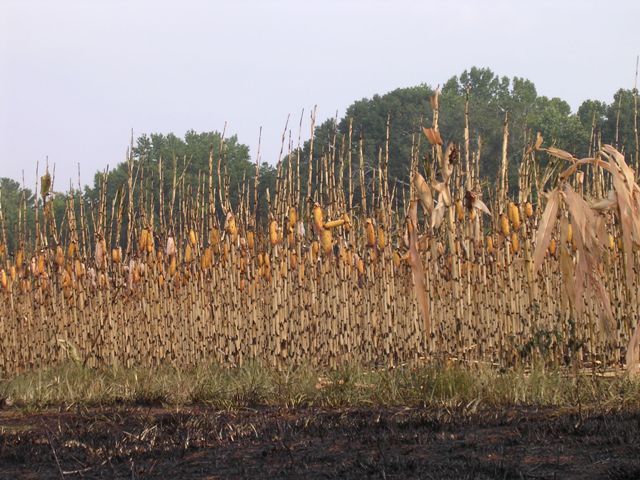
The second event happened Monday up the road on our north side.  Big fields of corn line the north side of the road, dry and crinkly tan as the drought has done it’s work.  A transformer on the power line that runs down the road exploded or caught fire (probably due to the high electric demand from the days of heat) which ignited a fire in the dry grass on the road side, fanned by the hot wind from the southwest it blew into the parched corn field.  It ran through that corn in a hurry, burning off all the leaves and the husks on the ears of corn leaving just stalks and the yellow orange ears of corn standing up right.  Soon it jumped into the woods and headed towards some new houses in the next field over.  The volunteer fire departments and the NC Forest Service stopped it there but it took most of the day to do so.  No damage to any buildings just to the nerves of the neighborhood.  I know we will feel better when the heat breaks and maybe some rains come, until then we are walking around the edges of our island and keeping an eye out for what might be coming next.

Picture of the Week
Burned over corn, just stalks and bare ears

8/29/07 Vol. 4 #23

What does local mean?  We are having this discussion within the Farmers’ Market right now because what seems fairly simple on the surface is not always so in todays agriculture.  The Carrboro Farmers’ Market has the tightest restrictions on this concept of any market we know of in the country.  We believe that our strict adherence to the rule that all products must be produced and sold by the original producer and that producer must live and produce them within 50 miles of Carrboro is the key to the great success of the market.  In the early days when that meant a farmer planted and tended tomatoes on their farm, within 50 miles, and then brought them, him or herself, to town on Saturday.  No middle men, just the farmer on their farm, then you the customer.  What makes it complicated is when further processing enters the picture, especially when it is something that takes resources greater than an individual farmer can reasonably manage.  Ever since our farmers have begun to produce and sell meat at market these once simple questions have become more complicated.  They raise that animal from just a few weeks old (or from birth) some times for years on their pastures.  In a perfect world they would then drive it only a few miles to a plant that can process it into not only various cuts but also other products that require further curing or cooking like bacon or sausages.  The problem is two fold, one there are only a few processing plants within the 50 mile radius of Carrboro and generally they don’t do any further processing.  Two, for the farmer to really make a profit from their animals they have to sell the whole thing, not just the pork chops, that means they really need to further process the rest of the animal.

The current debate is if that further processing isn’t also done within 50 miles then the product shouldn’t be sold at the market.  You know 50 is 50 is 50, doesn’t matter what the situation is.  One point of view is that those are the rules and the farmer can sell the products that don’t qualify somewhere else.  The other point of view is that these are products that are produced within 50 miles of the market by the seller and should be allowed to be sold even if they went off for processing and then came back (we are not talking about sending them to Italy or California, just eastern NC or South Carolina).  I guess the question really should be is what does “to produce” mean?  Is it that every last step in the process must be done by the farmer or the great majority of it?  The difference in the market could mean fewer kinds of products and fewer farmers.  It could also result in fewer customers for the rest of the farmers still at market, as some customers would maybe go somewhere else to buy their food, someplace that had a larger choice.  To me it is a matter of sustainability, as a member organization we need to make sure that our members are able to operate viable farm businesses as long as it is within our goals and mission.  We also need to view the market as a whole and make sure that it is viable too, if we narrow our product line so much as to lose farmers and customers then that is not sustainable either.  It is always something new and changing, I would be interested in know what your view of this is as well.

Picture of the Week
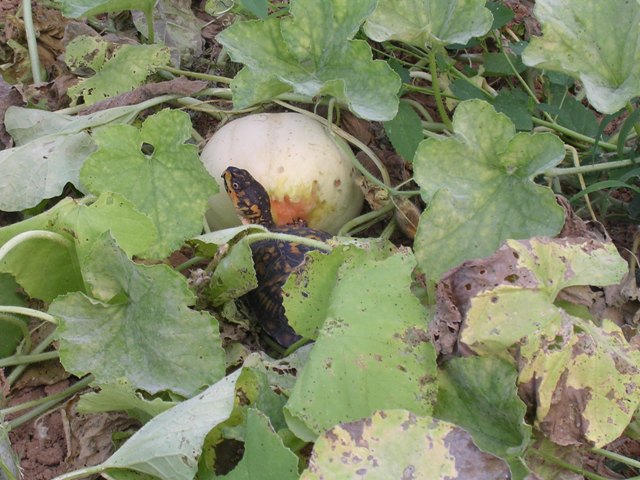
A hungry and thirsty turtle helping himself to a Charentais melon