4/30/08 Vol. 5 #7

Success!  All the tomatoes are in the ground and only a day later than last year.  Thursday the guys got the last of the trellises built, most of the tomato varieties we grow are heirlooms which grow tall and need strong support.  In the wild (in Central America) tomatoes are actually perennials and will grow and grow, here where they get killed by frost we forget about that.  These old heirloom types are closer to their wild cousins than the new hybrid types that are bred to be shorter and easier to grow.  The standard tomato support system in the industry is called “stake and weave” where you drive a stake every other plant and then weave a string down both sides of the plants and around the posts and so on.  In the past we have done some stake and weave on short plants and I hate it!  For one it means driving 35 stakes per 100 foot row and it’s difficult to weave with tall stakes.  So we developed what I call the one sided tomato cage.  Research has shown that the best production is tomatoes grown in cages, round cylinders of wire mesh where the plants just grow up in the middle and out the sides.  The problem with cages is they take a lot of wire and room in the field.  So we run the wire, field fencing, down the middle of the row with plants on either side.  They grow up through it and we only have to tie up the branches that head out into the aisle.  It only takes nine posts to support it and it fast to put up and take down at the end of the season.  Trellising 101.

Trellis done we planted half the rows on Thursday and finished up Friday with the rest.  Only fifteen varieties in this main planting this year, kind of going back to basics.  Sometimes a person gets so carried away with trying new kinds that it doesn’t leave enough room for the ones we need to grow to make a living and the new ones don’t give us enough to really make a display at market.  There is a new red that several growers raved to me about at meetings this winter and we are growing Mortgage Lifter (a pink) again for the first time in years partly due to a Slow Food tomato taste challenge going on later this summer (I will let you know more details later).  We are still trying to settle in on one of those Italian paste/eating tomatoes we brought back that everyone has given high marks to.  After years of side by side testing we have settled in on just two yellow varieties Kellogg’s Breakfast and the high acid Azoychka and have let Nebraska Wedding go, just not good enough production.  The rest are the mainstays of our show- Big Beefs, German Johnsons, Viva Italias, Green Zebra and Aunt Ruby’s German Green and of course the champion Cherokee Purple taking up a full third of our production.

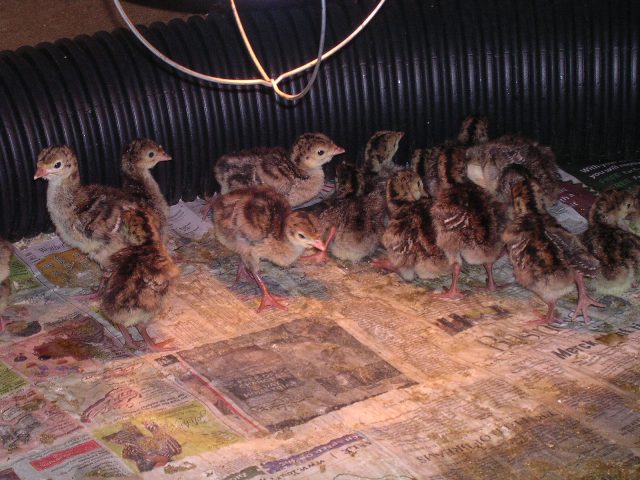
The other high point of the week was the arrival of the little turkey poults.  After a year hiatus raising turkeys we are once again back in the business.  You may remember all of the trials and difficulties we have participated in with poultry processing which is the reason we decided to take last year off.  The great news is we have a brand new processing plant in Siler City which just opened this month.  Abdul Chaudhry of Chaudhry’s Halal Meats has built a beautiful new poultry facility next door to his red meat plant and we are very excited to be working with him.  As usual the phone rings early, 7:30, and it’s the Post Office, “come get your turkeys” and you can hear them cheeping up a storm in the background.  Betsy zips off to Graham to collect them while I get their feeders, waterers and heat lamps ready.  Betsy returns with 66 energetic, Bourbon Red poults, maybe the best looking ones we have ever received.  Each on gets it’s beak dipped in the water then plopped down in the feed tray so they know where it is.  Now a week later they look great and it is nice to have them back on the farm.
Picture of the Week
What is this big animal in here bothering us?

5/7/08 Vol. 5 #8

What a great day it was last Saturday.  The celebration of the 30th season of the Carrboro Farmers’ Market brought out a huge crowd to enjoy the festivities and shop.  I know that there had to have been ten thousand of those raffle coupons handed out to all the shoppers.  We enjoy such great support both from all of you who come to market but also all of the surrounding businesses that donated for the raffles.  And a big thank you to Sarah Blacklin (our market manager) and all of the volunteers who helped put it on.  This is what the market founders envisioned all those years ago when they stated the goals of the market to be (from the By-Laws)  “The goal of the corporation is to operate farmers’ markets in the Chapel Hill-Carrboro area which serve the dual purpose of providing (1) a direct retail outlet for local farmers thereby promoting local agriculture, and (2) an alternative buying arrangement for consumers where high quality fresh products are available at reasonable prices in an atmosphere conducive to the exchange of information and ideas between the original producer and the consumer.” and the town of Carrboro wanted to bring more people into downtown to help keep it vibrant and working.  I would say that all of that has happened and more.

I rarely talk about “the seamy underbelly of the market” as we want most people to have the feeling that we all just happen to show up on Saturdays, Wednesdays and Thursdays and what a wonderful coincidence it is.  Yeah sure there are always glitches along the way, issues between vendors, between the market and the town and surrounding businesses, sometimes it’s difficult to park but we all have worked together to solve those problems so we can enjoy the benefits.  It’s called community.  As members of the market for 23 seasons now we are extremely proud and defensive of the market and it’s organization.  It has been a model for many of the markets in North Carolina and around the country too.  It is unusual for a market to be farmer run and farmer controlled, it takes a lot of time to run such a large organization when you have to farm as well.  I tell folks that it is as close to democracy as you can get when 80 plus individual businesses come together to agree on how their market place will be organized and then elect a board of their peers to make policy and run the day to day business of the market.  Farmers working together making decisions that work for farmers, not some other organization.  So we thank all of you for rewarding us with your support all these years, it takes all of us to have a dance!

Picture of the Week

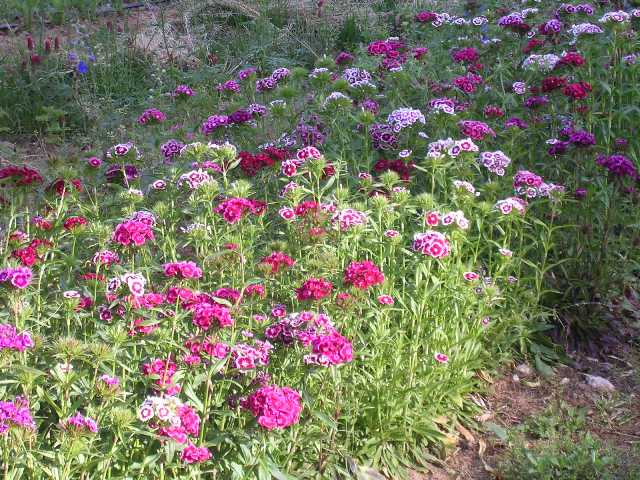
Sweet William in the first morning light

5/14/08 Vol. 5 #9

I know it’s a bit of a late notice but if you didn’t already know we are hosting a Slow Food Triangle chapter potluck this Sunday afternoon here at the farm.  I have talked in the past about our involvement with Slow Food most notably our attendance at the world conference of farmers in Italy, Terra Madre.  They are also the group most visibly responsible for the resurrection/popularity of the heritage turkeys, like the Bourbon Reds that we raise.  Their emphasis is on food that is “good, clean and fair”.   Everyone is invited, you don’t have to be a member, just bring a dish that serves eight (preferably made with local ingredients), the beverage of your choice and something to sit on.  It looks to be a beautiful late spring day and the farm is at the peak of spring vegetable production.  For more information and to RSVP here is the link We hope to see you here.

The last of the big spring jobs begins today, pepper planting.  The heavy rains over the weekend has put us behind a few days but I managed to get the beds tilled last night, nothing like a raised bed on a slope to help things dry out fast!  I have already pushed the planting date back a week to better accommodate the flowering of the cover crop, partly to let them make more nitrogen to feed the peppers and it makes it easier to kill them so they don’t become a weed in the peppers later.  I also want to get the little transplants into the ground this week as they are at the perfect size and growing rapidly.  I believe in timing the transplants so that they are growing well and hit the ground running and continue growing fast.  If we hold them too long, say because it is too wet to plant, then they slow down their growth and can become stunted waiting in the small containers.  So I start to get nervous around this time of year if something holds us up, the peppers must go in!

Big day yesterday for the turkeys, their first foray outdoors.  You may remember two years ago when we first let them out and they went wild, flying all over the farm.  We had to chase them through the woods and all around.  I know that was probably caused by having to keep them in longer than I like because it was so wet and I didn’t want them out on wet ground at first.  So we were a bit apprehensive when we opened the door yesterday even though it was at the three week old stage I usually first expose them to the outdoors.  They were very timid, and just stood massed at the opening. blinking in the sun.  It took hours before a few were bold enough to make it down the ramp and another few hours before the scouts went another few feet into the field shelter.  Relieved that we didn’t have to chase turkeys we left them on their own to explore the new green world.

Picture of the Week
This has got to be a trick, why would he let us out?

5/21/08 Vol. 5 #10

Undoubtedly the event of the week was the Slow Food potluck here at the farm on Sunday.  I was a beautiful sunny late spring day with temperatures in the 70’s and a breeze.  Betsy and I had mowed the place up and we had set up tables in what we call “the stand” (formerly our Pick-Your-Own stand) which is under the shade of three huge tulip poplars and a willow oak.  Looking out over the fields and gardens and right up next to the lettuce field and the fava beans.  At 4:00 cars began to roll in and by 5:00 there was quite a large group assembled.  The skies were getting fearsome looking and I ran in to check the radar, lots of red and purple!  I ran back out, climbed on a chair and announced that everyone needed to grab their potluck dish and go down to our house.  Just as everyone made it inside it began to dump rain, with thunder and lightning.  Fortunately we had just put that living room addition onto the house this winter and have lots of kitchen counter and a dining table we can put lots of leaves in.  The kitchen counters and the table were covered by food dishes and the food line snaked around the room like a conga line.  In Slow Food parlance the local chapters are called conviviums as in convivial- “fond of feasting, drinking, and good company; social, jovial”  we were certainly that!  Great food made with local ingredients and I think that everyone was able to move around the house and visit with each other.  As the rain stopped and people made their way back to their cars and home they also took short self guided tours of the farm.  Not exactly as planned but fun still the same.  We didn’t get a count of how many folks came but I can tell you we had over a hundred forks and there were four left unused!  Someone said it should have been the picture of the week but I couldn’t get to my camera.

Not without some nervous pacing around, we managed to get all the peppers in the ground this past week, hallelujah!  Wednesday the guys got all the black landscape fabric laid over the nine raised beds that I reserve for all the hot peppers which I think need the extra warm soil to do well and the fussier sweet peppers than need better drained soil.  As I headed off to market they proceeded to plant all of those nine beds with 26 different varieties.  That task alone of making sure that each variety is placed in the right location so we can know what it is and make it more efficient come picking time.  I leave them a detailed map of what goes where.  That job done we are only half finished planting.  The rest of the plants, all of the red bells and most of the yellow and oranges are planted directly into killed cover crops.  A slower process and we were held up by wet soil from what is beginning to feel like rain every other day.  Finally yesterday it seemed like it was dry enough and we needed to get them in before the next rain.  With speed and precision the three of us went about it and all went well, another nine beds all tucked into the mulch.  In total nearly 2400 hundred plants and they all got rained in last night, perfect!

Picture of the Week
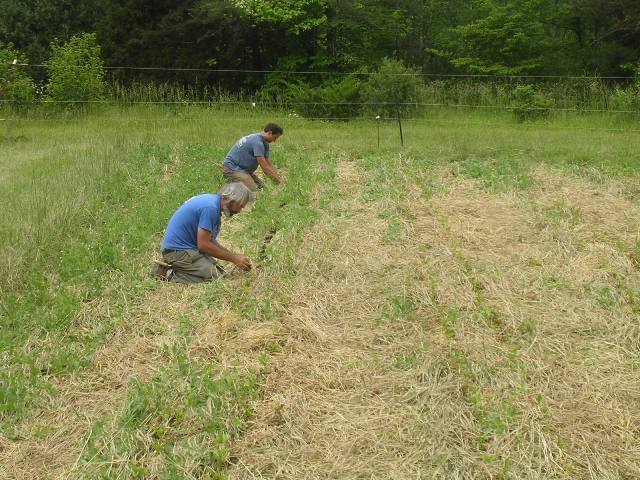
Dan and Cov poking the last peppers plants in the ground

5/28/08 Vol. 5 #11

The sprint is on now, the blueberries are beginning to ripen and the urgency to get other things done around the farm before we are all lost to berry picking is keen.  This is one of those transition weeks in the season when old crops begin to wane and the new ones are beginning to flex their “you need to come work in me” muscles.  Thankfully this is the last week and fifth week of wholesale lettuce deliveries to Weaver Street Market.  For seventeen seasons we have grown all the spring lettuce for Weaver Street and it dictates the pace of my spring work.  We plant nearly 9000 heads beginning in early February, covering, cultivating, irrigating until the late in April when I cut lettuce four mornings a week.  Monday and Thursdays are the large harvest days for the stores.  Early in the morning I call and get the orders from the produce departments so I can start cutting first thing when the lettuce is cool and with dew.  Most days it is twelve to sixteen cases, 24 heads to a case, some days it can be twenty or more.  It is the one thing on the farm that only I harvest, there is an eye one has to develop to know that the head is big enough for the stores.  I fall into a steady routine, Red Leaf is first as it is the most heat sensitive and usually I have to cut the most of it for the orders.  I move right to left down the beds after I cut a number of heads out to have a place to set the crate.  The lettuce is three plants across the bed and hopefully they are all the right size otherwise there can be substantial skipping around.  Cut the head off with the special lettuce knife at the base and then inspect the head for quality, peeling off a few of the old outer leaves, littering the ground around my feet with them.  The first layer in the case is three rows of three, layered in like singles; then layer of six heads followed by the final layer of nine.  I can barely get 24 full size heads in a case but do, carry it to the back of the truck, snap the lid on and pick up another empty crate.  Green Leaf follows next, then the Boston, Romaine is always last.  Romaine can take the heat better and is the easiest to cut and clean when I am getting tired.  When it is really large I tell myself it is like cutting down redwoods.  If the planting is really uniform I can cut ten cases an hour, fifteen seconds a head.  When I have to skip around it slows me down to six an hour.  With the days order cut I pull the truck down into the deep shade for a few hours before I take it into town.  Wednesday’s and Friday’s cuts for market are smaller only around eight cases but still the same.  After five straight weeks of wholesale lettuce I am ready to do something else every morning, it’s time for the season to change.

Big day yesterday the turkeys moved to the field.  The first time a batch of turkeys is exposed to something new they get crazy, this group seems especially jumpy so we have been careful in this big transition to the outdoors.  First we let them run in and out of the brooder to the field shelter just to get the hang of it.  Then we move the field shelter further away from the brooder and put food and water in there.  Finally we close the brooder and make them stay the night in the field shelter.  This group has not been high on the scale of early adopters, plenty of distress chirping and generally not getting it at first.  On field moving day we have to catch each one and carry it to the new field where we have moved their familiar feeders and waterers, lots of panic and chasing around.  Once they are all in the new field we move the field shelter (the new mothership) into the field and leave them alone for the rest of the day.  We were worried that come night fall we would be herding them around to get them into the shelter for the night, not being the highest achieving group.  Hallelujah, at dark they were all self loaded and we just had to close the door!  Transition complete.

Picture of the Week
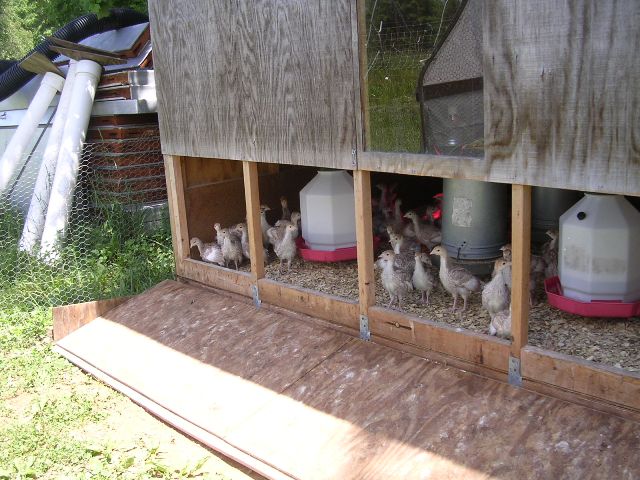
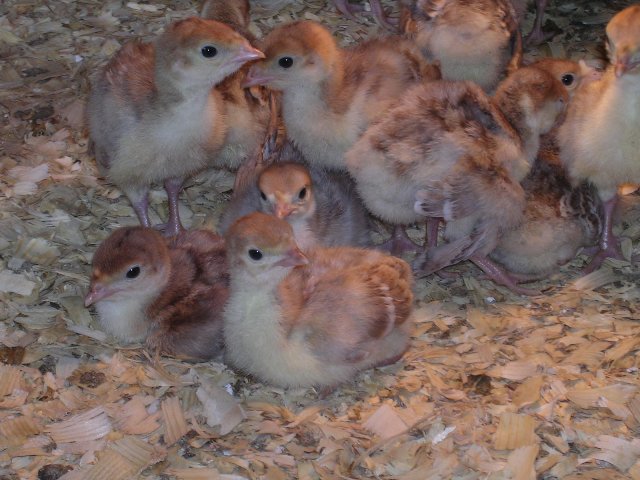
Cozy at first light, waiting to be released for their first full day in the field

6/4/08 Vol. 5 #12

Well we made it to June and the heat appears to have arrived with it.  High 90’s the end of the week and a whole week in the 90’s?  Why is it we can never just gently go thru the 80’s for a while and then into the brutal temperatures?  Oh well it makes the blueberries and the tomatoes ripen faster.  After last season without blueberries because of the record Easter freeze and the madness that it is trying to keep them picked we are now in the middle of it.  This week or next is going to be the peak of our blueberry crop, with next Monday probably the peak day due to the high temperatures.  Blueberry picking is the only time we hire extra help on the farm.  The whole operation is designed to run with a steady flow of human energy, just the two of us and two more part timers.  But there is an atmosphere that develops around blueberry season as new faces come to pick and join in our now established social structure.  For nearly 3 months it has just been the four of us doing the dance of employee-employer, student-teacher, worker-supervisor, advisor, helper, friends.  We now know each others routine, style, jokes and now there are new opinions, ideas, senses of humor.  Blueberry picking is maybe the best job on the farm, unless you hate tedious tasks, but with the new faces and discussions in the field it seems to go quickly.  It doesn’t hurt that it’s a beautiful setting on the hill, almost always with a slight breeze and the birds calling nonstop.  Everyday you end up on the otherside of the row from someone new with new stories and questions.  Other farmer friends of mine say I should hire migrant workers to pick, it would save money.  It might and we used to hire some local Latinos when we were in the wholesale blackberry business and they are amazing workers.  I have come to appreciate the other benefits of having these new faces on the farm, it gives us a boost, it gives the staff a break from working only with each other, it exposes these new people to farm work without some of the grittiness of it.  It is this social side of a sustainable farm that really makes it work, not just the crops and the tractors.  Soon enough it will be back to just the four of us, avoiding the heat, picking tomatoes and peppers and flowers, telling the same old jokes.


Pictures of the Week


6/11/08 Vol. 5 #13

Hmmm, let’s see what’s the news?  HEAT!!!!  Talk about a rude start to the summer, bang, here I am.  The 100’s really pushed the blueberries and Friday we could only get two out of six rows picked there were so many and turning blue in front of our eyes.  So Monday we called in the troops and had eleven of us out there going hard.  We did manage to get through those four unpicked rows and the fruit quality was really good.  Thank goodness they are blueberries and not blackberries.  When it gets that hot blackberries actually get sunburned and get white sections on the berries where the color has cooked out of them, technically it is called “leaking” (I am not making this up).  So now we are caught up and Monday was the peak day of the season.  We can now easily manage the rest of the season (only another ten days or so) with four additional pickers.  Whew!  As is our standard practice we do not work out in the fields after noon and this week it has been hard to stay out there until noon.  Betsy and I have been out early letting the turkeys out, irrigating and picking other crops before the blueberry picking begins at 8:00.

Two interesting extra curricular activities this week.  The first was a Slow Food co-sponsored event at Meredith college with the Durham-Chapel Hill Dieticians group.  Two short films about local food were viewed and then a panel discussion followed.  It is always interesting being the farmer on a panel of other food related folks.  Great questions about our local food system but barely enough time to just begin to scratch the surface.  Yesterday I went to the State Legislature to speak to a group of legislators about organic agriculture in North Carolina.  This Organic Legislative breakfast was just that, it started at 7:30 a.m. in the cafeteria, in the basement of the Legislature building.  While they ate organic food brought in from North Carolina farms, myself and three other farmers told them about our experiences as organic producers.  This is the second year that Carolina Farm Stewardship Association and other sustainable ag non-profits have put on the breakfast.  The idea is not to really press them for anything in particular but to just make them aware of organics and sustainable farming and hopefully more comfortable with the idea.  As I went to get coffee I overheard several of them saying to each other “Who knew we had organic pigs here in North Carolina?”  Nothing like a pork product to get a politicians attention.

Picture of the Week
Turkeys and Hydrangeas

6/18/08 Vol. 5 #14

What a glorious morning, just came back in from my morning perambulation (letting the turkeys out, turning on irrigation, general perusal of the place) and the 50 degree temperature that greeted me was almost shocking.  Thank goodness we are near the longest day of the year (and the first day of summer) because this waking up at 5:00 a.m. is not natural.  I always wake with the light and it is just not right to be up this early in the day!  The change of seasons is truly upon us as we are mowing down the spring vegetable and flower crops and planting more of what will be the late summer crops.  Under the tiller go the beet, carrot, spinach and lettuce beds making room for more zinnias, sunflowers and celosia.  We covered the last bay of the Big Tops last week and the guys built their last tomato trellis of the year.  Today we will plant the last round of tomatoes, the ones for August and September.  We do this planting no-till into a rolled down cover crop of grain rye and this year Austrian winter peas, just like all of the sweet peppers.  When we plant the sweet peppers we are always pushing the front end of using this no-till system because the cover crops are just barely mature enough to kill and the soil is still almost too cool under the insulating layer of mulch.  With the late tomatoes it is just right because the cover is well dead and the soil is warm but not hot.  Most farmers will plant their late tomatoes into white plastic in an attempt to keep the soil and the plants a little cooler, besides my disdain for using plastic mulch, we already have those conditions using the no-till.  Even with these more ideal planting conditions we only plant a limited selection of varieties because tomatoes don’t pollinate well in the hot nights of July and August so we only plant five beds and four varieties, a red, a pink, a yellow and of course Sun Gold cherries.

We really need some rain right now, not only is the pond going down but it is time to seed the summer cover crops.  As I was tilling yesterday the soil is getting very dry making it hard to incorporate the crop residues and difficult to germinate the new seeds.  This is beginning to look like last year where it was almost impossible to get the summer cover crops going.  Now that blueberry picking is almost over we are turning our attentions to catching up on all this planting, trellising and spring crop clean up, hopefully today we will also start the pepper trellising as those poblanos are getting tall and susceptible to being knocked over in a storm.  Friday we will begin the annual red onion harvest another sign of summer as right on cue the onion tops are flopping over, telling us it is time to get them out of the ground too.  As Betsy says, it’s like being a chicken on a hot plate, how fast can you dance?

Picture of the Week
Dan marking the beds, Cov planting celosia in the former spring lettuce beds

6/26/08 Vol. 5 #15

Newsletter a day late, this week has been like a fire drill since Monday.  One of those weeks where its nothing unusual or a major type event, just too many small “extra-curricular” items that tip the cart.  Monday had an extra trip to Burlington for supplies, I had to help our 84 year old neighbor fix his mower, we did deliveries and took the big truck to the mechanic and then topped it all off with a lovely evening at Watts Grocery in Durham for their wine dinner which featured our products.  Tuesday (after arriving home late the previous night) we hit the road at 7:00 a.m. for an all day meeting in Goldsboro, we are on the Board of Advisors for the Center for Environmental Farming Systems.  Back to the house about 5:30 in time to turn around to head into Carrboro for another board meeting for the Growers’ Choice poultry cooperative.  Wednesday up at the crack of dawn for the unusual chores and to prepare the brooder for the second round of turkeys that normally arrive at the Post Office early in the morning.  No call by 8:30 so I begin calling around to see where they are.  “Yes they were shipped on Monday”, she says at the hatchery.  Now we’re worried that they are sitting on some hot tarmac somewhere cooking (we hear these horror stories from other growers).  Second call to the Post Office, “no not here yet but there is one more plane that comes in at 10:30”.  Finally the call comes in at 11:30 they are here.  Betsy rushes up to Graham to collect them while I continue to work with the staff on the days projects.  By 1:00 the birds are here and installed in the brooder, all healthy and running around.  A quick bite of lunch and then we have to load and head off to market in the 95 degree heat.  By the time I get home and in the house at 8:00 last evening we are both fried.  Dinner and to bed by 9:00.

As my sister in law says, who is a nurse who works a crazy schedule of something like six twelve hour days straight, “I am headed into the tunnel”.  This is how she refers to going back to work after her days off.  We are headed into the tunnel now too, all of the growers at market are in the same place.  The early season excitement is past, the rush to get cool season crops in and out, the beautiful spring days, the planting and tending of the summer crops.  Now the heat is here and it is a careful balancing act to keep it all going while not burning the body out.  You can begin to see it in their faces now, that look of too many nights without enough sleep.  Now don’t misunderstand me, we still love this work and life, but all jobs have parts that take more effort or patience to get through to the next step.  How many days is it until the first frost?

Great news, we recently heard that we have been accepted as delegates, once again, to the Slow Food Terra Madre conference in Turin, Italy this October.  As you may remember, we have been extremely fortunate to have been able to attend the previous two Terra Madre’s in 2004 and 2006.  We have another strong group going from the Triangle area including eight of us from the Carrboro Farmers’ Market.  This world meeting of farmers, chefs and others in the food system has been an inspiration to us and we hope to be able to expose others to some of what we have been able to experience there.  Slow Food pays for all of the delegates expenses once they get to Italy but they have to get themselves there.  Look for various fund raisers this summer and fall, sponsored by Slow Food Triangle, to help send our local people.  The first of these is this coming Tuesday, July 1st, at the Lantern Restaurant.  A Greek wine dinner, featuring a Slow Food Presidia wine (Presidia are projects aimed at helping to preserve a food or food making tradition).  Andrea at Lantern says there are still seats available.  It will also feature some of our products on the menu.

Picture of the Week
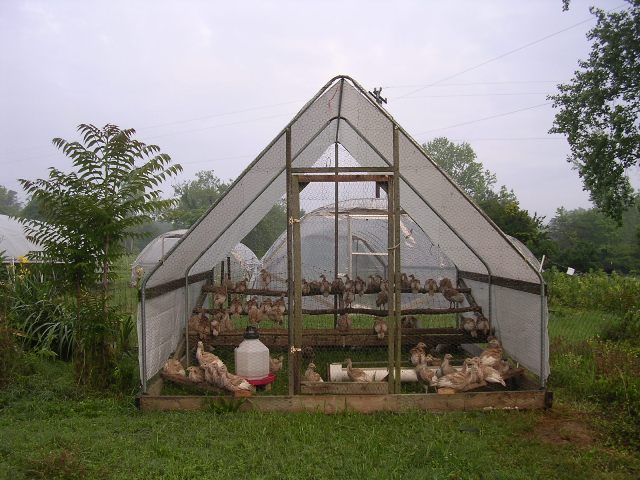
Happy three day old Broad Breasted Bronzes

7/2/08 Vol. 5 #16

A million dollar rain?   I’m not sure but it certainly was great to finally get something substantial, we had gone for over a month with only one tenth of an inch and were beginning to make alternative plans for the fall crops.  The 90 day forecast is for normal temperatures and rain, lets hope they are right.  These last few days have been sublime with the cool nights and clear days, almost like fall.  With that inch and a half of rain we can now start the process of getting cover crops in the ground.  When it gets as dry as it was it is impossible to “cut ground” as the old timers say.  Yesterday as I headed into town to deliver I noticed several farmers out disking their fields, turning under the residues of wheat or something else and drilling in soybeans or sudangrass.  So the same will occur here, except it will be the overwintered flowers and other spring crops just now finished.  Hopefully we will continue to get some good rains to bring up thick soil improving crops of cowpeas and sudangrass or soybeans and millet.  These crops will grow to eight feet high in eight weeks giving us thousands of pounds of organic matter to return to the soil along with over a hundred pounds of free nitrogen fixed by the bean crops to feed the next cash crops.  They will provide habitat for good bugs that will help us fight the bad bugs.  They will shade out summer weeds and give shade to the turkeys when we move them into those fields.  If the rains come.

A fairly normal week here on the farm, the staff is getting into the easy pattern of tomato picking Mondays and Thursdays, weeding a little, seeding new crops for the fall and winter, and continuing to trellis the summer crops.  The last planting of Sungold cherry tomatoes went in the ground yesterday, timed to be ready in late August and to carry us to the end of the season.  It has been interesting to watch the salmonella tainted tomato story unfold over the last few weeks and of course we are humored by that fact that they can’t seem to trace it back to where is came from or even if it was tomatoes at all.  To all of us local produce farmers it is just another supporting argument for local small scale agriculture.  If you know your farmer and where your produce comes from it you can be more assured it won’t come with bad things attached.  Now I am not saying that it can’t happen but the reality is that most small growers don’t have the volume to need produce washing lines which is where most of these health problems start.  When you dump thousands of pounds of tomatoes into a big tank and slosh them around it makes it much easier for the few tomatoes that might have had contact with something unhealthy to pass it onto the rest.  Most of us don’t wash our tomatoes at all.  Because we don’t spray anything bad on our tomato plants we are able to just wipe them with towels to clean them up and pack them straight into the boxes for market.  Nothing like a good local tomato.

Picture of the Week
A good looking field of peppers