5/10/06 Vol. 3 #9

So busy yesterday that I couldn’t get this done until this morning (after chasing yet more roaming turkeys), see you at market!

The big pepper plant is today and I hope we are ready for it.  It is a challenge this year as we are planting into maybe the most difficult field we have, as far as soil is concerned.  This is the field that we call “the Top” as it is the highest point on the farm and the farthest away from everything.  When we started going to Farmers’ Market in 1986 this was the only piece of ground that wasn’t planted to blackberries and raspberries so we turned it over and began the experiment with vegetables and cut flowers.  My brother Jon was here at that time and vegetables were his area of expertise.  He and Betsy borrowed a neighbors plow and turned over this far corner of the farm and found a mixed bag.  The field is long and irregular in shape (you know those of use who are members of the straight line police hate that) and the soil changes from one end to the other.  Marvelous sandy loam on the bottom end but the top end is the most difficult red clay we own, very slow to dry out and almost impossible to work into a good seed bed.  Joann is still scarred from having to plant tomatoes into that red clay and having to stack what amounted to pieces of brick around the root balls.  This spring, however, the beds worked up as nicely as they ever have so we don’t have to fight that problem, at least on half of the 1600 feet of pepper beds.  The other half we always plant without tilling the soil, right into thick cover crop of grain rye and hairy vetch that we have killed and flattened down by rolling it.  It is like growing our fertilizer and mulch right in place.  After we roll it down we cut slits into the mulch and the soil, with the the tractor, to set the plants into.  If it is too dry the cutting wheels can’t cut through.  If it is too wet, especially in red clay, it can make a mess that is hard to plant into.  With all of the rain in the last two weeks I am a bit worried that it could be a bit too wet.  We’ll find out later today if that is the case!  None-the-less Rachel and Will (the newest staff member) will be charged with carefully interpreting my diagram of which pepper varieties go where.  Just like the tomatoes there is a strategy as to which ones like or will do better in the different soil types.  The hot peppers definitely need to be in the warmer sandy loam soil while the more disease resistant sweet bells can stand up better to the red clay.  No matter what it will be one at time until the over 2000 plants are tucked into the ground whether it be sandy or clayey.

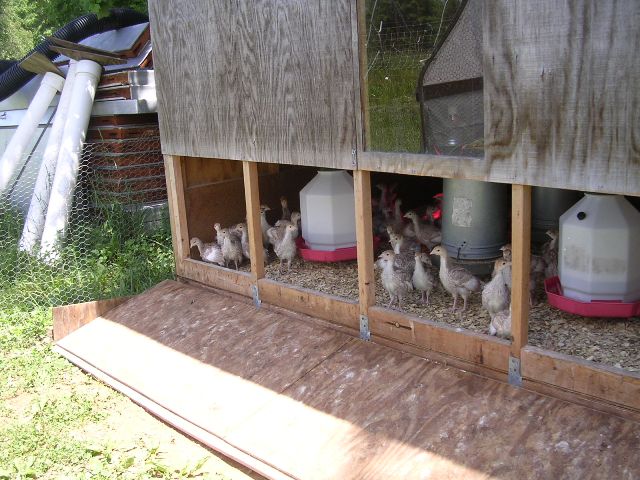
Late graduation day for the turkeys this week.  Usually we start letting them out to get used to the idea at three weeks of age.  This year because we got them earlier and it has been cold we just let them out yesterday for the first time.  Now five weeks old and full of extra energy from being cooped up they have been acting up already!  We pull one of the shelters up in front of the brooder building, about five feet away and then put up some chicken wire between the two.  There is a ramp/door on the front of the brooder so they can come in and out.  Usually they are very tentative and take a day or so to get used to going out, into the new shelter, and eating grass.  These guys came out and started flying over the chicken wire almost immediately.  I had to chase some down into the woods to catch them.  We clipped the wing feathers on these bad actors after they flew out a second time.  I hope we can get them calmed down or it will be a long summer of rounding up escapees.
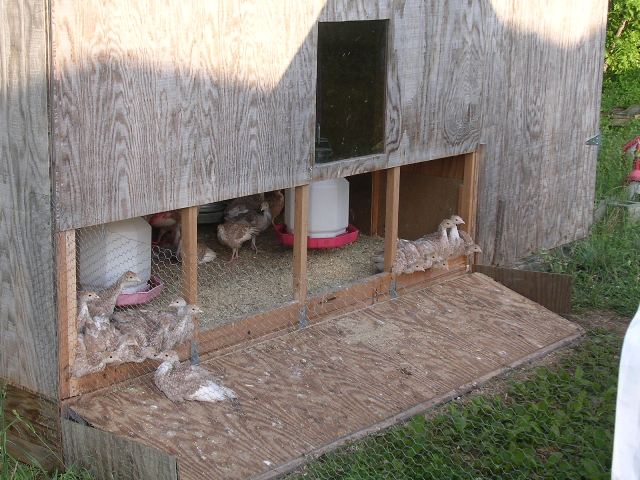
Picture of the Week
Tentative about the outdoors just before going wild in flight

6/14/06 Vol. 3 #14

Well I’ve been up since 4:00 a.m. trying to reserve plane tickets to Italy.  As these things go on the Internet sometimes, I have yet to successfully complete the transaction (it is now 6:30).  We have finally heard, quasi-officially, from the Slow Food people that we have been accepted to attend the second Terra Madre conference in Turin Italy!  Some of you may remember that we were very fortunate to have been nominated to attend the first ever world gathering of food producers two years ago.  That experience of convening with 5000 other farmers, ranchers, herders, gatherers, etc. and the on farm housing has colored many of the new things we do here on the farm.  The exposure to cultures steeped in artisanal foods and old breeds has made us explore new (to us) varieties and food production ideas.  The on going attempt to form a successful poultry and meat processing cooperative has partly sprung out of the knowledge that with out it, local farmers will not be able to move towards further sustainability of their operations.  So we are off again to Turin the end of October.  This time not only with 5000 food producers but also with 1000 chefs and over 150 academics from around the world.  Slow Food is correctly expanding their aim to include the professional people who cook with local foods and can most quickly affect peoples palates and minds.  Our local chapter (convivium in Slow Food parlance) put forth an ambitious slate of people to attend and it appears as if almost all were accepted to go.  This includes our good friends, chefs and customers Ben and Karen Barker of Magnolia Grill and Andrea Ruesing of Lantern Restaurant.  Our delegation will also consist of at least eight animal producers and eight representatives of the seven local producer-only farmers’ markets.  We see this as a great opportunity to help move our local food system to a new level of understanding and cooperation.

The Slow Food organization and it’s mission resounds closely with what Betsy and I have been trying to do for the past twenty five years.  In the words of it’s founder, Carlo Petrini, producing food that is “good, clean and fair”.  We have always tried to grow products with great flavor and eye appeal (good), in a way that is sustainable (clean) and treats us, our employees and our customers well (fair).  With over 80,000 members world wide there appears to be lots of folks who think similarly.

Otherwise it is a rain day as the remnants of Alberto pour down.  We now appear to be in the monsoon season.  In preparation for todays storms we did cover the last of the Big Tops under which the late tomatoes are to be planted.  The trellis is up and probably tomorrow the plants will be slipped into the ground.  We also got the first layer of trellis on the hot peppers.  Unfortunately the huge storms on Sunday had laid over many of the tall Poblano and Anaheim plants.  So we stood them back up and secured them with the trellis strings before any more damage occurs today.  In general the peppers look really good but need a little more heat to really get going.  The eggplant and tomatillos are now in as well.  The turkeys are wearing trench coats and rubber boots, it was hard to find some small enough for Shrimpy.

Picture of the Week
On a sunny day the birds are eyeing Betsy’s lush Zinnias

7/12/06 Vol. 3 #18

Now the weather is returning to more normal summers conditions this week but in general we are all looking at each other and saying “I don’t ever remember a summer like this”.  This, this… not so hot.  No complaining here mind you but it does sort of throw one off balance.  Just as you have your brain programmed to expect one thing and act in a certain way it doesn’t happen.  The only comparison is back in 1991, which we always refer to as the Mt. Pinatubo summer.  That summer that volcano in the Philippines erupted and sent huge amounts of ash into the stratosphere which circulated the globe for months.  The result was a very cool summer in North Carolina,  we barely got into the 90’s.  Back then we were in the midst of the long and expensive “Raspberry Experiment”.  The most noticeable result from that cool summer was that the raspberry canes grew almost twice a tall as normal and the following year we had the best harvest we had ever had.  It turns out that it is too hot here for raspberries to grow vigorously, but that summer it was more like the conditions further north where they produce them in abundance.  Soon there after the raspberries came out of the ground never to be planted here again (under threat of certain penalties from Betsy!).  So while we are not experiencing as dramatic conditions as that year it is still affecting crops here on there farm.  Most noticeably the tomatoes are still not producing at the level we are accustomed to.  Every Monday and Thursday we go out and pick and while we are getting some of all the varieties we are not bringing back the number of boxes that we should be.  Normally this would be the peak week of tomato harvest but it will be at least next week if not later.  Yesterday we were up working in the peppers and the rows that are on black landscape fabric are moving along well but the rows planted no-till are way behind.  The soil is cooler under all that mulch which in hot weather a good thing but this season it is holding those plants back.  Just when your brain is programmed one way…

We did manage to get the cover crops all seeded before the big rains last week and they are up already and looking great, little soybean plants raising there fat heads out of the soil and the millet with one blade pointed straight up towards the sky.  The turkeys have all been rotated around the farm.  The little guys as we call the Broad Breasted Bronzes right now (they will eventually weigh twice a much as the Bourbon Reds) graduated out to the blueberries from the brooder and are extremely happy lazing the days away in the shade of the blueberry bushes and taking group walks around their new grassy enclosure.  The Bourbon Reds have moved into Betsy’s first and now abandoned Zinnia patch (we plant Zinnias five times and she is now cutting off the second batch).  This is the same field that had the leeks, radicchio and the last lettuce among other crops so they are now eating the crab grass and other weeds while hiding out in the four foot tall Zinnia rows like outlaws only to come creeping out when someone walks by the fence.  The last Zinnias get planted this week and the Brussels Sprouts for Thanksgiving went into the ground this week too.  Despite the different weather we still march on with the calendar assuming that normalcy will return.

Picture of the Week
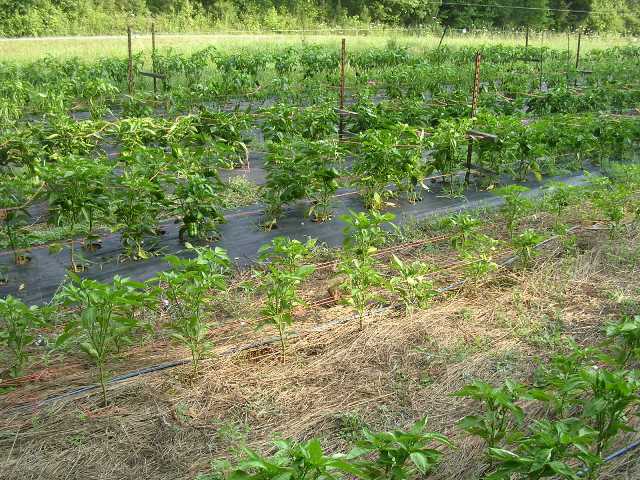
The effects of cool weather.  The same varieties next to each other but the plants on the warmer black fabric are much larger and have large peppers on them.

8/14/06 Vol. 3 #22

Back from the summer “break” and already we are running around like crazy so this will be a quick newsletter.  The time off was too short and we worked far too much, we did have some nice dinners out and slower afternoons but we are going to have to rethink how to actually make it even slower.  Now we are back at it trying to get caught up and into the swing.  The staff is back too and are ready to go, after a good long week off.  Today was tomato picking and turkey moving.  The rest of the week there are more fall crops to plant, peppers to pick and plenty of regular maintenance chores to take care of.  The dry spell is really getting noticeable as the cover crops are not growing as they should and some near the tree lines are really stunted.  The creek stopped running last week and we will have to start pulling water out of the upper pond soon.  Perfect weather for peppers as long as we keep them irrigated.

What’s up with the early newsletter?  Betsy and I have to leave for the airport at 4:30 in the morning to fly to Wisconsin.  Not exactly the week we would have planned to be gone again but we are receiving the Patrick Madden Award for Sustainable Agriculture and thought we might ought to be there to accept it.  We are very surprised and honored to have been even nominated for such an award and nearly speechless (well almost, you know Alex).  The award is presented by the Sustainable Agriculture Research and Education program, the USDA’s effort at helping to make agriculture more sustainable.  “This award recognizes producers who have explored ways to make farming more profitable, environmentally sound and good for communities, and have served as effective educators”.  We are always amazed when anyone recognizes us for what we consider everyday farm work and the outreach we do to anyone who has questions.  On top of it there will be an embarrassing amount of publicity about it including an interview on NPR’s All Things Considered with Melissa Block on Wednesday afternoon.  We won’t be back until Thursday late so Rachel and Will will be taking care of Wednesday market and the farm along with Joann.

Picture of the Week

It is colored bell and pepper roaster time!

4/11/07 Vol. 4 #4

Wow, that was cold!  Five mornings in the twenties with the nadir Sunday morning at 20 degrees!  Everyone wants to know what the damage has been to the crops but it is really too early to really tell about most of them.  The tomatoes survived with some severe freeze damage on the outside rows but they all should grow out of it.  The cucumbers look unscathed, amazing.  The dutch iris actually look great, Betsy has begun to cut a few. and we haven’t had any open completely yet but so far they appear to have no injury.  The big question is the blueberries.  That will take a week or more for the damage to be really apparent.  This freeze is very similar to the April freeze in 2001, when it was 24 degrees on the 18th with high winds.   That season we lost all the blueberries.  Most of the rest of the crops look fine, the sugar snap peas are burned a bit along with other odds and ends of crops.  Time will tell.

Monday I gave my last big presentation of the speaking season in Spartanburg, SC.  While I have traveled around the country quite a bit giving talks on all kinds of farming subjects it is these full day workshops that I seem to becoming known for.  This one, for 60 farmers and other ag related folks, is at least the fifth or sixth where I hold forth for an entire day, attempting to cover the entire subject of organic/sustainable vegetable production.  Can’t be done really.  The best part, is that after an entire day of examples and pictures I think they go away with the most important lesson: this kind of farming is an interrelated system where each action the farmer takes affects other things up and down the line.  Sure they go away with a big notebook full of information, and lots of details on soil management, how to control weeds and more but it is the big picture that I hope has become clearer to them.  It is hard to get a grasp on this complex system when you only hear someone speak for and hour or so.  I am currently working with the Southern Sustainable Agricultural Working Group (SSAWG) on a CD-Rom on Organic Vegetable Production and Marketing that is modeled after my full day workshops.  Now all of this is really just the Readers Digest version of the Sustainable Vegetable Production course that I designed and taught for five or six years at the Sustainable Farming Program at Central Carolina Community College in Pittsboro.  There I carried on for three hours a night for sixteen weeks!  Full immersion for sure.  Now the real benefit for Betsy and me to all of this is that the more times I have to explain to people how we farm, the closer I scrutinize why we do things in certain ways and, hopefully, we refine the system even more.

Picture of the Week
The perfect rainy day activity, moving up the 2500 plus pepper plants

5/10/07 Vol. 4 #8

Blackberry winter is what my father always called these times in late spring when we get abnormally cool periods.  Not really abnormal as it seems to happen every year, and it is when the blackberries are blooming along the roadsides.  We were in the high 30’s on Monday morning and all of the crops, except for the lettuce maybe, are looking skyward wondering when the heat will come and make them bust out in profusion.  Another Mother’s Day and graduation upon us and Betsy is wondering just when all those flowers will start to bloom too.  There is a bloom here and there just teasing her and the plants are looking really good and full of buds.   This is the story the beginning of each May when the big question from Weaver Street, graduates, parents of graduates, brides and others is “When will you have more flowers?”, we just shrug and say probably the week after Mothers Day.  It does seem to be exaggerated this year due to the tremendous cold snap at Easter, it really made a lot of crops just stop and it has taken some time for them to get rolling again.

The last big hurdle is in front of us this week.  Pepper planting.  Now that the tomatoes are in and looking really great, the last of the large plantings is upon us.  From here on we only plant a few beds a week and never are they as important to the whole farm as the big pepper array is.  Twenty two varieties this year including a few new ones.  The best part is we are in one of the best fields we have.  Great soil and sun, the last time we had peppers here (2002) it was a superb crop.  The plants look as good as they ever have too.  Good germination and they have grown well and look very uniform.  Sometimes, especially with the hot peppers, germination can be poor and then they can take forever to get going.  The last few years we have gotten into the pattern of planting the peppers in two stages.  The first half go into raised beds covered with black landscape fabric which warms up the soil a bit faster.  We put the hot peppers and some of the finicky sweet ones  into these beds, I think they need the additional boost the warmer soil gives them.  In the second planting stage, all of the red bells, and half of the yellow and orange bells, we plant “no-till” into the remains of a huge cover crop of rye and hairy vetch.  There are many reasons why we do it this way but better long term soil management and less disease on the peppers are the main ones.  We have been experimenting/working with this system since 1995 and each year we refine it.  This year is exciting as we have new tractor implements that we hope will make it really easy to plant into the thick residue from the cover crops.  Again this spring we may have to wait another week to get them in the ground because it is impossible to kill the cover crop organically until the hairy vetch is really blooming.  Like everything else, it is delayed from all of the cool weather.  Once the rye has sent out its seed heads and the hairy vetch is in full bloom we can just roll down this mass of plant material which crimps the stems and they give up the ghost and die.  If they are not blooming then, even with the rolling, they have a will to live and make a seed that allows them to re grow which then makes them a pesky weed in the peppers.  Patience is the key, they began blooming nicely this week so next week will be just fine.

Picture of the Week
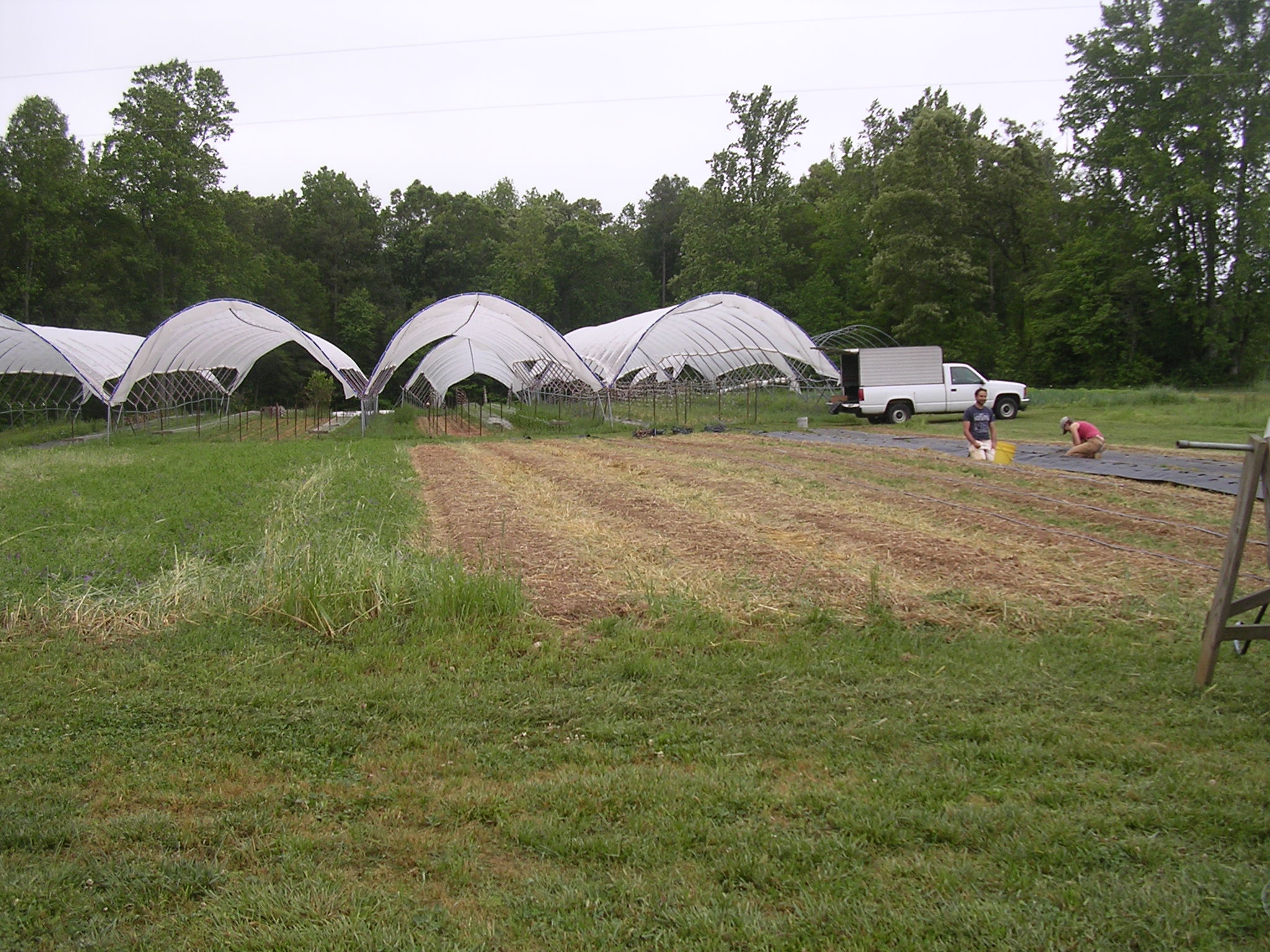
Preparing the pepper beds for planting, no-till on left, tilled with fabric going on, on the right.

6/13/07 Vol. 4 #13

This is the time of year that we are always tieing something up.  Many of the summer crops need “assistance” standing up, so over the years we have developed multiple ways to trellis them.  Trellising takes extra time and labor so we only do it for certain crops that really need it.  Tomatoes, peppers, cucumbers and pole beans in the vegetables along with lisianthus, sunflowers, celosia, delphinium and a few others in the flowers.  Besides making it easier to harvest them because they are up off the ground it also gives us better quality.  Straight flower stems with clean blooms are Betsy’s goal, those S shaped sunflower stems may look cool but most folks won’t buy them.  In the vegetables it also give us nice clean fruit but also allows for good airflow around the plants so they dry out faster in the mornings after a rain or heavy dew.  Most of the diseases that affect these crops are a fungus or a bacteria, warm wet conditions are perfect for them to go wild.  If we can get those plants up into the breeze then we can slow down the inevitable spread of these diseases.  So we have come up with a set of trellis designs that can be put up fast, do the job and then come down just as fast.  I am the king of metal T-posts, electric fence wire, a few pieces of 2X4, baling twine and some kind of mesh either plastic or metal.  Sounds just like a farmer, a job is not worth doing if it doesn’t involve some electric fence wire, baling twine and maybe some duct tape.

Early in the year the staff is gradually trained in how to build the various “styles”.  Heavy duty tomato trellis with metal fencing hanging off of six foot T-posts, strong enough to bear the weight of nearly 1000 pounds of fruit and vine per 100 foot long row.  Then the wispy pea fences of plastic mesh hanging off the same post set up, just enough structure for them to grab onto with their tendrils and light hollow stems.  Soon they move to the graduate courses in trellising, horizontal structures that float over the rows on cross arms attached to… metal T-posts.  First the plastic flower netting placed just above the growing and budding plants so the weight of just the heavy blooms are supported as they grow up through it.  Finally the two and three level condos of trellises, the pepper array.  A lower level of baling twine run on either side of the little ten inch tall plants to keep them upright in the summer storms.  Then another layer eighteen inches above that of wires and baling twine to catch the branches as they grow up through it to support the weight of the growing fruit, really tall peppers like poblanos get a third, pent house layer at almost four feet above ground.  Cov and Elizabeth are now certified trellis technicians, with almost 6000 feet of construction behind them.  This week the last 500 feet of tomato trellis and the first layer on the pepper trellis.  A friend once said my tombstone would read “He was an OK farmer but he sure could tie things up”.

Pictures of the Week
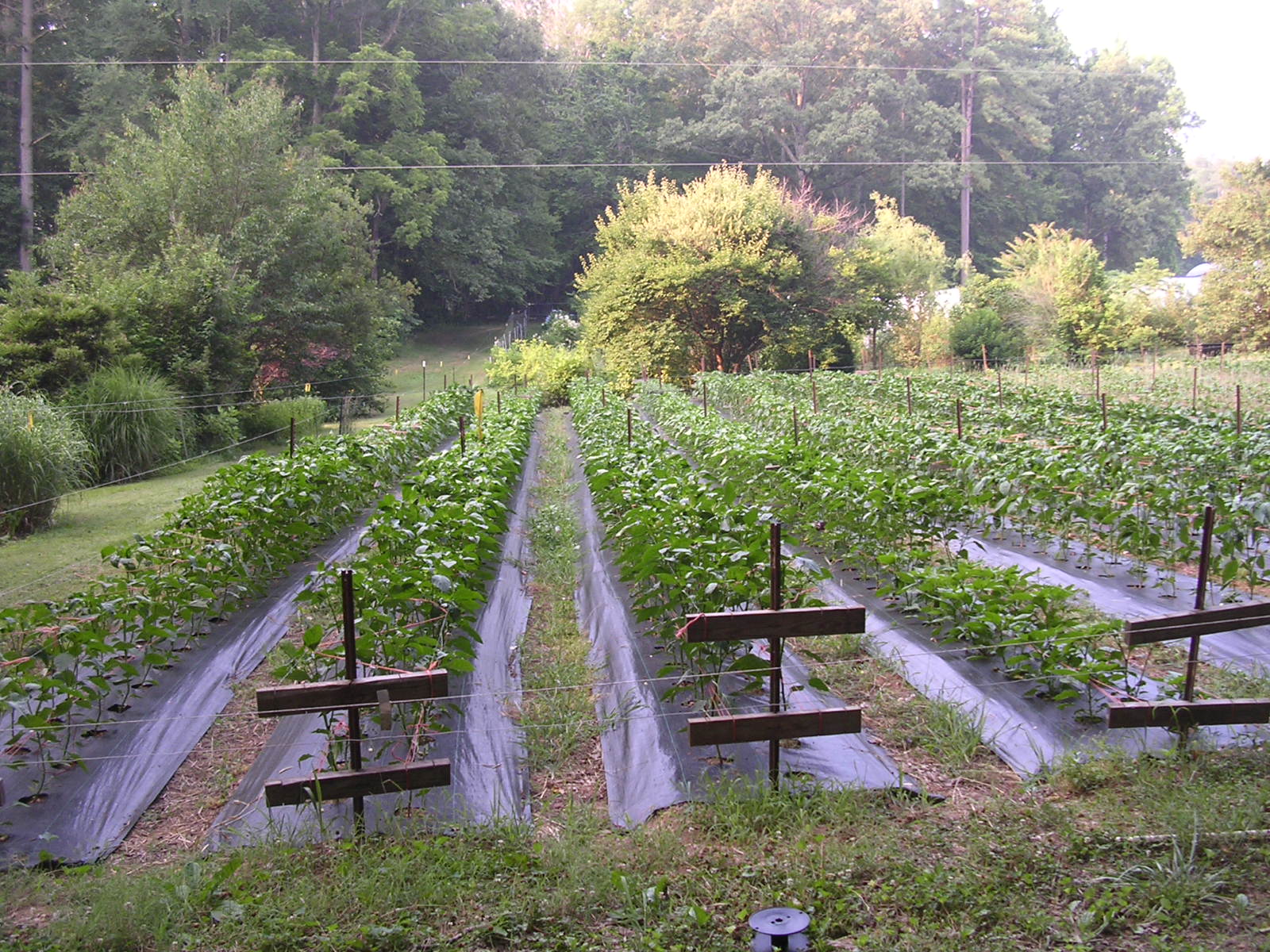
Tomatoes reaching for the sky and nice straight peppers

6/27/07 Vol. 4 #15

This is one of those growing seasons that feels like death by a thousand cuts.  Now every year we have crops that don’t do well or fail completely and others that are magnificent and make up for the short falls, that is what being diversified is all about.  You hear farmers say something like “this year I lost money but we had a couple of good years in a row there, we have another bad one and we might lose the farm”.  For twenty three straight years we had always made more money than the year before, in the early years that was easy to do as we were so pitiful at the beginning the only way we could go was up.  The later years we were still figuring things out, building the business, settling on markets and crops to grow with lots of room for improvement.  Now that trick gets harder as we have pretty much settled in to a  routine, so when one crop fails, there is not a new one in the wings to surprise us.  For the last few years we have done well but not better than the previous best year, the thousand cuts are more of a psychological issue than a serious financial one.  They just begin to weigh on you, especially as it gets hotter and as I tell the staff “I begin to lose my sense of humor”.

The list of nicks is already long this year, the freeze took the blueberries and affected other crops in strange ways.  The unusually cold spring affected germination of many of the early direct seeded vegetables and flowers, we had to replant the first Zinnia planting when it didn’t come up, an eighth of an acre!  The drought in May made it hard to get crops established and others slow to grow.  No turkeys or asparagus this year either.  Then lately the varmit eating tomatoes and melon issue.  The most recent discoveries are that half the red onions are not what we had ordered (they will still eat well, just not what we wanted) and the 400 poblano plants that were looking so good appear to not be poblanos, but some kind of bell pepper instead!!!!  This too will change and the other summer crops look great.  The lisianthus may be even more fantastic than last years incredible crop.  We picked the first good batch of tomatoes out of the big planting Monday and they look good too.  The rest of the peppers are right on schedule and even the onions are bigger than last year (even if some of them are the wrong variety).  This adversity is what drives some people out of farming, they can’t take the unknowns and set backs, no matter how great the rest of the rewards are.  For us this is the challenge that keeps us getting up in the morning, trying to figure out how to solve a problem or learn yet more about how nature works.  Some days I just wish the box of band aids wasn’t out on the counter.

Picture of the Week
It did rain enough to get the summer cover crop up!  Cowpeas with the daisies.

5/14/08 Vol. 5 #9

I know it’s a bit of a late notice but if you didn’t already know we are hosting a Slow Food Triangle chapter potluck this Sunday afternoon here at the farm.  I have talked in the past about our involvement with Slow Food most notably our attendance at the world conference of farmers in Italy, Terra Madre.  They are also the group most visibly responsible for the resurrection/popularity of the heritage turkeys, like the Bourbon Reds that we raise.  Their emphasis is on food that is “good, clean and fair”.   Everyone is invited, you don’t have to be a member, just bring a dish that serves eight (preferably made with local ingredients), the beverage of your choice and something to sit on.  It looks to be a beautiful late spring day and the farm is at the peak of spring vegetable production.  For more information and to RSVP here is the link We hope to see you here.

The last of the big spring jobs begins today, pepper planting.  The heavy rains over the weekend has put us behind a few days but I managed to get the beds tilled last night, nothing like a raised bed on a slope to help things dry out fast!  I have already pushed the planting date back a week to better accommodate the flowering of the cover crop, partly to let them make more nitrogen to feed the peppers and it makes it easier to kill them so they don’t become a weed in the peppers later.  I also want to get the little transplants into the ground this week as they are at the perfect size and growing rapidly.  I believe in timing the transplants so that they are growing well and hit the ground running and continue growing fast.  If we hold them too long, say because it is too wet to plant, then they slow down their growth and can become stunted waiting in the small containers.  So I start to get nervous around this time of year if something holds us up, the peppers must go in!

Big day yesterday for the turkeys, their first foray outdoors.  You may remember two years ago when we first let them out and they went wild, flying all over the farm.  We had to chase them through the woods and all around.  I know that was probably caused by having to keep them in longer than I like because it was so wet and I didn’t want them out on wet ground at first.  So we were a bit apprehensive when we opened the door yesterday even though it was at the three week old stage I usually first expose them to the outdoors.  They were very timid, and just stood massed at the opening. blinking in the sun.  It took hours before a few were bold enough to make it down the ramp and another few hours before the scouts went another few feet into the field shelter.  Relieved that we didn’t have to chase turkeys we left them on their own to explore the new green world.

Picture of the Week
This has got to be a trick, why would he let us out?

5/21/08 Vol. 5 #10

Undoubtedly the event of the week was the Slow Food potluck here at the farm on Sunday.  I was a beautiful sunny late spring day with temperatures in the 70’s and a breeze.  Betsy and I had mowed the place up and we had set up tables in what we call “the stand” (formerly our Pick-Your-Own stand) which is under the shade of three huge tulip poplars and a willow oak.  Looking out over the fields and gardens and right up next to the lettuce field and the fava beans.  At 4:00 cars began to roll in and by 5:00 there was quite a large group assembled.  The skies were getting fearsome looking and I ran in to check the radar, lots of red and purple!  I ran back out, climbed on a chair and announced that everyone needed to grab their potluck dish and go down to our house.  Just as everyone made it inside it began to dump rain, with thunder and lightning.  Fortunately we had just put that living room addition onto the house this winter and have lots of kitchen counter and a dining table we can put lots of leaves in.  The kitchen counters and the table were covered by food dishes and the food line snaked around the room like a conga line.  In Slow Food parlance the local chapters are called conviviums as in convivial- “fond of feasting, drinking, and good company; social, jovial”  we were certainly that!  Great food made with local ingredients and I think that everyone was able to move around the house and visit with each other.  As the rain stopped and people made their way back to their cars and home they also took short self guided tours of the farm.  Not exactly as planned but fun still the same.  We didn’t get a count of how many folks came but I can tell you we had over a hundred forks and there were four left unused!  Someone said it should have been the picture of the week but I couldn’t get to my camera.

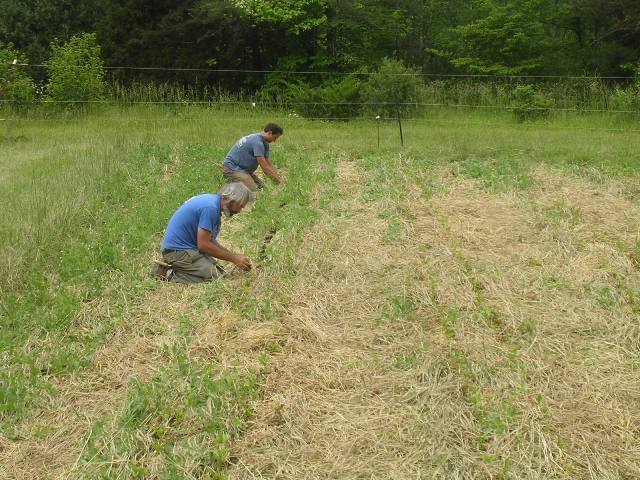
Not without some nervous pacing around, we managed to get all the peppers in the ground this past week, hallelujah!  Wednesday the guys got all the black landscape fabric laid over the nine raised beds that I reserve for all the hot peppers which I think need the extra warm soil to do well and the fussier sweet peppers than need better drained soil.  As I headed off to market they proceeded to plant all of those nine beds with 26 different varieties.  That task alone of making sure that each variety is placed in the right location so we can know what it is and make it more efficient come picking time.  I leave them a detailed map of what goes where.  That job done we are only half finished planting.  The rest of the plants, all of the red bells and most of the yellow and oranges are planted directly into killed cover crops.  A slower process and we were held up by wet soil from what is beginning to feel like rain every other day.  Finally yesterday it seemed like it was dry enough and we needed to get them in before the next rain.  With speed and precision the three of us went about it and all went well, another nine beds all tucked into the mulch.  In total nearly 2400 hundred plants and they all got rained in last night, perfect!

Picture of the Week
Dan and Cov poking the last peppers plants in the ground